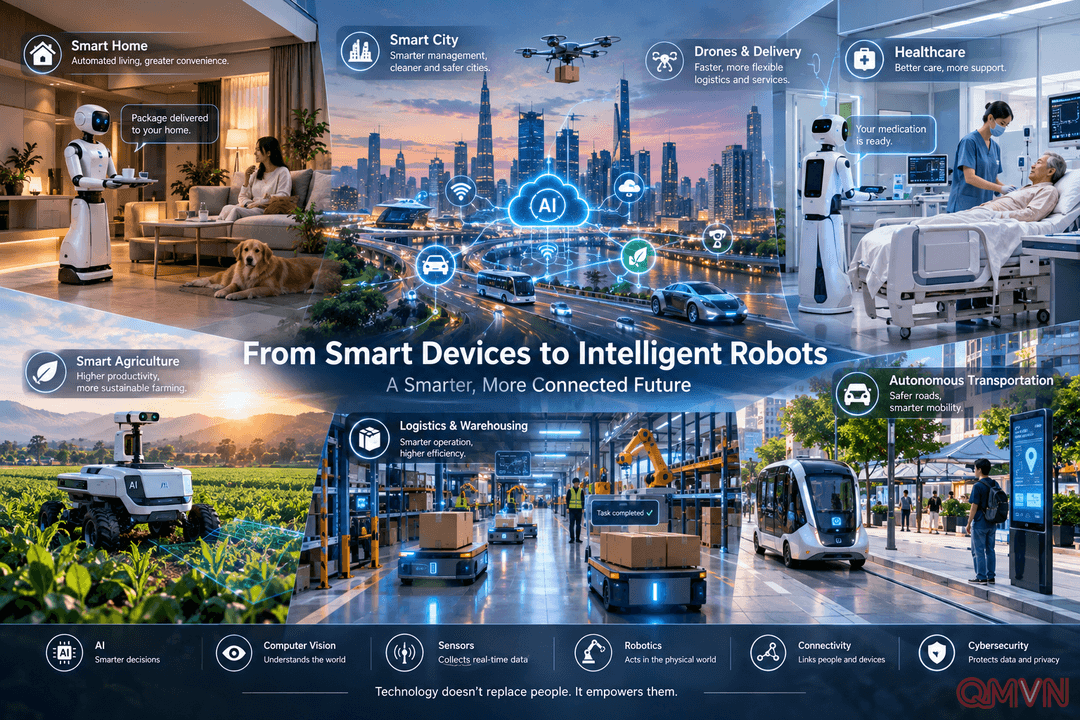
The Cloud Has Changed Computing Cloud computing has transformed the way people use technology. Instead of storing files and running applications entirely on a local computer, users can rely on powerful servers located in remote data centers. This model allows organizations to access significant computing resources without owning all of the underlying infrastructure. Artificial intelligence has benefited enormously from this approach. Large AI models often require substantial computing power and memory. Centralized data centers can provide the hardware needed to train and operate these systems at scale. However, the cloud is not always the perfect solution. When an intelligent device needs an immediate response, sending data to a remote server and waiting for the result can introduce additional delay. This is where edge computing becomes increasingly important. What Is Edge AI? Edge AI refers to running artificial intelligence processing closer to the device or location where data is generated. Instead of sending every camera frame, sensor reading, or audio recording to a remote server, some processing can happen directly on the device. A security camera, for example, could analyze video locally and only send an alert when it detects a particular event. A vehicle could process information from its cameras and sensors locally rather than depending entirely on a distant server. A smartphone could perform certain AI tasks without uploading the user's entire dataset to the cloud. The basic idea is simple: Move some intelligence closer to the source of the data. Speed Becomes a Major Advantage One of the biggest benefits of Edge AI is reduced latency. Consider a robot operating in a warehouse. If the robot detects an obstacle, it may need to react immediately. Waiting for information to travel to a remote server, be processed, and return to the robot introduces unnecessary delay. With local AI processing, the robot can analyze sensor information directly and respond much faster. The same principle applies to autonomous systems, industrial equipment, cameras, drones, and other machines that need to make decisions in real time. For these systems, milliseconds can sometimes matter. Privacy Could Become Another Major Benefit Edge AI can also reduce the amount of sensitive information that needs to leave a device. Imagine a smart camera that needs to determine whether a person is present. Instead of continuously uploading video to a cloud server, the device could perform the initial analysis locally and transmit only limited information when necessary. This does not automatically make a system private or secure. Devices can still be attacked, and poorly designed systems can still expose sensitive information. However, processing data locally can reduce the amount of raw information that needs to be transmitted and stored elsewhere. This creates an important design principle:
The Rise of Edge AI: Why the Future of Computing May Move Closer to Us
For years, much of the world's digital activity has depended on distant data centers and cloud services. But as artificial intelligence becomes part of cameras, vehicles, smartphones, robots, and industrial machines, sending every piece of information to the cloud is not always practical. Edge AI offers another approach: processing data closer to where it is created. This shift could make intelligent systems faster, more private, and more capable of operating without a constant Internet connection.
Admin PHAN ĐĂNG KHOA5 min read · 10 min listen20 tháng 9 2026, 18:31 GMT+7