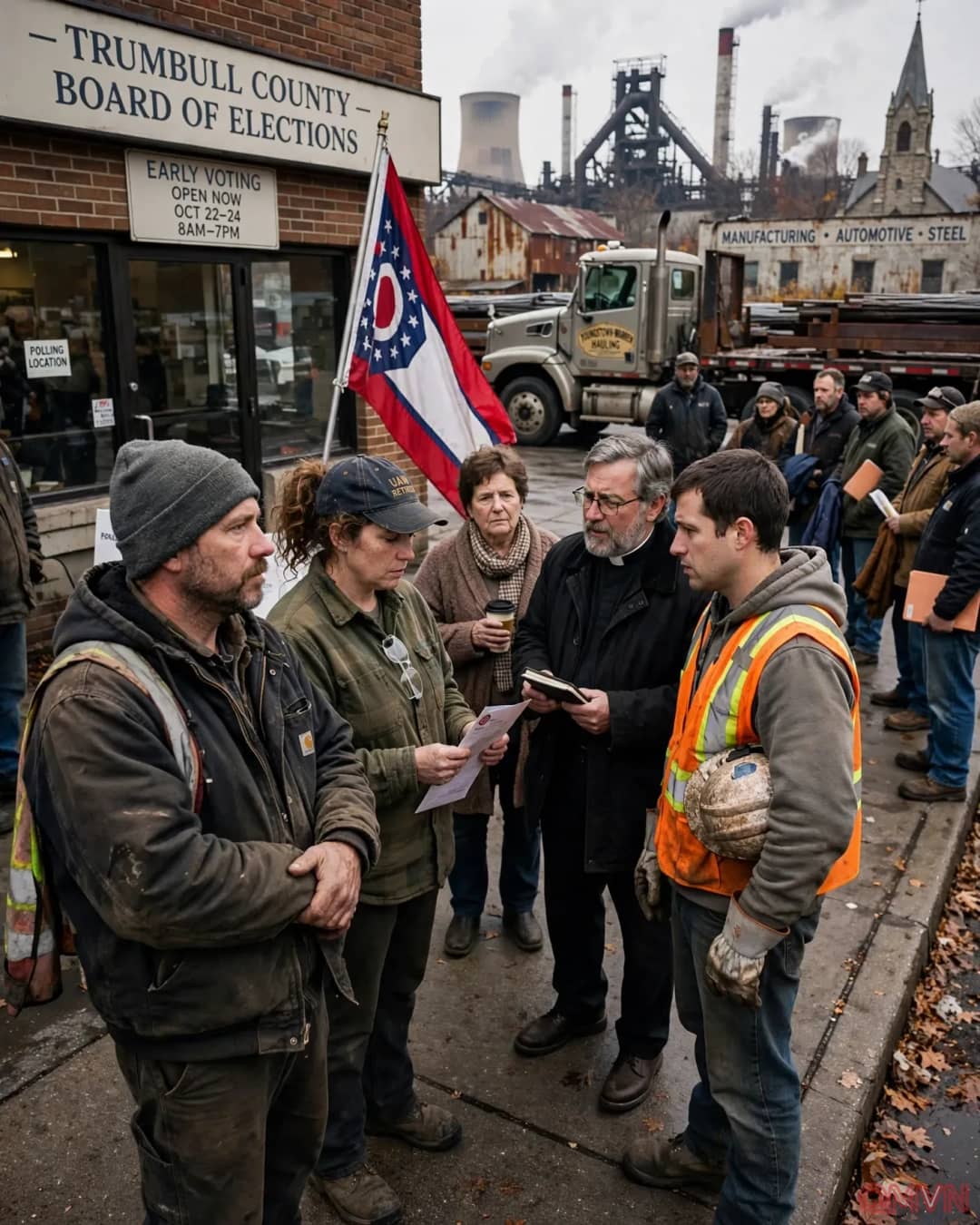
From bellwether to Republican stronghold
For decades Ohio was seen as the compass of American politics: it voted for the eventual winner in 14 straight presidential elections from 1964. That changed in 2016, when Trump won strong support from working-class voters who felt their economic concerns were finally being heard.
This year Trump is not on the ballot but has told supporters to act as if he is. On October 12 he campaigned in Youngstown for Husted and Ramaswamy. Ohio has a Senate seat, the governor’s office and two House races rated “toss-ups”, enough to influence the balance of power in Congress during the last two years of his term.
Votes still up for grabs
Paul Ringold, 48, a steel hauler and pastor of a mostly Black congregation in the city of Warren, embodies that uncertainty. He voted for Trump in 2016, for Joe Biden in 2020 and for Trump again in 2024, but is still undecided this year. Rising fuel and food prices have left him disillusioned.
God knows we didn’t vote for this.
Like several voters interviewed by Reuters, Ringold also wishes the president would tone down his combative rhetoric. Bill Callahan, 75, a former General Electric employee, said some relatives who once backed Trump “are traveling back” towards Democrats because they do not like politicians “taking money out of their pockets”.
Signals from early voting
In early voting that began last week, Democrats appeared far more motivated. Notable figures include:
In Trumbull County, 1,224 Democrats voted in the first three days, compared with 559 Republicans and 453 voters with no known affiliation.
A New York Times/Siena poll conducted from September 22 to October 1 put Brown at 49 per cent against Husted’s 46 per cent.
In the governor’s race, Acton stood at 49 per cent, ahead of Ramaswamy on 45 per cent, although both margins are within the margin of error.
Paul Sracic, a senior fellow at the right-of-centre Hudson Institute, said that if working-class voters are moving away from Trump at all, Brown, with his populist record, is “a safe landing spot” for them.
Union frustration
Union leaders argue that Trump is skilled at exploiting social issues but has not turned his promises into policies that genuinely improve working people’s lives. At the start of his second term he fired two Democratic members of the National Labor Relations Board (NLRB), leaving the agency paralysed for nearly a year. Ohio AFL-CIO President Tim Burga called it the “dismantling” of the NLRB, which has made union organising and contract negotiations harder.
We were on a path for the first time in my lifetime, under the Biden administration, for having a national industrial policy.
Jose Arroyo, a United Steelworkers official, acknowledged that the Iran war has boosted domestic oil exploration and demand for steel equipment, but said it has also pushed up consumer prices. Manufacturing jobs in the Youngstown-Warren area have fallen from 50,000 in 1990 to about 20,000 in 2026.
Those who remain loyal
Not everyone is changing their mind. Joe and Kathryn Scarabino, who run a bait-and-tackle shop near Cortland, responded to higher fuel costs by raising delivery charges rather than product prices, and say gas prices will not decide their vote.
We believe our Christian values are more than gas prices.
Chuck Burns, 67, a retired coal-fired power plant worker from Wellsville, praised Trump for reducing illegal immigration at the southern border and for the rising value of his retirement savings. He also voiced concern about Democrats’ positions on social issues such as transgender rights.