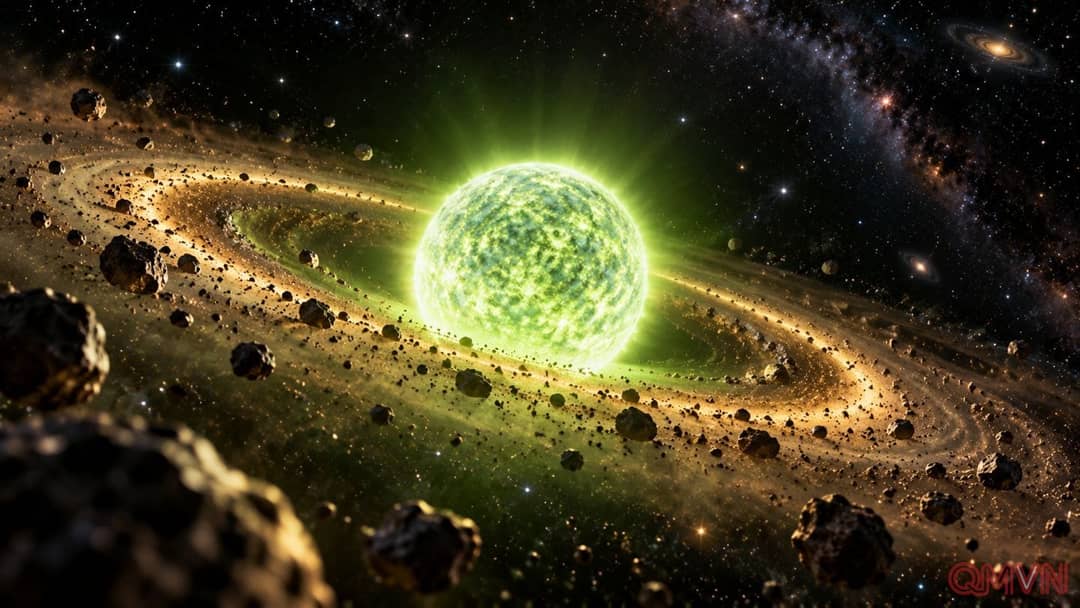
MAIN STORY
A green star discovered through its spectrum
WD J1330+6435 is a white dwarf, the compact core left behind when a moderately massive star sheds its outer layers late in life. Such remnants can pack substantial mass into a body roughly the size of Earth. Their faintness and tiny apparent diameters mean distant observers see points of light, not visible stellar surfaces with readily identifiable colours.
Led by Mark Hollands, the researchers interpreted the star’s spectrum using atmospheric calculations and models of human colour perception. Their paper in RAS Techniques and Instruments puts its effective temperature near 4,240 kelvin, roughly 4,000 degrees Celsius. Seen from an imagined close vantage point, it would have a pale chartreuse-green appearance, unlike the standard shades commonly associated with stars.
How a dense atmosphere reshapes the light
An ordinary star’s overall colour is largely determined by temperature. The situation becomes more complicated inside the exceptionally dense, helium-rich atmospheres of cool white dwarfs.