Match information
Competition: Bundesliga 2026/27, matchday 10. Kickoff: Saturday, 21 November 2026, 14:30 UTC (15:30 CET). Venue: Deutsche Bank Park, Frankfurt am Main, Germany. Referee: Dr Max Burda; assistants Sascha Thielert and Julius Martenstein; fourth official Benjamin Brand; video referee Pascal Müller. German coverage is listed by the hosts as DAZN, alongside EintrachtFM and Sky Sport Bundesliga 5. Official starting elevens are not yet confirmed at the time of this preview.
Context and significance
The points are as important as the position: Frankfurt sit tenth and Hoffenheim ninth, both with 12 after nine games. Victory can lift either side toward the European conversation, while defeat would reinforce their inconsistent starts. Hütter has an exceptional record against Hoffenheim, winning seven of eight managerial meetings and drawing the other. Nevertheless, Ilzer’s pressing-intensive version of Hoffenheim is a different challenge. The first fixture following an international break also tests preparation and rhythm after extensive national-team travel.
Form guide and team narratives
Frankfurt’s campaign opened uncertainly, including a heavy defeat at Leipzig, but recent displays suggest greater resilience. Across their last four league matches they have taken seven points. The 2–2 away draw at Paderborn was particularly revealing: reduced to ten players, Frankfurt still found an added-time equaliser through Jonathan Burkardt. This mental response matters to a home side that has scored in every league home fixture this season. They have 15 league goals, although eleven belong to Burkardt (five) and Younes Ebnoutalib (six), an unusually concentrated output that opponents can target.
Hoffenheim collected nine points from their previous four league fixtures and beat Schalke 2–1 before the break, signs of a side rediscovering momentum. Their 16 goals come from ten different scorers, limiting dependence on one forward. Ilzer favours sustained running, counterpressing and organised possession; his team has averaged 54.9% of the ball and ranks near the top for sprints and intensive runs. Yet European commitments created nine competitive games in 29 days before the break, and 14 players then travelled internationally. Those physical demands could affect late-game pressing accuracy. Both defences have conceded frequently, creating a more compelling attacking story than either league position suggests.
Team news and predicted lineups
Frankfurt must replace Elias Baum, suspended following a second yellow card at Paderborn. Jessic Ngankam is recovering from an adductor problem; Can Uzun has been ill and remains doubtful. Hütter has indicated that Robin Koch is available. Hoffenheim are without Nathan De Cat, Valentin Gendrey, Albian Hajdari, Robin Hranáč and reportedly Patrick Wimmer. The following are projected selections, not official team sheets; final availability and formations can change shortly before kick-off.
Predicted Frankfurt XI (4-4-2): Noah Atubolu; Ansgar Knauff, Robin Koch, Lilian Brassier, Keita Kosugi; Ritsu Dōan, Raphael Onyedika, Noel Aséko, Farès Chaïbi; Younes Ebnoutalib, Jonathan Burkardt. Predicted Hoffenheim XI (4-4-2): Oliver Baumann; Vladimír Coufal, Ozan Kabak, Koki Machida, Mats Rots; Bambasé Conté, Leon Avdullahu, Wouter Burger, Alexander Prass; Tim Lemperle, Fisnik Asllani. Adam Daghim and Andrej Kramarić offer alternative attacking solutions.
Tactical analysis and operational approach
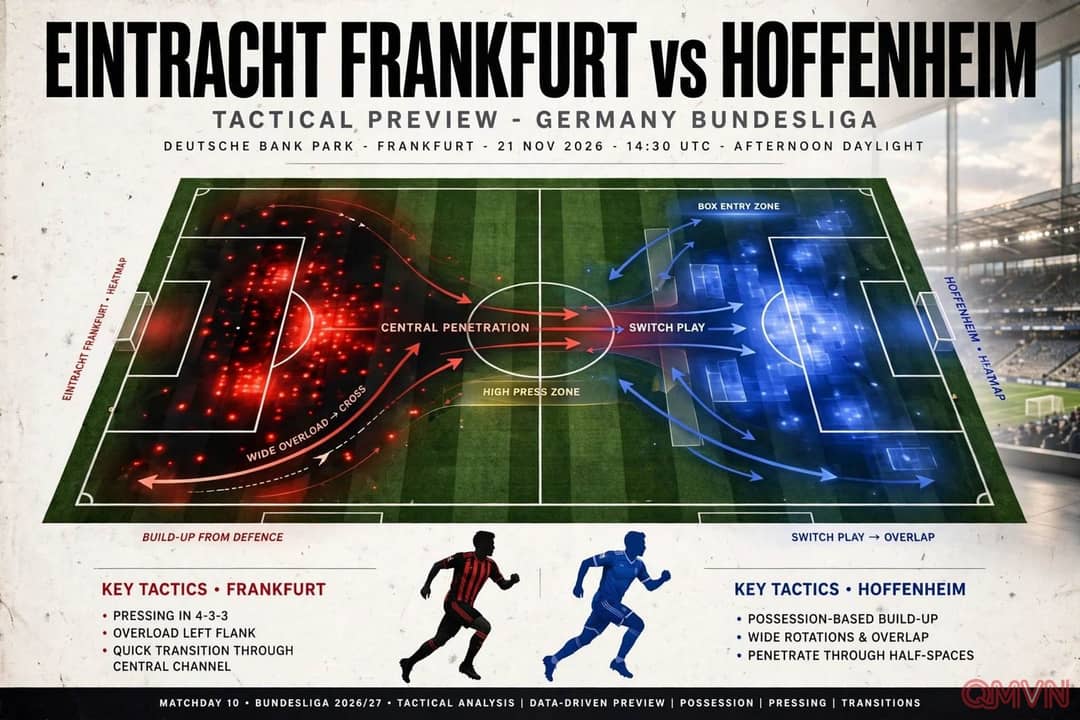
Frankfurt should build through Koch and Brassier, with Onyedika and Aséko providing central outlets when Hoffenheim press. The wide movement of Dōan and Chaïbi can draw defenders out, opening direct routes to Burkardt and Ebnoutalib.
Without Baum, the left-back replacement’s positioning in transition becomes a key concern. Frankfurt’s best counterpress will happen immediately after losing the ball, before Hoffenheim can isolate the centre-backs.
Ilzer’s Hoffenheim prefer a 4-4-2 that compresses central passing lanes and quickly turns recoveries into vertical attacks. Avdullahu protects circulation and offers a reliable passing base, while Burger supports second balls. The full-backs can advance, leaving room behind them if Frankfurt escape pressure. Hoffenheim must manage their block height carefully: excessive aggression makes Frankfurt’s forward partnership dangerous, while a passive block may allow Dōan to dictate possession near the area.
Three key decisive matchups
First, Onyedika and Aséko versus Avdullahu and Burger will decide whether play becomes frantic or controlled. Hoffenheim’s central pair aim to force rushed passes; Frankfurt need clean first contacts to release runners.
Second, Dōan against Rots and the supporting left midfielder tests Hoffenheim’s defensive width. Successful overlaps could deliver early crosses to two in-form Frankfurt finishers, but turnovers expose Frankfurt’s flank.
Third, Burkardt and Ebnoutalib against Kabak and Machida is a battle of timing around the penalty area. Hoffenheim must track double movements and second balls. At the other end, Lemperle and Asllani will look to punish a Frankfurt back line adjusting to Baum’s absence.
Exploitable weaknesses
Frankfurt’s scoring is concentrated in two forwards. If Hoffenheim prevent service into them and force less prolific teammates to finish, the home attack may become predictable. The absence of Baum can also leave awkward defensive distances on Frankfurt’s left, especially during fast switches. Hoffenheim’s ball-winning intensity and wide runners give them a credible way to exploit those gaps.
Hoffenheim carry their own risks: the high block may leave generous channels behind the full-backs, and they have conceded at least once in every away league game this season. Frankfurt have the direct passing and finishing quality to capitalise. Meanwhile, Hoffenheim’s recent fixture load can blunt the effectiveness of their pressure late on. Set-piece concentration could become decisive if neither side controls open play.
Potential match scenarios
Scenario one: Frankfurt score early after an effective wide combination involving Dōan or Chaïbi. Hoffenheim then raise their line, generating an open contest with counterattacking chances for the hosts.
Scenario two: both midfields cancel each other, and the game remains level until a set piece, penalty-box rebound or a substitution changes the balance. An early yellow card to a holding midfielder could alter the pressing map.
Scenario three: Hoffenheim force turnovers near halfway and use Lemperle, Asllani or a pacey wide substitute to strike before Frankfurt reset. If the visitors lead, their ability to retain possession matters more than their pressing volume. A red card or fatigue after the international break would make any forecast fragile.
Analysis and score prediction
Frankfurt hold a slight advantage because of home support, Hütter’s strong head-to-head record and the clinical Burkardt–Ebnoutalib partnership. However, the teams start level on points, Hoffenheim’s recent form is marginally stronger and their goals are spread across many players. Ilzer’s pressing can frustrate Frankfurt’s buildup, especially with Baum suspended. Neither side should be treated as a clear favourite. Expect periods of Frankfurt pressure interspersed with sharp Hoffenheim transitions; both teams have the tools to score. Predicted score: Eintracht Frankfurt 2–2 Hoffenheim. This is an editorial forecast, not a confirmed outcome or betting recommendation.
Sources: Bundesliga official fixture and lineup preview (21 November 2026); Eintracht Frankfurt official match preview (17 November), press conference (19 November) and tactical opponent report (20 November).
Subscribe to the QMVN newsletter
A daily morning digest - only stories worth reading, no spam.