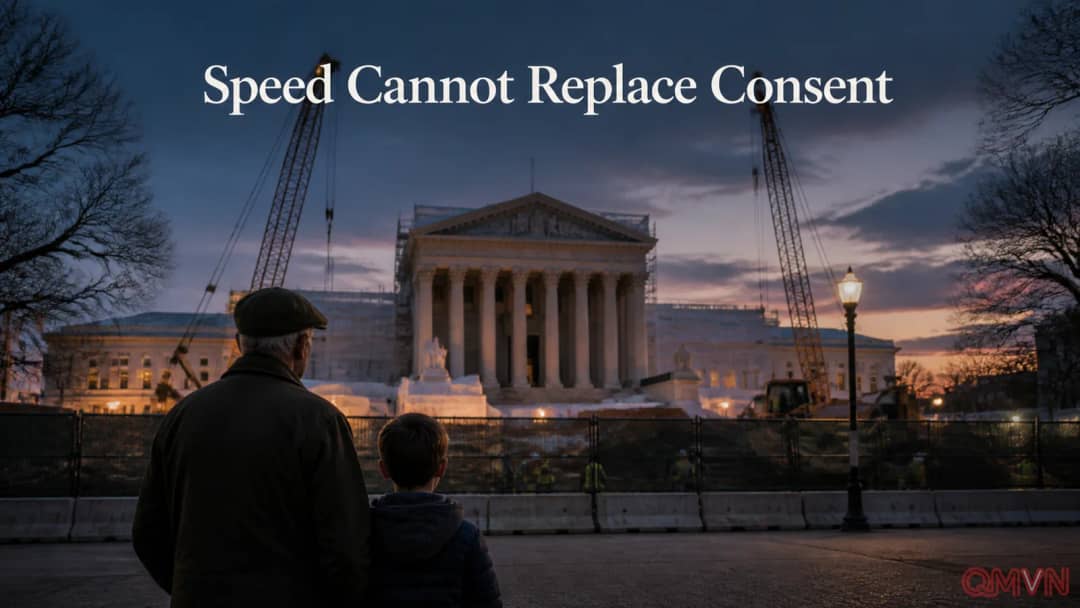
A burst of construction around the White House has revived an old democratic question with new urgency: who gets to shape a nation’s shared landmarks, and when do citizens get a meaningful chance to be heard? The dispute over a proposed $400 million ballroom complex replacing the former East Wing is not simply an argument about architecture or expense. It has become a test of approval procedures, judicial restraint, executive authority and the public feeling that decisions affecting national memory may be moving faster than public participation can follow. The U.S. Supreme Court’s 5-4 order allowing construction to continue while litigation proceeds has sharpened that concern. At the same time, proposals to reshape public space elsewhere in Washington suggest that the line between decisive leadership and democratic consent is best protected by transparency, not by haste. Buildings can be finished quickly; civic trust cannot.
SPEED CANNOT REPLACE CONSENT
Ảnh minh hoạ newsroom 16:9 - Newsroom-style illustration 16:9
A Construction Site With Larger Meaning
The new White House ballroom project has been advanced by the Donald Trump administration as a major expansion of the country’s most recognizable government complex. Public reporting has put the project’s estimated cost at $400 million. It is being built on the site of the old East Wing, which was demolished late last year. Supporters portray the undertaking as a modernization intended to improve the White House’s capacity for national events, and they say private funding will pay for it.