Federal judge and US Supreme Court decisively block Trump administration from transmitting voter citizenship challenges to states
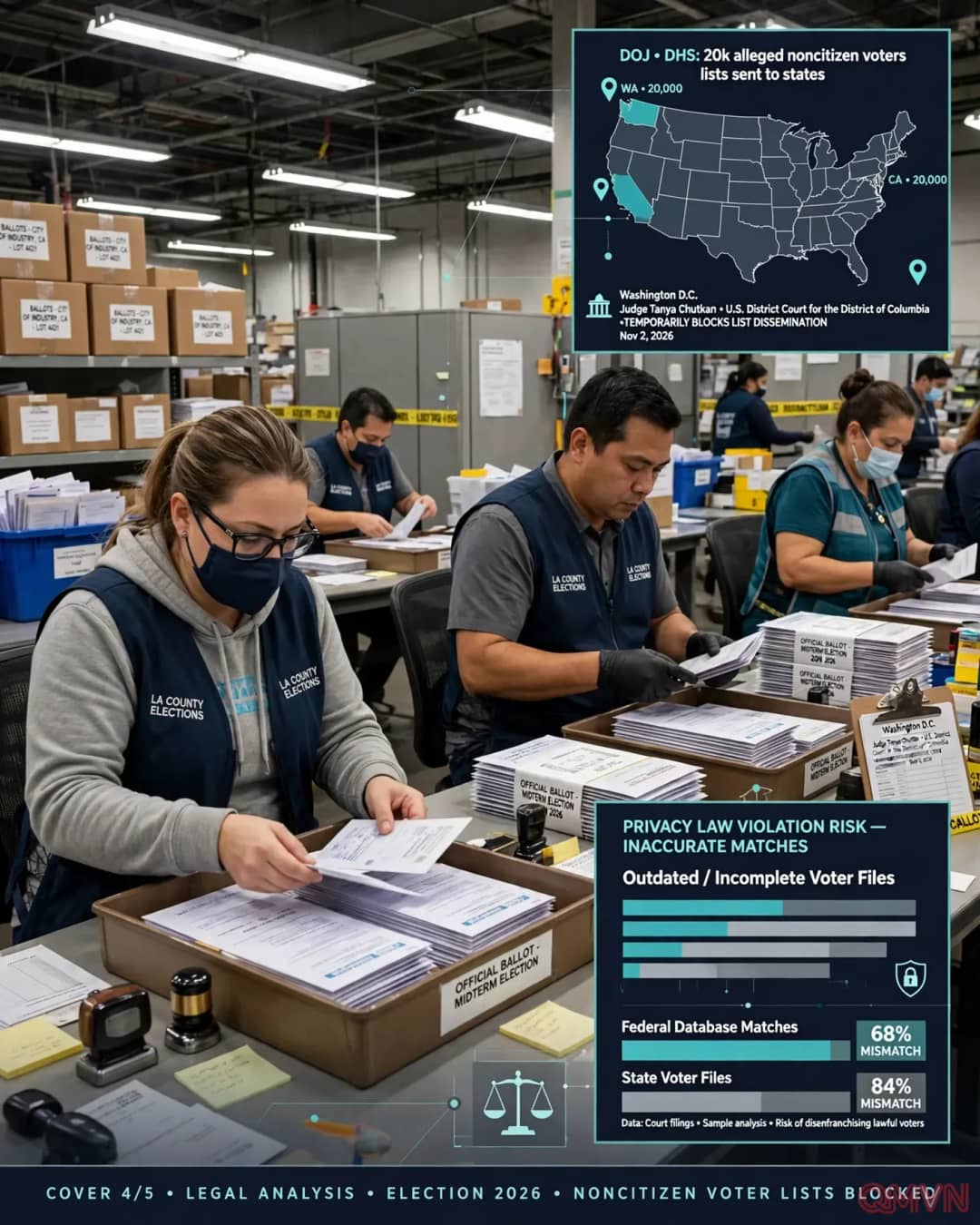
In a rapid series of decisive legal defeats for the executive branch on the eve of the 2026 US midterm elections, federal courts and the Supreme Court of the United States systematically halted the Trump administration’s aggressive pressure campaign aimed at forcing states to segregate ballots of alleged noncitizen voters. US District Judge Tanya Chutkan in Washington, DC, issued a comprehensive late Monday order finding that the Department of Justice and the Department of Homeland Security likely violated federal statutory privacy protections and lacked legal authority when transmitting speculative lists of challenged voters to election officials in California and Washington. Concurrently, the US Supreme Court swiftly denied an emergency petition from the administration seeking to halt the counting of over 20,000 California mail-in ballots, establishing an insurmountable judicial barrier against federal encroachment into decentralized state election sovereignty.
Edite QUANG MINH·2 min read · 3 min listen·3 November 2026, 07:49 EST·
AI-generated illustration
MAIN BODY
Judge Chutkan’s statutory privacy ruling and the Supreme Court’s emergency dismissal
Judge Tanya Chutkan’s late Monday injunction firmly concluded that the federal government exceeded its statutory powers by disseminating sensitive voter data to state jurisdictions accompanied by administrative mandates to segregate ballots. The court emphasized that the executive branch failed to establish legal authority under the Privacy Act of 1974 for such disclosures.
Advertisement300 × 250
*
"The administration likely violated federal privacy law in its disclosure of the voter data and lacked legal authority to disseminate the lists." — US District Judge Tanya Chutkan, District of Columbia
*
Hours earlier, the Trump administration escalated its legal campaign to the Supreme Court, petitioning the high bench to temporarily block California from tallying mail-in ballots cast by more than 20,000 voters alleged by federal agencies to lack citizenship. The Supreme Court decisively rejected the petition, extinguishing the administration’s eleventh-hour legal challenge.
Judge Chutkan halted DOJ and DHS efforts to transmit alleged noncitizen voter rolls and mandate ballot segregation.
The US Supreme Court swiftly shut down the Trump administration’s emergency petition targeting 20,000 California ballots.
Federal courts confirmed the administration lacked statutory authorization to force ballot segregation procedures.
Flawed federal cross-matching databases and sweeping injunctions protecting state officials
State and municipal election directors demonstrated that federal agency databases were profoundly inaccurate, as Homeland Security officials matched federal immigration files against incomplete, outdated state voter registers. This administrative practice systematically swept up naturalized and native-born US citizens eligible to vote.
*"Federal databases are likely to incorrectly sweep up US citizens who are eligible to vote because Homeland Security officials compared federal data with outdated, incomplete state voter files that generate inaccurate matches." — Consensus Statement by Local Election Officials and Election Law Experts*
In parallel judicial rulings, federal judges further prohibited the Justice and Homeland Security departments from demanding that election administrators in any state purge registration records or suspend regular ballot processing, while enjoining federal authorities from threatening state election officials with criminal prosecution for noncompliance.
Judicial injunctions prohibited federal agencies from ordering voter purges or suspending ballot processing in any state.
Federal courts explicitly barred the Justice Department from threatening state election officials with criminal prosecution.
EVENT BACKGROUND
This major constitutional and judicial confrontation culminated on November 2 and 3, 2026, as nationwide polling commenced for the US midterm elections, which determine control of the 119th Congress during the midpoint of President Donald Trump’s second administration. Across October 2026, the Departments of Justice and Homeland Security escalated administrative interventions against Western battleground states, particularly California and Washington, transmitting dossiers containing names of registered voters alleged to lack citizenship and demanding the physical segregation of their ballots. The underlying constitutional crux lies in the direct collision between the Tenth Amendment—which vests states with plenary authority to administer federal and local elections—and the executive branch’s attempt to weaponize unverified federal administrative databases to disrupt local balloting; the joint intervention of the Washington DC District Court, regional federal judges, and the Supreme Court created an emergency firewall protecting individual constitutional franchises and preserving the integrity of decentralized election administration.
KEY LESSONS LEARNED
The federal judiciary and the Supreme Court serve as the ultimate constitutional bulwark preserving decentralized election administration.
Administrative enforcement predicated on unverified and outdated databases creates acute disenfranchisement risks for eligible citizens.
Statutory privacy laws operate as an indispensable check preventing executive agencies from weaponizing citizen data for political ends.
Subscribe to the QMVN newsletter
A daily morning digest - only stories worth reading, no spam.