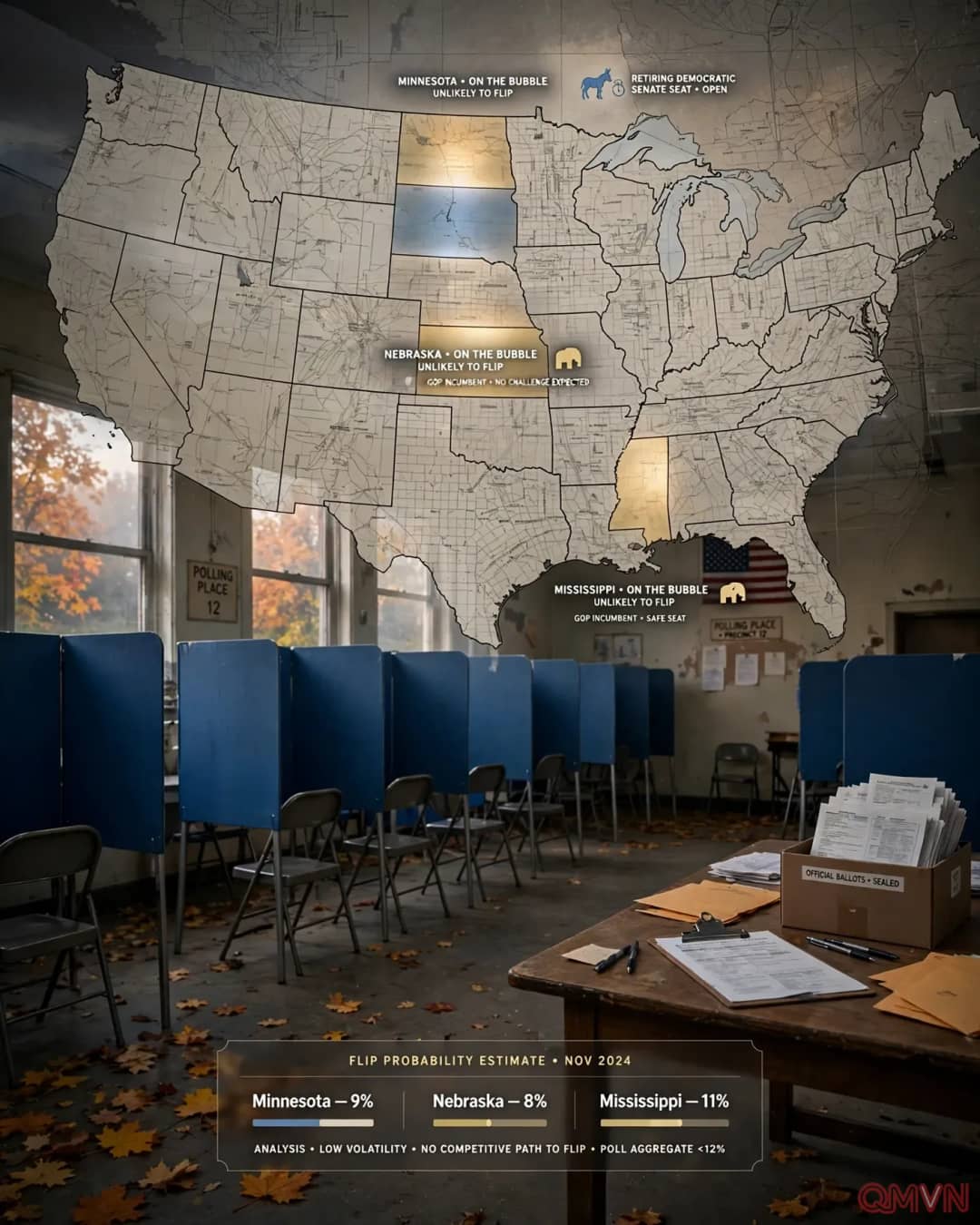
Senate seats on the bubble across Nebraska Mississippi and Minnesota unlikely to yield election surprises
As the intensely fought 2026 United States midterm elections approach their final hours, strategic interest has crystallized around a trio of fringe contests that lingered on the periphery of national surveillance without ever fully developing into active battlegrounds. These bubble states encompass two seats defended by Republican incumbents in Nebraska and Mississippi, alongside an open seat in Minnesota vacated by a retiring Democratic veteran. While campaign analysts initially speculated that extended timelines and aggressive external cash infusions could have elevated these contests into competitive play, structural realities on the ground have decisively foreclosed broad electoral volatility. With national campaign committees prioritizing scarce capital across genuine toss-up battlegrounds, nonpartisan analysts agree that a seat flip in any of these three states on Tuesday would constitute an extraordinary political shock.
Edite QUANG MINH·2 min read · 3 min listen·2 November 2026, 09:06 EST·
AI-generated illustration
MAIN BODY
Entrenched partisan baselines in Nebraska and Mississippi defy challenger momentum
Across the conservative terrain of Nebraska and Mississippi, Republican incumbents maintained durable institutional advantages that insulated their candidacies from serious disruption. Despite localized attempts by independent labor movements and grassroots organizers to channel economic frustration over inflation and agricultural costs, the necessary external investments never materialized.
Advertisement300 × 250
*
"Maybe they would have come online in a more serious way with more money and time, but at this point, flips in these three states would be a big surprise." — Midterm Congressional Campaign Analytics Directorate
*
The deliberate absence of sustained independent expenditure blitzes in the final weeks signaled that both national party leaderships had accepted the structural baseline of these conservative bastions. Barring unprecedented demographic turnout anomalies, Republican incumbents remain overwhelmingly positioned to retain their seats comfortably.
Republican incumbents in Nebraska and Mississippi successfully defended their foundational conservative margins.
National political action committees largely bypassed these peripheral contests in final late-stage ad allocations.
Independent challenger candidacies lacked the institutional infrastructure to overcome deep partisan loyalties.
Minnesota open seat resilience and the discipline of national resource allocation
Concurrently, Republican aspirations to expand the electoral playing field into Minnesota fell short as Democratic infrastructure mobilized to protect the open seat left by their retiring incumbent. Anchored by commanding majorities across the Twin Cities metropolitan area, Democratic operations neutralized conservative messaging early in the cycle.
*"Securing base strongholds allows strategic managers to channel vital capital into the narrow handful of races that will truly decide Senate control." — Independent Electoral Research Institute Report*
The calcification of these three bubble states highlights the ruthless efficiency of modern campaign resource allocation. Rather than speculative investments across hostile terrain, national committees concentrated hundreds of millions of dollars into tier-one battlegrounds such as Ohio, Iowa, and Pennsylvania where the Senate majority will ultimately be forged.
Democratic organizations effectively fortified Minnesota’s open Senate seat against late-breaking Republican incursions.
Metropolitan turnout patterns in Minneapolis and Saint Paul provided an unyielding defensive barrier for the Democratic ticket.
Both national parties converged on a disciplined strategy, reallocating capital away from peripheral fringes toward core battlegrounds.
EVENT BACKGROUND
This strategic consolidation occurred in the final stretch of the 2026 United States midterm elections, where narrow majorities across the legislative branch mandated strict fiscal discipline among party strategists. Throughout the biennial cycle, speculative attention occasionally drifted toward secondary targets: Nebraska, where independent union leaders challenged the corporate-friendly status quo; Mississippi, where civil rights coalitions sought to mobilize historically disenfranchised demographics; and Minnesota, where the retirement of a veteran Democratic lawmaker offered an apparent opening for a conservative breakthrough. However, as the campaign entered its decisive autumn phase, compounding macroeconomic tensions—ranging from energy costs fueled by the ongoing Middle Eastern conflict to regional disputes over technology data centers—forced both parties to triage their operations. The essential crux of the matter lies in the high barrier to entry required to expand the competitive map, leaving these secondary contests safely anchored within their traditional partisan alignments as voters prepare to cast their ballots.
KEY LESSONS LEARNED
Strategic prioritization of core assets is the paramount operational imperative when managing high-stakes political contests.
Established structural and demographic foundations possess immense inertia that cannot be dismantled by late-stage speculative spending.
Disciplined triage of secondary objectives ensures that vital defensive and offensive resources remain concentrated on decisive battlefields.
Subscribe to the QMVN newsletter
A daily morning digest - only stories worth reading, no spam.