Global stocks retreat as mounting artificial intelligence jitters and US midterm elections unsettle investors
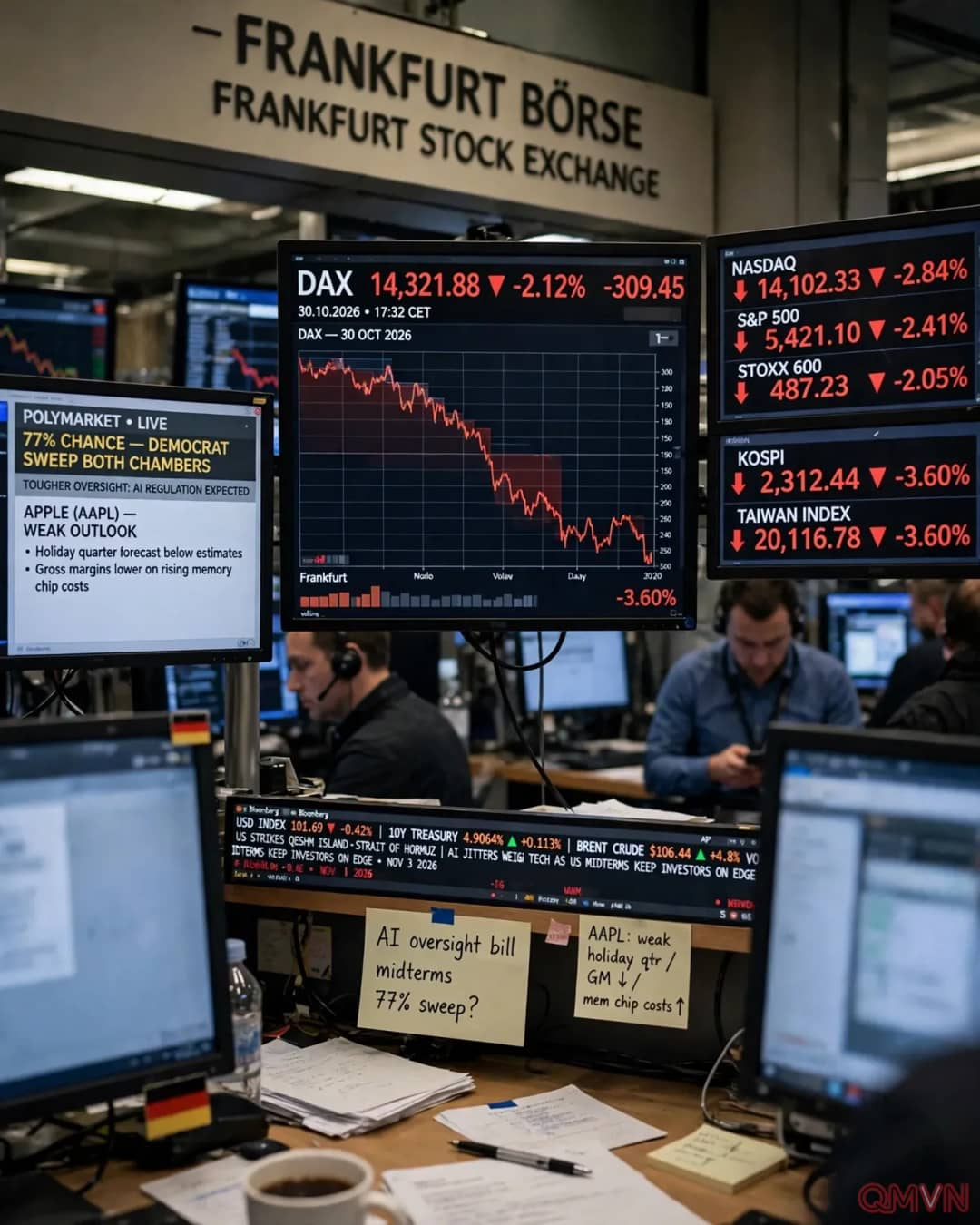
Global equity markets slid broadly on Tuesday, November 3, 2026, as a fresh wave of anxiety surrounding artificial intelligence valuations combined with acute apprehension over the outcome of the United States midterm elections to keep investors on edge. On digital prediction exchange Polymarket, contract pricing surged to indicate a 77 per cent probability of a Democratic sweep across both houses of the US Congress, raising the specter of aggressive legislative oversight, antitrust inquiries, and increased regulatory compliance costs for technology hyperscalers. Compounding the political unease, Apple’s uninspiring holiday-quarter forecast citing elevated memory-chip expenses deepened earnings gloom across Big Tech, precipitating a 3.6 per cent rout across key Asian equity benchmarks, while escalating military actions in the Persian Gulf kept crude oil elevated above $106 a barrel.
Edite QUANG MINH·2 min read · 3 min listen·3 November 2026, 05:57 EST·
AI-generated illustration
MAIN BODY
Midterm election anxieties and the 77% probability of a Democratic regulatory wave
Wall Street opened the trading session under heightened defensive positioning as pre-election market indicators reflected increasing probability of a major congressional power shift. On Polymarket, odds of Democrats capturing both the House and Senate climbed to 77%, an outcome expected to trigger populist pushback against massive AI capital expenditure programs.
Advertisement300 × 250
*
"In the case of a full blue sweep, I would expect some populist measures against AI; the narrative against data centres would get a tailwind." — Alexander Lis, Chief Investment Officer at Social Discovery Ventures
*
Market contracts reflected this caution: futures tied to the tech-heavy Nasdaq-100 remained subdued, while the S&P 500 slipped following three consecutive losing sessions. The US dollar index softened to 101.69 points, and the benchmark 10-year Treasury yield edged upward by 1.2 basis points to 4.9064%, reflecting macroeconomic cross-currents.
Polymarket traders priced in a 77% probability of a total Democratic congressional sweep.
Major US equity index futures declined for a fourth consecutive trading session on regulatory concerns.
The 10-year Treasury note yield rose to 4.9064% as the US dollar index retreated to 101.69.
Apple’s margin warnings, Asian market sell-offs, and Middle Eastern geopolitical friction
The retreat in equities accelerated following an uninspiring financial update from Apple, which projected lower gross margins for the pivotal holiday quarter due to soaring memory-chip procurement costs and guided services growth below Wall Street forecasts. The announcement ignited sharp declines across semiconductor-heavy Asian bourses, with South Korea’s KOSPI and Taiwan’s TWII both tumbling 3.6%.
*"I don’t think you could build a high conviction view based on the Iran developments right now; and I think more investors should think the same way as I do." — Alexander Lis, Global Financial Asset Strategist*
Commodity markets witnessed heightened volatility, with Brent crude rising 1.6% to $106.44 per barrel after confirmation that the US carried out tactical strikes on Iran’s Qeshm Island in the Strait of Hormuz. In foreign exchange, the Chinese yuan softened after the central bank raised reserve requirements, while cryptocurrency markets remained subdued following a major digital exchange security breach.
Apple shares pressured market sentiment after forecasting holiday margin contractions driven by chip inflation.
South Korea’s KOSPI and Taiwan’s benchmark recorded sharp 3.6% drops, their steepest daily losses since July.
Brent crude climbed 1.6% to $106.44 per barrel following US airstrikes on Iranian infrastructure in the Strait of Hormuz.
EVENT BACKGROUND
This financial retrenchment materialized on Tuesday, November 3, 2026, coinciding with the opening of voting precincts across the United States for the pivotal midterm congressional elections. Over the previous two years under President Donald Trump’s second administration, global stock indexes had gained substantially, buoyed by multi-billion-dollar enterprise capital spending on AI infrastructure and pro-growth domestic policies. However, recent corporate earnings reports revealed that the immense cost of building specialized data centers is beginning to compress operating margins across leading technology conglomerates. Concurrently, persistent military friction between the United States and Iran—epitomized by airstrikes in the Strait of Hormuz—pushed energy prices above $106 per barrel, reigniting inflation fears. The central crux of the market’s vulnerability lies in the intersection between rich technology valuations confronting physical supply-chain inflation (such as memory chips) and the acute political risk of a unified Democratic legislative majority determined to investigate energy-intensive data centers and enforce mandatory AI safety standards.
KEY LESSONS LEARNED
High valuation multiples in technological cycles are highly vulnerable to basic input-cost inflation, such as memory components.
Political forecasting markets provide vital leading indicators of impending regulatory and fiscal policy shifts.
Persistent geopolitical friction in energy chokepoints introduces structural baseline risks that cannot be hedged away cheaply.
Subscribe to the QMVN newsletter
A daily morning digest - only stories worth reading, no spam.