South Carolina Senate race enters dead heat as Democratic surge threatens traditional Republican stronghold
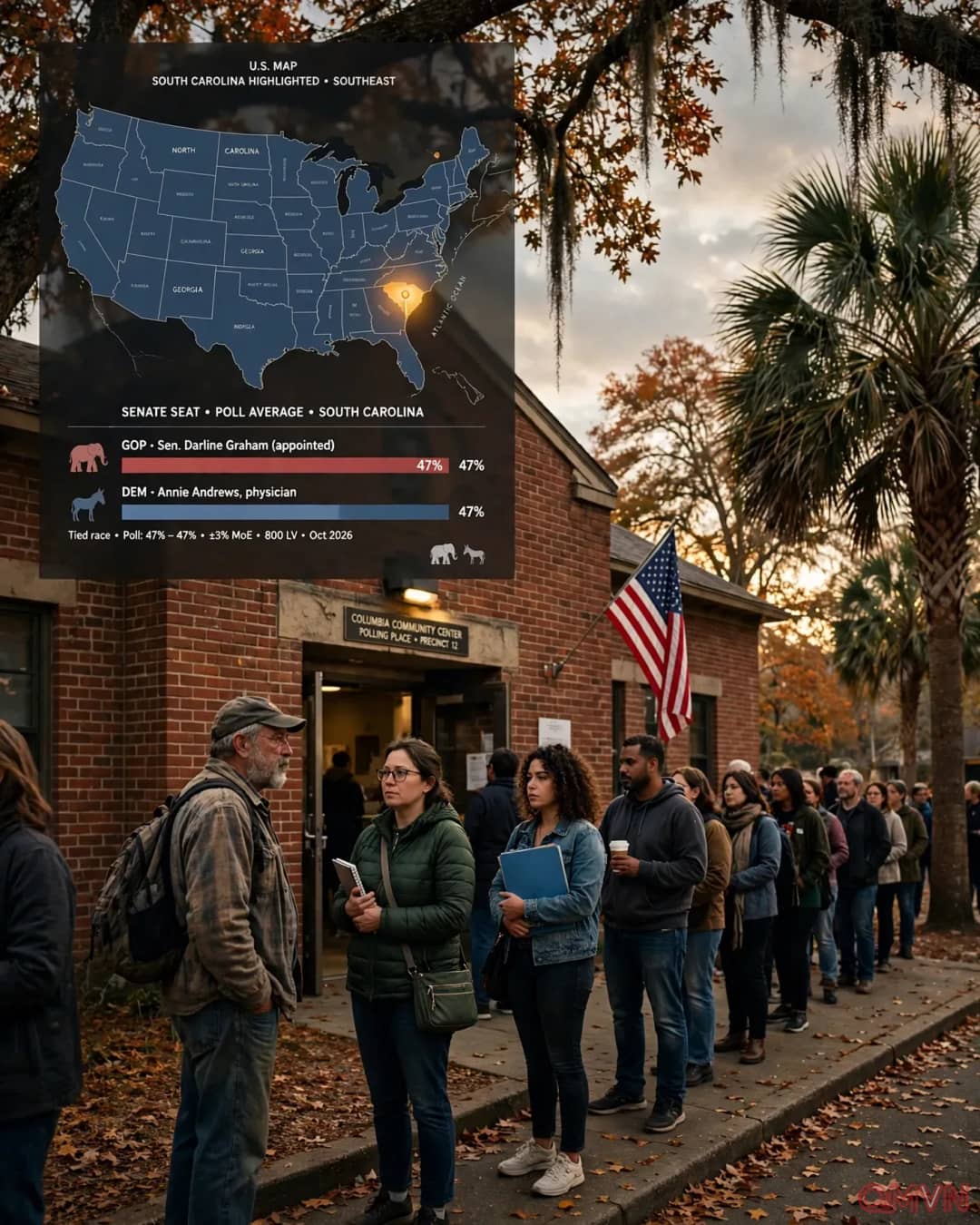
In an extraordinary electoral realignment on the eve of the 2026 United States midterm elections, South Carolina has debuted on national tracking monitors as one of the country’s most vulnerable Senate battlegrounds, rattling Republican leadership in Washington. An authoritative New York Times/Siena College survey published last week revealed a statistical tie between appointed Republican Senator Darline Graham and Democratic challenger Dr. Annie Andrews, a prominent pediatric physician. Appointed to the chamber following the unexpected passing in July of her brother, longtime veteran Senator Lindsey Graham, Darline Graham’s maiden campaign has been marred by unforced debate missteps on international security and outspoken resistance from conservative congressional colleagues. Despite former President Donald Trump carrying the Palmetto State by an overwhelming 18-point margin in 2024, heavy outside financial outlays and acute intra-party fractures have transformed a reliably red bulwark into a precarious election-night toss-up.
Edite QUANG MINH·2 min read · 3 min listen·2 November 2026, 09:02 EST·
AI-generated illustration
MAIN BODY
Debate vulnerabilities and public fractures across the conservative base
Darline Graham’s bid to secure a full six-year Senate term stumbled during a widely viewed televised debate when she conceded that national security was not her forte in response to questions regarding Taiwan. The comment detonated intense criticism, underscoring persistent doubts regarding her preparedness to inherit her predecessor’s high-profile foreign policy mantle.
Advertisement300 × 250
*
"My entire family is not voting for my former opponent; she is not a true conservative." — Republican Representative Ralph Norman
*
The candidate’s vulnerabilities were magnified when conservative Representative Ralph Norman, who narrowly lost to Graham in the Republican primary runoff, publicly denounced her ideological credentials on national television. Seeking to prevent an embarrassing southern defeat, former President Donald Trump traveled to South Carolina twice within the final month to rally conservative turnout.
The New York Times/Siena survey confirmed a dead heat between Darline Graham and Democratic physician Annie Andrews.
Representative Ralph Norman broke party ranks to publicly declare his family will oppose Graham on Election Day.
Donald Trump executed two campaign appearances in South Carolina during the final month to energize rural base voters.
Democratic fundraising dominance and unprecedented outside expenditure scrambles
Challenger Annie Andrews achieved commanding fundraising totals throughout the general election cycle, consistently out-raising the incumbent appointee through grassroots donations. Outside political action groups recognized the opening, deploying an estimated $17 million per side across the final two weeks in an aggressive effort to saturate broadcast and digital airwaves.
*"The close nature of the race is giving some Republicans genuine anxiety heading into election night." — CNN Senate Electoral Race Overview*
Structural demographic fundamentals continue to favor the Republican Party in a state carried by Donald Trump by 18 percentage points in 2024. Nevertheless, the combination of internal party rebellion and the Democrat’s substantial war chest has eroded Graham’s institutional cushion, leaving Republicans bracing for a nail-biting finish.
Democratic nominee Annie Andrews significantly out-raised the appointed incumbent across individual contribution metrics.
Outside committees committed roughly $17 million per party during the final fortnight in a frantic voter outreach blitz.
The unexpected parity tests whether traditional southern conservative loyalties can withstand internal GOP fractures.
EVENT BACKGROUND
This legislative battle emerged from the high-stakes 2026 United States midterm elections, where the battle for Senate control expanded into states previously dismissed as non-competitive. In South Carolina, the Senate seat became vacant following the unexpected death in July 2026 of Senator Lindsey Graham, who had occupied the post for over two decades as a cornerstone of the national defense establishment. The state executive’s subsequent appointment of his sister, Darline Graham, was intended to project continuity, but her lack of prior legislative experience and visible debate miscues provoked immediate primary pushback from conservative hardliners like Representative Ralph Norman. Simultaneously, the Democratic Party coalesced around Dr. Annie Andrews, whose pragmatic medical background and suburban fundraising appeal attracted moderate independent voters alienated by dynastic succession. The core crux of the race lies in the tension between South Carolina’s foundational Republican partisan identity versus candidate-specific weaknesses and external financial parity, turning a historic conservative fortress into an unexpected focal point of congressional power.
KEY LESSONS LEARNED
Dynastic political appointments cannot compensate for individual debate readiness and mastery of core policy briefs.
Internal party division and public defections by prominent primary rivals pose severe risks to incumbent electoral viability.
Disciplined campaign fundraising combined with a professional civilian profile can make deep inroads into traditional strongholds.
Subscribe to the QMVN newsletter
A daily morning digest - only stories worth reading, no spam.