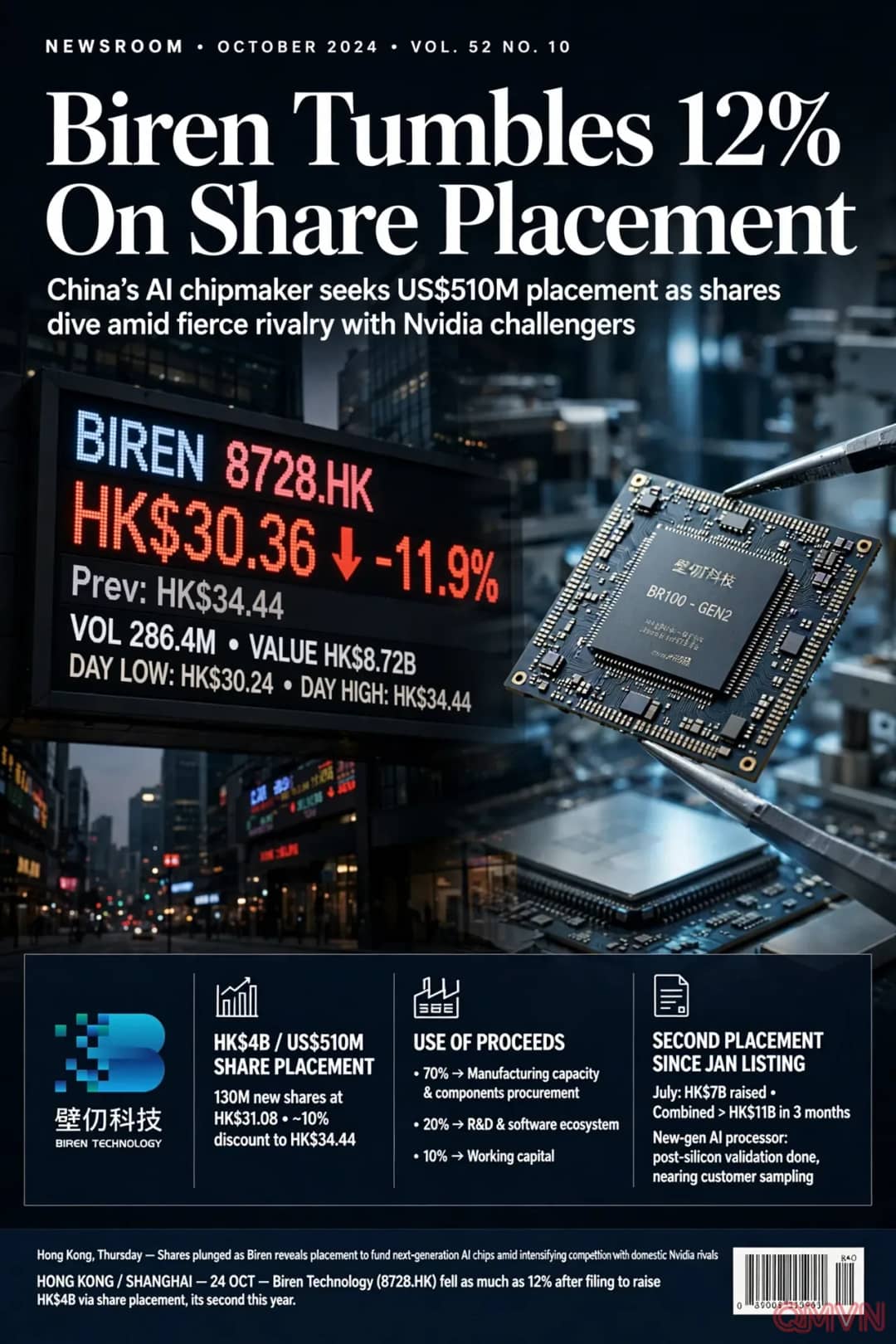
A 12 per cent slide in one session
The sell-off followed a stock exchange filing late on October 7, in which Biren said it had engaged placing agents on a “best effort” basis to issue 130 million new shares, equal to about 5 per cent of its total issued shares. The offer price of HK$31.08 a share represents a discount of about 10 per cent to the previous day’s close of HK$34.44.
On October 8, Biren shares fell as low as HK$30.24 before closing at HK$30.36, down 11.9 per cent. For existing shareholders, the discount and the risk of dilution were understandable reasons for a negative reaction, even if the company’s long-term growth story remains compelling.
More than HK$11 billion in three months
This is Biren’s second placement since it debuted in Hong Kong on January 2, 2026. The previous round in July raised HK$7 billion, bringing the combined total from the two recent placements to more than HK$11 billion in only three months.
Biren is not alone. This year China’s semiconductor sector has seen a wave of massive fundraising as domestic Nvidia challengers tap equity markets to finance Beijing’s drive for tech self-reliance. Rivals Moore Threads and MetaX, both listed in Shanghai, have announced plans for Hong Kong listings – a sign that the competition for capital is set to grow fiercer.
Where the money will go
According to the filing, Biren’s new-generation product has completed initial testing and entered post-silicon validation, bringing it closer to customer sampling and commercial production. Net proceeds are earmarked as follows:
- About 70 per cent to secure manufacturing capacity, procure components and prepare the commercial launch of next-generation products
- About 20 per cent to strengthen research and development (R&D) capabilities and its software ecosystem
- The remaining 10 per cent for working capital and general corporate purposes
Channelling most of the money into manufacturing capacity highlights the survival challenge facing Chinese AI chipmakers: designing a chip is one thing, but securing production slots amid tight supply is quite another.
Red-hot growth, narrowing losses
In the first six months of 2026, Biren’s revenue surged around 21-fold to 1.24 billion yuan (US$184.9 million), driven largely by sales of its intelligent computing solutions. Its net loss narrowed to 377 million yuan from 1.6 billion yuan a year earlier.
Even so, the company keeps spending heavily: R&D expenses rose 40.7 per cent to 804 million yuan in the first half. That is the price of a race in which the pace of innovation decides who survives – and the reason Biren keeps returning to the capital markets.