MAIN ARTICLE
The wealth found between apartments
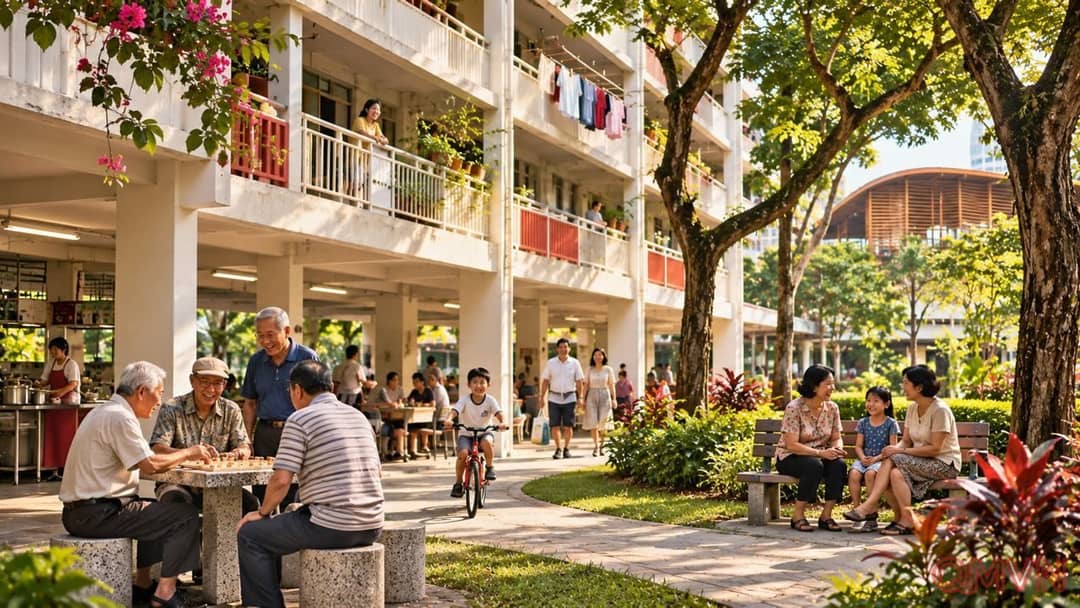
Kengo Kuma is known for landmark architecture, yet one of his strongest memories of Singapore is not a luxurious tower. He admires the earliest HDB housing blocks, whose modest construction provided everyday places to meet, linger and share life. In his account to The Straits Times, their public areas were unusually rich, despite the country’s limited resources when public housing began expanding.
Established in 1960, the HDB set out to address an acute housing shortage. Kuma sees more than a practical response to a national emergency: the housing model also recognized community as an essential part of urban life. He worries that contemporary apartments can prioritize isolation and complete privacy, making neighbors physically close yet socially distant. An open walkway or ground-floor gathering space may appear architecturally insignificant until it disappears.
A cultural bridge inside the Tanglin redevelopment
That concern creates a demanding question for fast-growing cities: can tall buildings support community rather than erode it? On the former Tanglin Shopping Centre site at 19 Tanglin Road, a mixed-use redevelopment offers one possible response.
Singapore’s National Arts Council announced a purpose-built 1,000-seat theatre planned to open by 2030, alongside a contemporary art museum and other commercial uses.
Developed by Pacific Eagle Real Estate, the project falls within Singapore’s Strategic Development Incentive framework. Kuma’s argument is that theatres and museums must do more than embellish a developer’s brochure. By drawing artists, audiences and neighbors into a shared setting, culture can connect an otherwise imposing tower to street life. His preference for wood and greenery suggests another means of softening the experience of density without denying the economic pressure to build upward.
A memorial intended to belong to its garden
At Bay East Garden, Kengo Kuma & Associates and K2LD Architects won the international competition for the Founders’ Memorial in 2020. Official plans describe a combined gallery and garden experience that introduces visitors to Singapore’s founding generations through a carefully structured journey. Instead of proposing a single dominating stone object, the design integrates paths and landscapes so that the act of remembering unfolds in the public realm.
Kuma has described an architectural philosophy often rendered as makeru kenchiku, or architecture willing to yield to its surroundings. That approach does not mean reducing history to decoration or refusing ambitious projects. It asks a different question: could trees, changes in elevation, shade and collective movement communicate a national story as powerfully as monumental walls? In Singapore, where the relationship between development and greenery is central to the urban identity, that question has unusual resonance.
The wildflower drawing that completes the argument
The same ideas appear on the smallest possible stage: a T-shirt. Kuma’s design for Uniqlo’s Peace For All line shows a loose bouquet of wildflowers bound with a ribbon, drawn in chalk-like strokes. He links it to an ordinary childhood gesture of giving flowers to someone he cared for. He also favors hand-drawn sketches, explaining that digital lines can feel too artificial for the atmosphere he seeks.
Uniqlo’s charity initiative channels proceeds toward organizations working on humanitarian and peace-related causes. A simple printed bouquet and a major civic project might seem worlds apart. For Kuma, however, their underlying purpose is similar: to let people recognize their own lives in an object or a place. This is a standard of value that cannot be captured by building height, floor area or investment alone, and one that city planners risk forgetting.