MAIN ARTICLE
A vanished lake in today’s great desert
Travel across the Empty Quarter today and the dominant impressions are heat, sand and exposed rock. Yet sediments and fossils in the Mundafan basin record a much wetter phase of the late Pleistocene, when a freshwater lake covered roughly 340 square kilometers and reached nearly 30 meters deep. Grasses, shrubs and aquatic vegetation transformed its margins into a productive habitat.
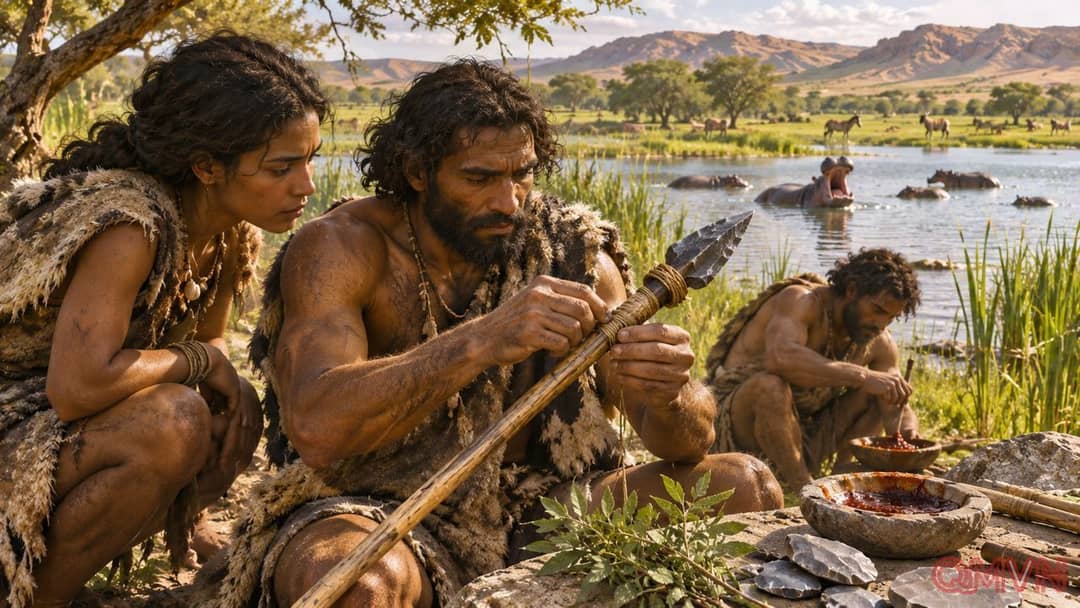
Researchers led by Christopher Clarkson and colleagues documented the remains of hippos, large buffalo, antelopes, ostriches and other animals. These fossils provide more than an environmental portrait. They help explain why human groups may have repeatedly visited the lakeshore to find prey, make implements and exploit plant resources.
Luminescence dating of lake and shoreline sediments, combined with fossil evidence, places the ancient setting at approximately 125,000 years ago. Crucially, that dates the geological context: it does not directly establish the age of each artifact now lying on the surface.
Stone points preserve evidence of composite technology
The team mapped more than 5,500 stone artifacts, including cores, flakes and pointed pieces. Some flakes could be fitted together, allowing researchers to identify where stones were worked.