ARTICLE
A bell made with both hammer and ear
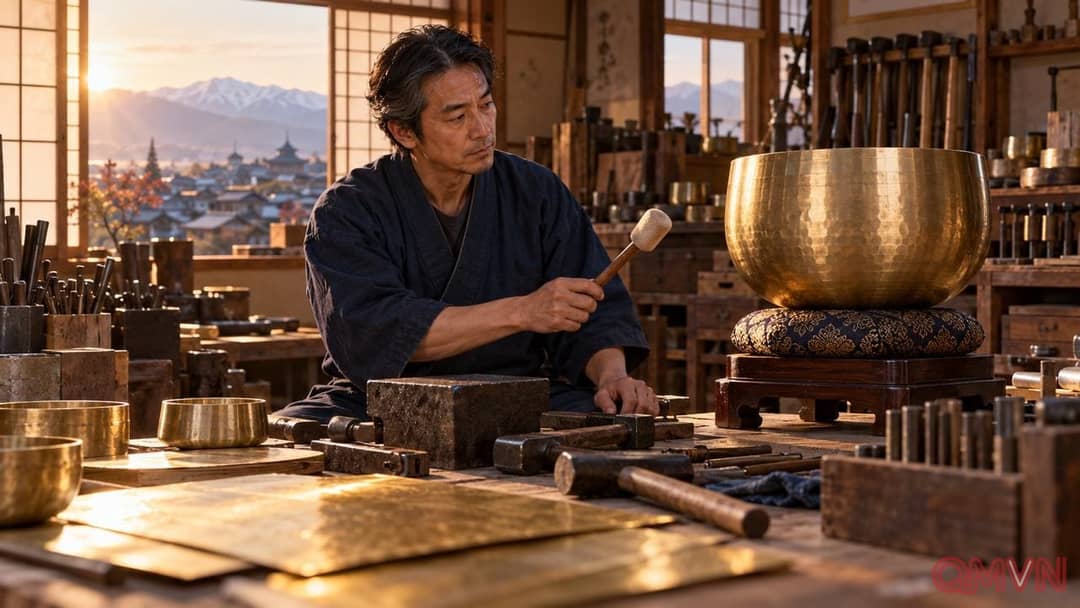
In Shimatani Syouryu Studio, blows against brass give way to intervals of close listening. Yoshinori Shimatani told The Japan Times that he cannot always know whether an unfinished bowl will produce a beautiful sound. He has to find the places where a strike and a small change in shape will release it. An orin is a standing, bowl-shaped bell used in Buddhist temples and household observances. Its ring matters at a moment when someone is invited to pause, pray or remember. The artisan is shaping an encounter with sound, not merely a decorative object.
An approximately 40-centimeter bell may take six months to complete. In the model described by the paper, three parts are joined: a sturdy rim, a thin vibrating body and a base. The brass is roughly 70% copper and 30% zinc. Repeated hammering shapes it; heating and gradual cooling make it workable again when necessary. Those dimensions and temperatures describe this workshop’s process, rather than a universal formula. Finally, Shimatani sounds the inside, listens to the resonance and adjusts precise points outside with his hammer. A note that wavers or fades too soon sends him back to the anvil.
There is no written score for the result. The maker learns to feel the difference between a harsh ring and a sustained tone through years of practice. Some pieces cannot be brought to the desired standard and return to the furnace. This demanding choice locates quality in what listeners hear, not in how quickly the workshop can fill an order.