MAIN CONTENT
A Hubble cold case reopened after more than two decades
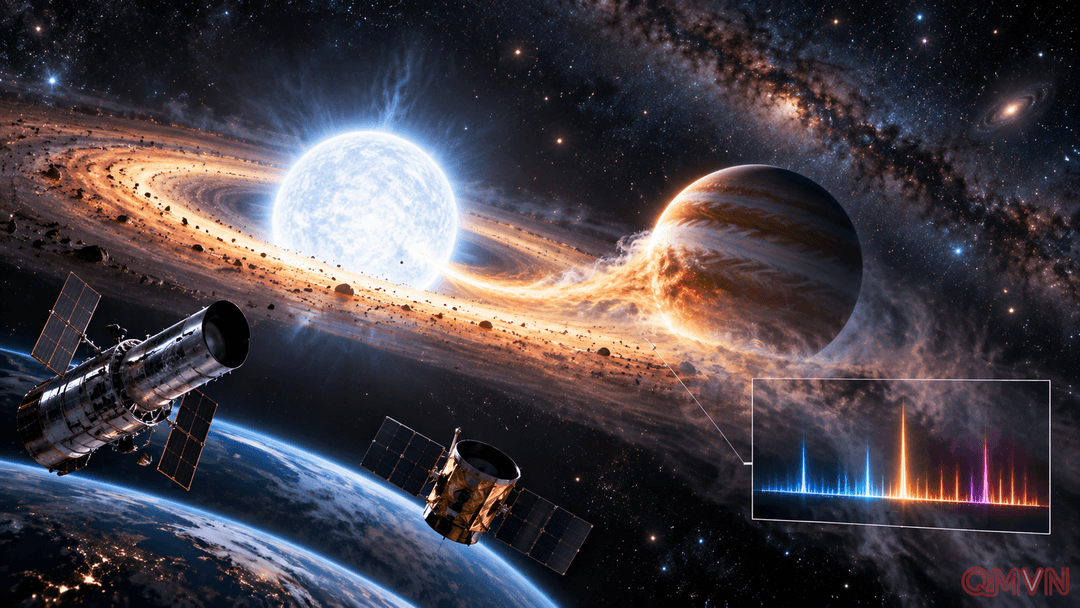
HS 0209+0832 is a white dwarf, the exposed core left after a Sun-like star exhausts its fuel, swells into a red giant and sheds its outer layers. Hubble observed the system in 1999 and recorded roughly one hundred spectral features that could not then be identified. Years later, University of Warwick doctoral researcher Jamie Williams revisited the archival data with improved atomic databases and found that many of the unexplained features matched niobium.
The composition was the real surprise. White dwarfs accreting old planetary debris usually show familiar rock-forming elements such as silicon and iron. HS 0209+0832 instead contains unusually high amounts of zinc, copper and especially niobium, reported at more than a thousand times the solar abundance. That pattern resembles material enriched by the slow neutron-capture, or s-process, inside an aging star rather than the chemistry expected from an ordinary first-generation planet.
The radical idea: a dead star helped build a new world
The team’s preferred explanation is that the white dwarf is accreting material from a planet that formed after the star’s death. In this scenario, gas and dust expelled during the final stages of stellar evolution did not all escape. Some remained bound, formed a new disk around the stellar remnant and eventually condensed into a giant planet. Because that planet would have been made from material already chemically processed inside the star, its composition would naturally differ from worlds born alongside a young star.