MAIN CONTENT
A promise made at a sensitive frontier
Rutte’s message was deliberately unambiguous: Poland should expect the full protection of its allies. Reuters, citing the Polish Press Agency, reported his assurance that NATO would defend every inch of Polish territory. The declaration was a statement of deterrence, rather than an announcement that NATO had entered the war in Ukraine. That distinction matters because the alliance’s credibility rests not only on its ability to respond to threats, but also on its capacity to describe those threats precisely.
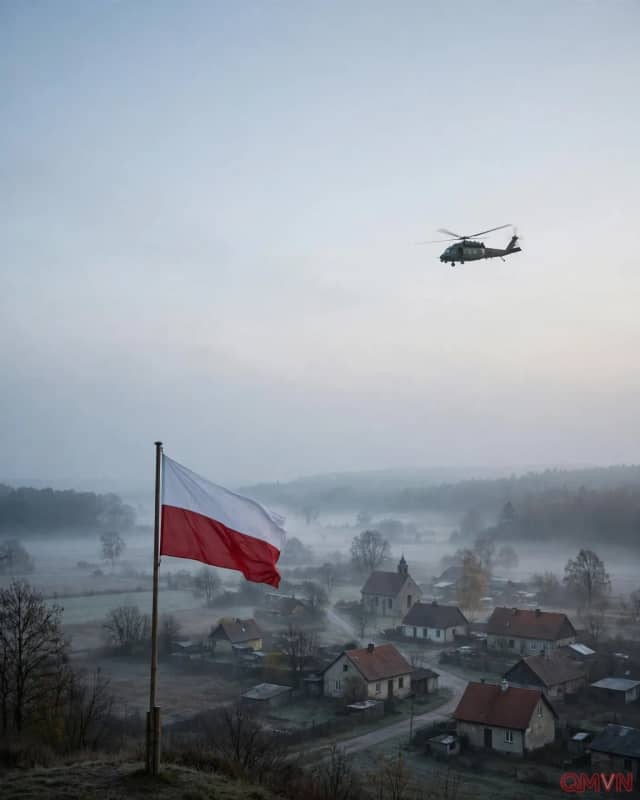
Polish authorities said the objects that crossed their airspace on Friday were probably two missiles and a drone, and attributed the violation to Russia. The available report did not provide a complete public reconstruction of the objects’ trajectories or any independently verified account of intent. The immediate task for military investigators is therefore to establish what happened, assess the risk to civilians and determine whether any changes in surveillance, identification or interception procedures are needed.
Why the timing sharpened anxiety
The incident took place while Poland was hosting exercises associated with the Coalition of the Willing, a group of countries supporting Ukraine and discussing possible security arrangements after a future settlement. Polish officials considered the timing significant, according to Reuters.
Yet coincidence and intention are not the same thing: a finding of deliberate provocation would require evidence beyond the fact that military activities and an intrusion occurred close together.
For communities close to Ukraine, the danger is not abstract. A fast-moving object can cross an international frontier within minutes, leaving decision-makers little time to decide whether it is malfunctioning, lost or hostile. Repeated incidents can strain public confidence even when no injuries are reported. They also force European governments to balance greater readiness with restraint, because an overly hasty response can carry consequences of its own.
Collective defence is a commitment, not an automatic trigger
NATO’s founding treaty sets out the principle that an armed attack against one member is considered an attack against all. Article 5, however, does not state that every border crossing automatically invokes a common military response. Allies examine the nature and circumstances of an incident, and each takes such action as it deems necessary if collective defence is invoked. NATO’s official explanation distinguishes an armed attack from other security incidents requiring consultation and coordination.
The North Atlantic Council, NATO’s principal political decision-making body, was expected to discuss the Polish case in Brussels on Monday, PAP reported. Such meetings provide a venue for comparing intelligence, coordinating a common account of events and considering proportionate measures. Public confidence depends on those processes being both rigorous and credible: governments must avoid understating a danger, but should also resist presenting preliminary assessments as settled findings.
A wider test for European air defence
NATO has already reinforced monitoring and air-defence arrangements along its eastern flank as the war in Ukraine has continued. The alliance describes air defence as a continuous shared task, drawing on national radar networks, aircraft, command structures and interception capabilities. General Grynkewich’s potential adjustments, as outlined by Rutte, fit within that standing responsibility to identify evolving threats and strengthen deterrence.
The unanswered questions are practical as well as political: how quickly can suspicious objects be detected, how effectively can national forces exchange information, and how can civilians be warned without unnecessary alarm? Poland’s border is both a national boundary and part of NATO’s collective security perimeter. The Warsaw assurance carries weight only when backed by reliable systems, clear procedures and sustained cooperation among member governments.