MAIN CONTENT
A manufactured star that measures the air
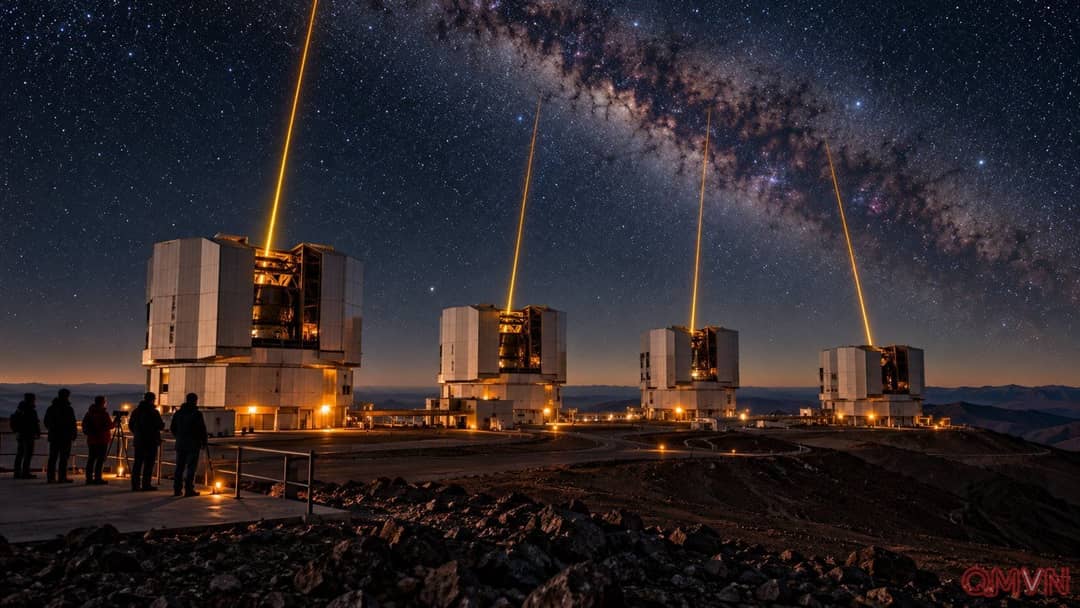
The beams above Paranal can look like messages being sent into space. Their practical work happens much closer to Earth. A laser excites sodium atoms in a high atmospheric layer, approximately 90 kilometres up. Those atoms emit light that a telescope can collect. The resulting bright point is a laser guide star: a reference deliberately created for measurement.
It is neither a new celestial body nor a searchlight reaching a distant planet. The light studied from astronomical targets still originates from them or associated natural sources. The artificial star supplies a reference signal. As its light travels down through changing air, the system measures distortions that need correction. Sodium occurs in a particular high layer; the surrounding atmosphere should not be imagined as uniformly rich in it.
This solves a specific difficulty. Adaptive optics needs a sufficiently bright reference near the observing direction, and a suitable natural star is not always available. Astronomers cannot move real stars into convenient positions. Creating a bright point in the atmosphere reduces dependence on the favourable alignments nature happens to provide.