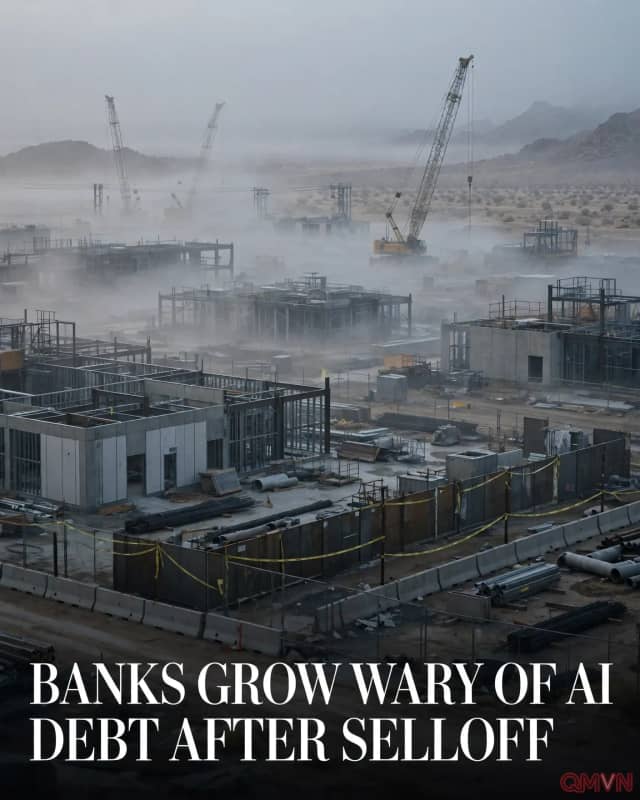
Global financiers warn of systemic overheating and infrastructure bottlenecks from the unprecedented artificial intelligence boom
Speaking at the prestigious Global Financial Leaders’ Investment Summit in Hong Kong on November 3, 2026, chief executives and chief investment officers of the world’s pre-eminent asset management institutions and investment banks issued stark warnings regarding the escalating systemic risks associated with the artificial intelligence boom. With cumulative global AI infrastructure capital expenditures projected to reach an astounding $10 trillion over the next five years—approaching the entire $12 trillion capitalization of the United States corporate bond market—financial titans from Pimco, Blackstone, Bridgewater Associates, and Brookfield expressed profound reservations over whether physical electrical grids, corporate productivity gains, and international debt markets can withstand the technology’s velocity. As surging power deficits, asymmetrical debt-holder return profiles, and elevated interest rates collide with historic equity valuations, Wall Street is fundamentally recalibrating its risk models.
Edite QUANG MINH·2 min read · 3 min listen·3 November 2026, 05:42 EST·
AI-generated illustration
MAIN BODY
A $10 trillion capital requirement and asymmetrical debt market exposures
The immense capital intensity demanded by next-generation computing infrastructure is unprecedented in modern market history. Addressing a keynote panel in Hong Kong, Pimco Chief Executive Officer Emmanuel Roman drew direct parallels between the current AI infrastructure buildout and Britain’s Industrial Revolution of 1760, while warning that structural limits are being tested.
Advertisement300 × 250
*
"At some point in time, it’s going to be too much; rising interest rates or intensifying geopolitical tensions could trigger a downturn." — Emmanuel Roman, Chief Executive Officer of Pimco
*
Blackstone President and Chief Operating Officer Jonathan Gray noted that funding requirements are fundamentally shifting institutional risk calculations. While major computing projects are insulated by 15- to 20-year off-take agreements with hyperscalers, fixed-income lenders bear full credit downside without participating in potential equity windfalls.
AI infrastructure capital expenditure is forecast to approach $10 trillion across the next five-year window.
Debt investors absorb substantial balance-sheet risk while receiving only fixed coupons without equity upside.
Rising long-term benchmark yields and macroeconomic volatility increase vulnerability across leveraged tech portfolios.
Electrical grid capacity constraints and the imperative of verified enterprise productivity
Beyond financing constraints, global allocators emphasized that the ultimate physical ceiling on AI deployment is electric utility capacity rather than silicon processing availability. Brookfield CEO Bruce Flatt observed that constructing baseload power generation, including nuclear plants, requires seven-year lead times, creating an unprecedented window for energy infrastructure investors.
*"Supply for AI inference could increase 30-fold by 2028, and about $2 trillion in annual revenue globally would be required to absorb such capacity." — Bob Prince, Co-Chief Investment Officer and Chairman of Bridgewater Associates*
Corporate enterprise leaders underscored that monetization depends entirely upon transforming software spending into verified operational margins. While Franklin Templeton demonstrated an 11% sales expansion via internal AI deployment, JPMorgan Chase Vice-Chairman Daniel Pinto cautioned that implied revenue growth required to justify prevailing market capitalizations may be expanding unsustainably fast.
Electrical grid infrastructure represents the primary physical bottleneck, requiring up to seven years for new baseload deployment.
The global economy must generate approximately $2 trillion in incremental annual revenues to digest projected 2028 computing capacity.
JPMorgan Chase warns of broad-market contagion risks if hyper-valued technology shares undergo a valuation correction.
EVENT BACKGROUND
This high-level financial reassessment transpired during the Global Financial Leaders’ Investment Summit at the Four Seasons Hotel Hong Kong on November 3, 2026, assembling the chief executives of the world’s largest sovereign wealth funds, alternative asset managers, and commercial banks. Over the preceding four years of accelerating generative AI integration, massive enterprise capital spending catalyzed historic equity market advances, with the S&P 500 rising 27% under pro-growth federal policies. However, the compounding macroeconomic friction established by elevated sovereign debt yields, high utility power tariffs, and persistent Middle Eastern energy disruptions following the February strikes on Iran sharply raised capital-carrying costs. The central crux of financial anxiety lies in the stark divergence between speculative projections of exponential machine intelligence expansion versus the unyielding physical realities of energy generation, extended utility lead times, and the obligation of corporate borrowers to deliver verified returns on trillions in debt-financed infrastructure.
KEY LESSONS LEARNED
Technological paradigm shifts are fundamentally anchored by physical utility infrastructure and environmental energy realities.
Prudent capital allocation demands maintaining rigorous credit underwriting discipline during speculative investment cycles.
Sustainable enterprise valuation requires concrete productivity metrics and cash-flow monetization rather than optimistic capex momentum.
Subscribe to the QMVN newsletter
A daily morning digest - only stories worth reading, no spam.