MAIN CONTENT
A financial performance that resets expectations
Dell's November 24 earnings release, filed with the US Securities and Exchange Commission (SEC), shows that revenue for the quarter ended October 30 increased 103% from a year earlier. Adjusted earnings per share reached $9.45. Both figures exceeded analyst expectations of $49.32 billion and $6.59 respectively, according to LSEG estimates cited by Reuters.
This is the third upward revision of Dell's annual outlook this year. The new figures express management's confidence but also raise the benchmark against which future performance will be judged. The Wall Street Journal reported that Dell expects fourth-quarter revenue of approximately $56.3 billion. That remains a forecast rather than an achieved result.
Full-year revenue: $202 billion, up from $192 billion.
AI-optimized server revenue: $78 billion, up from $74 billion.
Full-year adjusted earnings per share: $29.68, up from $25.50.
Infrastructure moves to the center of the business
The Infrastructure Solutions Group generated $41.97 billion, accounting for more than three quarters of Dell's consolidated revenue. The company's detailed financial statements show that AI-optimized server sales reached $22.03 billion, an increase of 291% year on year.
Traditional servers and networking contributed approximately $15.01 billion, while storage sales reached $4.9 billion.
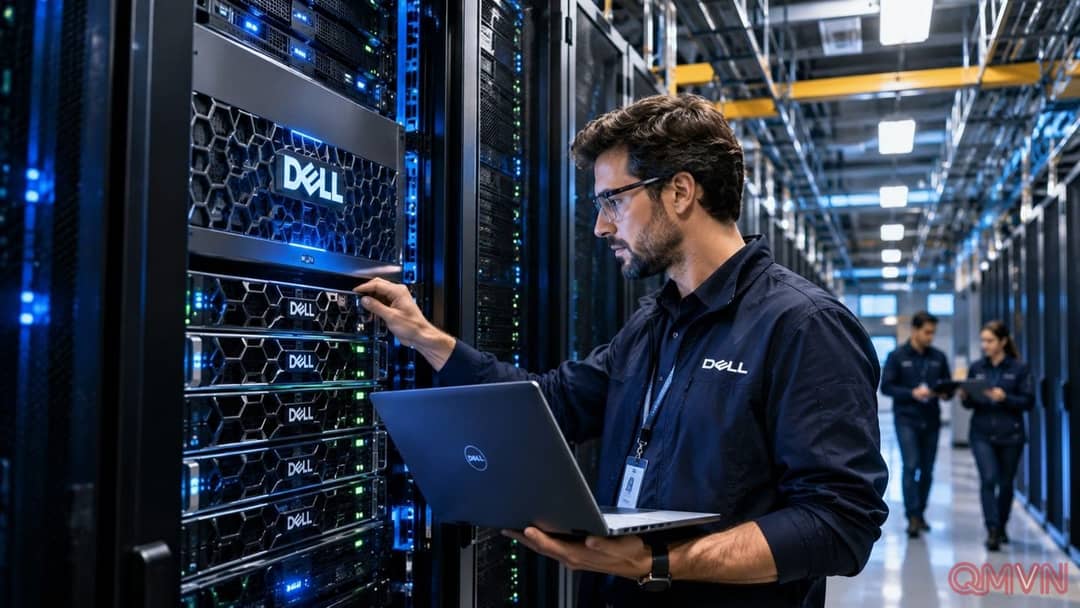
Importantly, artificial intelligence creates demand for much more than Nvidia's graphics processors. Companies putting models into production also need storage, high-speed connections, cooling equipment and management software. A supplier capable of assembling these components into integrated systems can develop deeper customer relationships rather than competing solely to sell individual pieces of hardware. The infrastructure opportunity therefore encompasses both emerging and established technologies.
A large backlog is not cash in the bank
Dell booked $60.2 billion in new AI orders during the quarter, bringing its outstanding order book to $132.3 billion. Management says more than 7,500 customers are deploying Dell AI Factories, a combination of servers, storage, networking and software. The scale suggests that demand is extending beyond early experimental installations toward broader deployment.
Nevertheless, an order backlog is not recognized revenue. Delivery schedules depend on production capacity, customer financing, available land and electricity for data centers. A delay in any one of these areas may alter the implementation timetable. Investors therefore have reason to examine cash generation and contract execution alongside the headline order figures. An expanding order book is encouraging, but its quality and conversion rate matter just as much as its size.
Memory and personal computers complicate the picture
Dell's personal computer business generated $12.89 billion in revenue, up 3%, compared with growth of 20% in the preceding quarter. Meanwhile, rival HP reported fourth-quarter sales of $16 billion, exceeding expectations with support from commercial computer demand and AI-enabled devices, according to Reuters. Both companies warned of pressure from memory costs.
Dell's previous quarterly SEC filing already described restricted memory supply and rising component prices. The company expects the shortage to extend into 2027. Its board also authorized an additional $25 billion in share repurchases. Balancing shareholder distributions with component procurement and financing the expansion of production will require careful capital allocation, particularly when equipment orders are growing much faster than traditional consumer demand.