MAIN BODY
A first breakthrough in a fragmented parliament
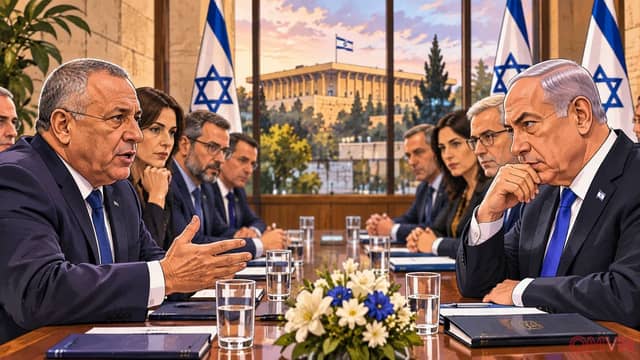
Reuters and The Times of Israel reported on November 24 that a meeting between Eisenkot and Lieberman paved the way for the first coalition agreement since Eisenkot received his government-forming mandate. Yashar holds 21 seats and Yisrael Beytenu seven. Their combined 28 seats provide a starting point for negotiations, but remain well below the 61 seats normally associated with an absolute parliamentary majority.
The agreement matters because a significant prospective partner is prepared to move beyond preliminary consultations. Lieberman has previously opposed both a government reliant on Arab parties and a unity cabinet involving Netanyahu. A common desire to replace the prime minister does not necessarily mean the parties agree on the membership or priorities of a future administration. That distinction will become increasingly important as negotiations widen.
The 61-seat challenge and the limits of arithmetic
The election has produced three particularly important groups. Likud and its right-wing and ultra-Orthodox allies hold 53 seats. Yashar and potential partners in the change bloc account for 48, while parties representing Arab citizens of Israel occupy the remaining 19. None of these groups can independently muster an absolute majority.
On paper, combining the 48 and 19 seats would produce 67. Yet arithmetic is no guarantee of actual political support. Parties must reach understandings on governing priorities, relations among communities and parliamentary cooperation. A coalition with enough seats but insufficient trust could struggle when confronted with a budget or controversial legislation. For Eisenkot, the challenge is not merely to assemble numbers but to turn them into a workable relationship.
Three possible paths under consideration
Seek additional support from Arab parties to build a majority extending beyond the change bloc.
Explore a unity government with Likud, subject to agreement on leadership and policy priorities.
Continue bargaining with other parties to find a compromise, or face the prospect of another election if the process ultimately fails.
Fractures among prospective partners
The Democrats, which won eight seats, announced that they were suspending negotiations with Yashar. The Times of Israel reported that the move came amid progress in discussions between Yashar and Likud and a stalemate in efforts to construct a change government. Democrats leader Yair Golan favors a government excluding Netanyahu but involving Arab parties.
The disagreement illustrates how opening a new avenue with one partner can undermine confidence with another. The Times reported on November 24 that lengthy talks between Likud and Yashar had yet to yield an agreement. Questions about Netanyahu's role and the military conscription issue also illustrate the policy gaps that negotiators face. Meetings and expressions of willingness to compromise should not be mistaken for a finalized unity cabinet.
A narrowing window for negotiations
President Isaac Herzog has entrusted Eisenkot with forming the government. According to Reuters, the initial deadline is December 6. The Knesset and Israel Democracy Institute explain that the Basic Law on government formation gives the first nominee 28 days, with a presidential extension of up to 14 days. If the attempt fails, another member of parliament may receive the mandate. Netanyahu is a possible candidate, not an automatic successor.
If subsequent attempts also fail, the law provides a further opportunity for a parliamentary majority to propose a candidate within 21 days. A fresh election could eventually follow if that mechanism fails to yield a government. Netanyahu remains caretaker prime minister in the meantime. The crucial question is not simply who will lead the next administration, but whether it can establish sufficient common ground to deliver on its commitments.