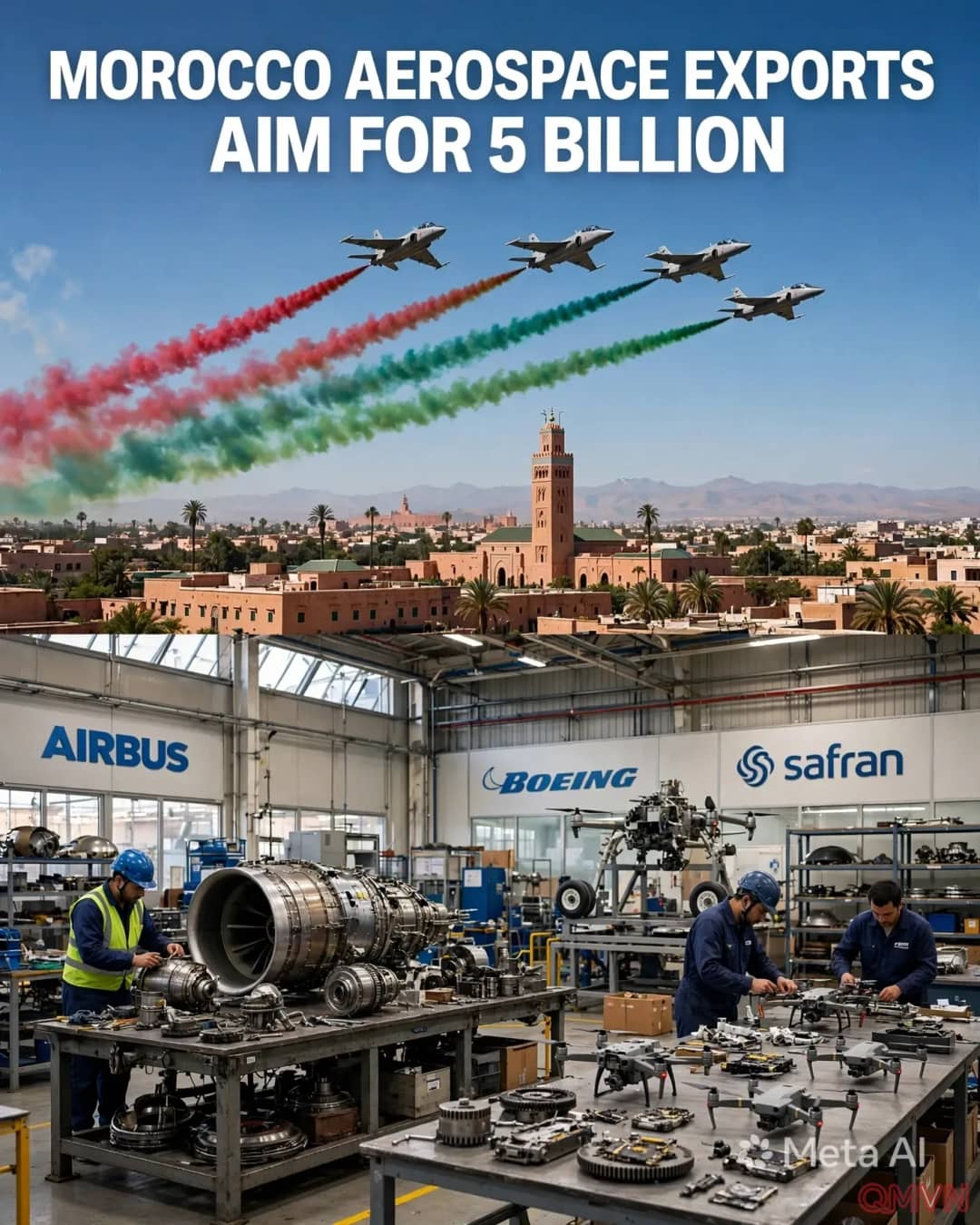
Targeting $5 Billion and Escalating Domestic Industrial Value
On the sidelines of the biennial Marrakech Airshow, running from October 7 to 10, 2026, Mohammed Bellatig, head of the Moroccan aerospace association GIMAS, outlined a transformative economic growth trajectory. Having generated an impressive $3 billion in annual export revenues last year, the sector is positioned to attain $5 billion within thirty-six months as multinational suppliers integrate complex fabrication lines across local manufacturing zones.
The primary strategic objective involves escalating domestic value-added processes by moving past baseline sub-assembly components toward integrated aerospace systems. Rather than supplying standalone airframe brackets or specialized wiring harnesses, Moroccan manufacturing clusters are actively preparing to assemble primary propulsion and landing mechanisms.
In the near future, Morocco will be assembling engines and landing gear so that we provide much bigger added value than we have today.
Illustrating this transition, French defense and aerospace conglomerate Safran is aggressively expanding its Moroccan presence, constructing dedicated production facilities to manufacture aircraft landing systems and engine assemblies for Airbus passenger aircraft.
Expanding Into Strategic Sovereign Drone Production
Beyond civil aviation infrastructure, Moroccan authorities are vigorously pursuing an established footprint within the autonomous unmanned aerial vehicle (UAV) market. Industry strategists view drone engineering as an organic, logical evolution of the advanced materials expertise, precision assembly protocols, and specialized metallurgy cultivated across Moroccan factories.
This defense initiative gained substantial traction at the Marrakech Airshow, where Morocco finalized a historic memorandum of understanding with French defense startup Harmattan AI. The collaborative agreement formalizes plans to develop and manufacture indigenous Moroccan autonomous drones engineered for deep-strike operational profiles at ranges of up to 2,000 kilometers, with critical proprietary subsystems developed locally.
Drone production can directly leverage expertise in composite materials, precision assembly, and advanced engineering already present in Morocco's aerospace sector.
This pact complements a series of operational licenses granted to foreign-backed UAV initiatives, notably featuring partnerships with Turkish defense giant Baykar, the manufacturer of the combat-proven Bayraktar TB2 system.
A Strategic Industrial Gateway Linking Africa to Global Supply Chains
Anchored by a dedicated workforce of 25,000 technicians and engineers across roughly 160 specialized enterprises, Morocco has firmly established itself as a premier competitive manufacturing nexus spanning the Mediterranean basin and North Africa. Its geographical proximity to mainland Europe and supportive trade policies make it a vital partner for Boeing and Airbus.
The convergence of commercial aviation manufacturing and strategic defense independence introduces a durable, high-margin growth cycle for the Moroccan economy. This dual focus enhances national security while facilitating technological transfer, elevating the nation's sovereign capabilities within the competitive global aerospace supply hierarchy.
Morocco demonstrates how developing economies can systematically transition up the industrial value chain into high-technology aerospace engineering through disciplined policy execution.
The ongoing evolution of Morocco's aerospace ecosystem represents a compelling blueprint for emerging markets seeking to anchor high-value global manufacturing.