Iowa absentee ballot sequence warns of early Democratic mirage before swift midnight resolution in Senate race
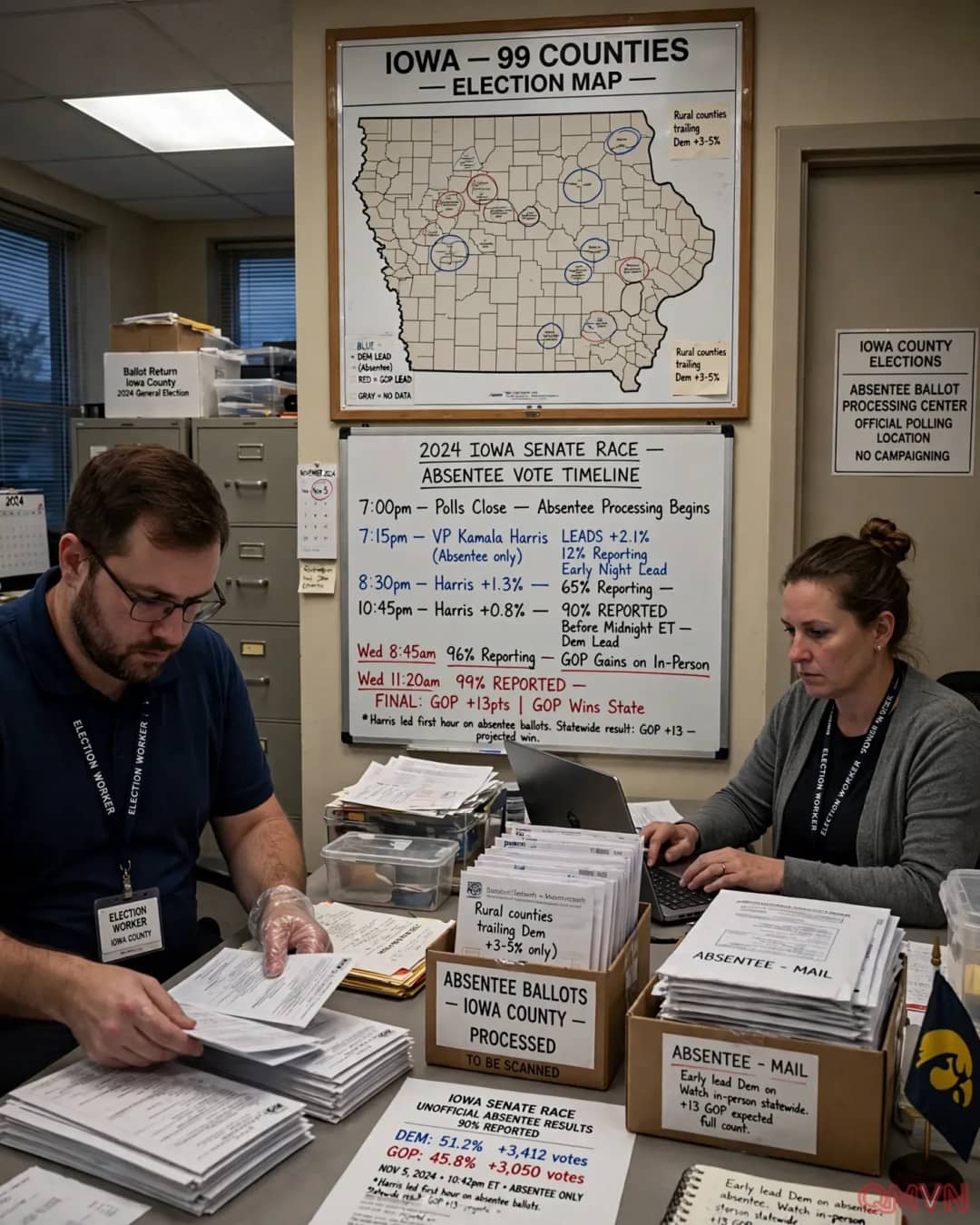
The pivotal battle for the open United States Senate seat in Iowa during the 2026 midterm elections presents a classic procedural dynamic that could produce an early optical distortion on election night. Most Iowa counties prioritize the initial tabulation and reporting of absentee ballots, which historically generates an artificial, short-lived lead for Democratic candidates during the first hours of network coverage. Precedent from the 2024 general election serves as a stark reminder: Vice President Kamala Harris maintained a continuous lead across Iowa for essentially the entire first hour of returns, yet ultimately lost the state by 13 percentage points once standard in-person precinct tallies were processed. Because Iowa operates one of the nation’s most efficient election administration systems—consistently reporting 90% of ballots before midnight Eastern Time—observers must resist premature conclusions during the initial counting window.
Edite QUANG MINH·2 min read · 3 min listen·3 November 2026, 05:15 EST·
AI-generated illustration
MAIN BODY
The early "blue mirage" and historical precedents of rapid reversal
The reporting architecture across Iowa’s 99 county auditor offices systematically prioritizes mail-in and in-person absentee ballots deposited prior to Election Day. Because Democratic voters utilize pre-election balloting channels at substantially higher rates, early statewide tabulations routinely project a deceptive progressive advantage immediately after polls close at 9:00 p.m. Eastern Time.
Advertisement300 × 250
*
"In 2024, Vice President Kamala Harris led in Iowa for essentially the whole first hour, even as she lost the state by 13 points." — Iowa State Board of Elections Historical Analysis
*
This transitory margin rapidly compresses as conservative rural precincts report standard Election Day ballots. The resulting statistical shift constitutes a predictable administrative phenomenon inherent to ballot batching rather than an organic swing in late voter sentiment.
Most Iowa county auditors upload processed absentee ballots as their initial public data release.
Democratic contenders routinely establish wide, temporary leads throughout the first 60 minutes of tabulation.
The 2024 presidential baseline demonstrates that early hourly margins can completely invert as precinct machines report.
Operational efficiency and decisive statistical clarity before midnight
In sharp contrast to battleground states hampered by protracted counting timelines or extended mail-in grace periods, Iowa’s election machinery delivers rapid, definitive results. Utilizing centralized high-speed scanners, local clerks process precinct returns with remarkable speed.
*"In 2024, 90% of the state’s votes were reported before midnight ET, with 99% reported by late morning Wednesday." — Office of the Iowa Secretary of State*
This operational velocity ensures that the razor-thin Senate contest between Democrat Josh Turek and Republican Ashley Hinson will achieve mathematical clarity within hours of poll closures. State totals will converge toward certified baselines well before the early hours of Wednesday.
Approximately 90% of all statewide ballots are projected to be counted and publicly certified before midnight ET.
Tabulation completion typically surpasses 99% by late morning Wednesday, eliminating protracted legal uncertainty.
Rapid tabulation protocols ensure Iowa’s Senate verdict will be rendered without multi-day procedural delays.
EVENT BACKGROUND
This tabulation dynamic unfolded within the 2026 United States midterm elections, centered on the fiercely contested open Senate seat vacated by retiring Republican Senator Joni Ernst. While Iowa shifted decisively into the conservative column over the preceding decade under Donald Trump’s political realignment, severe agricultural inflation, surging diesel costs, and trade disruptions tied to the Middle Eastern conflict compressed polling margins into a virtual dead heat between Josh Turek and Representative Ashley Hinson. Under Iowa election statutes, absentee ballots received prior to the close of polls are processed and uploaded immediately upon precinct closure, while ballots cast in person on Election Day require physical transportation and localized machine tabulation. The core crux of election night lies in this temporal reporting gap, where early progressive mail returns inevitably give way to high-volume conservative rural precinct tallies, creating a compressed, high-stakes reporting cycle that fully resolves before midnight.
KEY LESSONS LEARNED
Evaluating the sequence of ballot processing by method is critical to avoiding misinterpretations of early election night margins.
Administrative efficiency and rapid vote reporting are vital institutional safeguards against misinformation and public distrust.
Electoral certainty depends on comprehensive aggregation across all demographic and geographic voting channels.
Subscribe to the QMVN newsletter
A daily morning digest - only stories worth reading, no spam.