Ghanaian cocoa farmers pin hopes on March harvest recovery after weather disruptions cause poor seasonal start
Cocoa farmers across Ghana are pinning their hopes on a production rebound during the secondary harvest window in March 2027 following an acutely disappointing start to the agricultural season driven by extreme weather divergence, Reuters reported on Tuesday, November 3, 2026. A compounding combination of unseasonal downpours in certain growing belts and prolonged drought in others—exacerbated by a powerful El Niño cycle—has triggered severe floral abortion, preventing early pod development and depressing baseline yields well below historical levels. Compounding ecological distress, bureaucratic bottlenecks delayed critical subsidized fertilizer distributions by several months, compelling the national industry regulator, the Ghana Cocoa Board (COCOBOD), to project an aggregate production decline of at least 16 per cent for the world’s second-largest producer.
Edite QUANG MINH·2 min read · 3 min listen·3 November 2026, 09:27 EST·
AI-generated illustration
MAIN BODY
Severe early-season yield declines and cautious expectations for March recovery
Advertisement300 × 250
Field assessments across Ghana’s primary cocoa farming belts reveal substantial production deficits relative to historical norms. Farming communities have borne the brunt of irregular rainfall distributions that disrupted the delicate flowering phases of mature tree stocks.
*"It has now started raining, so we are looking forward to an improved harvest by March next year." — Joseph Agbeko, Commercial Cocoa Farmer in Ghana*
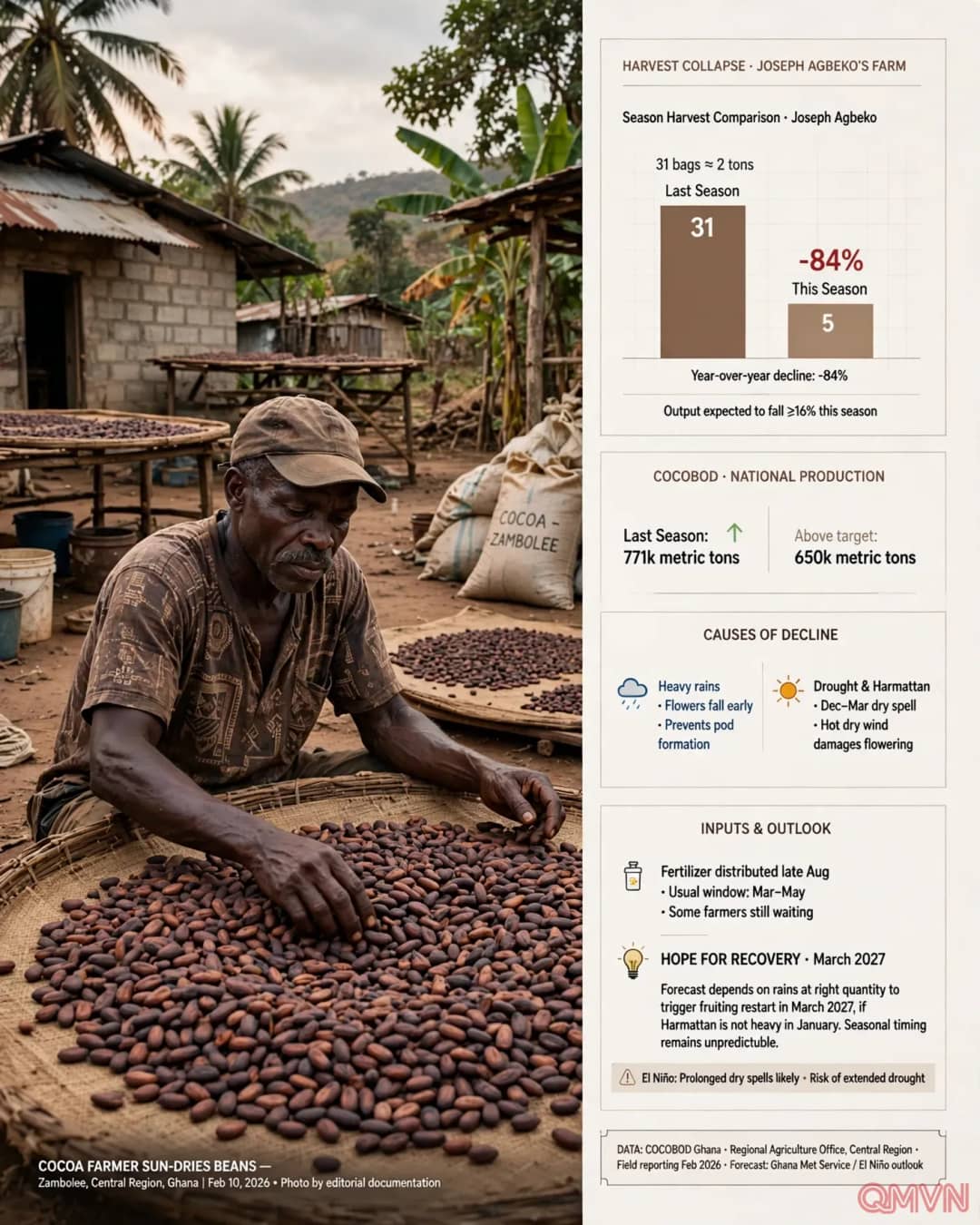
Individual grower accounts highlight the severity of the localized shortfall: producers such as Agbeko harvested merely five bags of beans during the initial phase, plummeting from 31 bags (approx. two metric tons) gathered last season. While recent precipitation has renewed hopes for late pod setting, cooperative representatives emphasize that output remains vulnerable to upcoming desert winds.
• Early season cocoa bean collections experienced steep declines, with individual yields collapsing by up to 80%.
• Growers anticipate that late rainfall patterns will stimulate a secondary fruiting cycle maturing in March 2027.
• Heavy rains knocked flowers off canopies in southern regions while unyielding dry spells withered blooms in eastern tracts.
El Niño climatological strains, Harmattan wind risks, and fertilizer delays
The Ghana Cooperative Cocoa Farmers and Marketing Association cautioned that declaring a seasonal recovery remains premature. The Ghana Meteorological Agency issued official bulletins confirming a severe El Niño profile, warning of extended dry spells capable of stunting crop maturation.
*"If the rains come in the right quantities, fruiting will start again; if the harmattan does not set in heavily in January, we could see some improved harvest from March, but this is not predictable." — Moses Djan Asiedu, Administrator of Ghana Cooperative Cocoa Farmers and Marketing Association*
Operational vulnerability has been magnified by state logistics failures: agricultural fertilizer, normally administered between March and May, was delayed until August, with numerous remote cooperatives still awaiting supplies. COCOBOD projects national output will fall at least 16 per cent below last season’s 771,000 metric ton benchmark.
• The Ghana Meteorological Agency confirmed powerful El Niño patterns causing protracted regional moisture deficits.
• The dry Harmattan wind sweeping from the Sahara between December and March poses acute risks to developing young pods.
• Subsidized fertilizer distributions suffered administrative delays of over three months, undermining canopy nutrition.
EVENT BACKGROUND
This agricultural and commodity development unfolded in early November 2026 across Ghana, which stands alongside Côte d’Ivoire as the backbone of global confectionery supply chains, producing approximately 15 to 20 per cent of the world’s raw cocoa beans. During the 2025–2026 season, Ghana exceeded national forecasts by harvesting 771,000 metric tons against an initial target of 650,000 tons. However, the subsequent season was upended by severe meteorological volatility linked to a resurgent El Niño event, alternating between torrential May–June downpours that washed away vital blossoms and severe dry spells that desiccated canopy health. The central structural crux lies in the precarious intersection between fragile biological crop cycles and state administrative capability: with the Sahara’s arid Harmattan winds looming in January, any failure of the delayed rains or continued distribution bottlenecks by COCOBOD will permanently eliminate the March mid-crop, cementing structural supply deficits across global chocolate manufacturing.