Wall Street investors brace for potential congressional realignment as midterm Election Day arrives
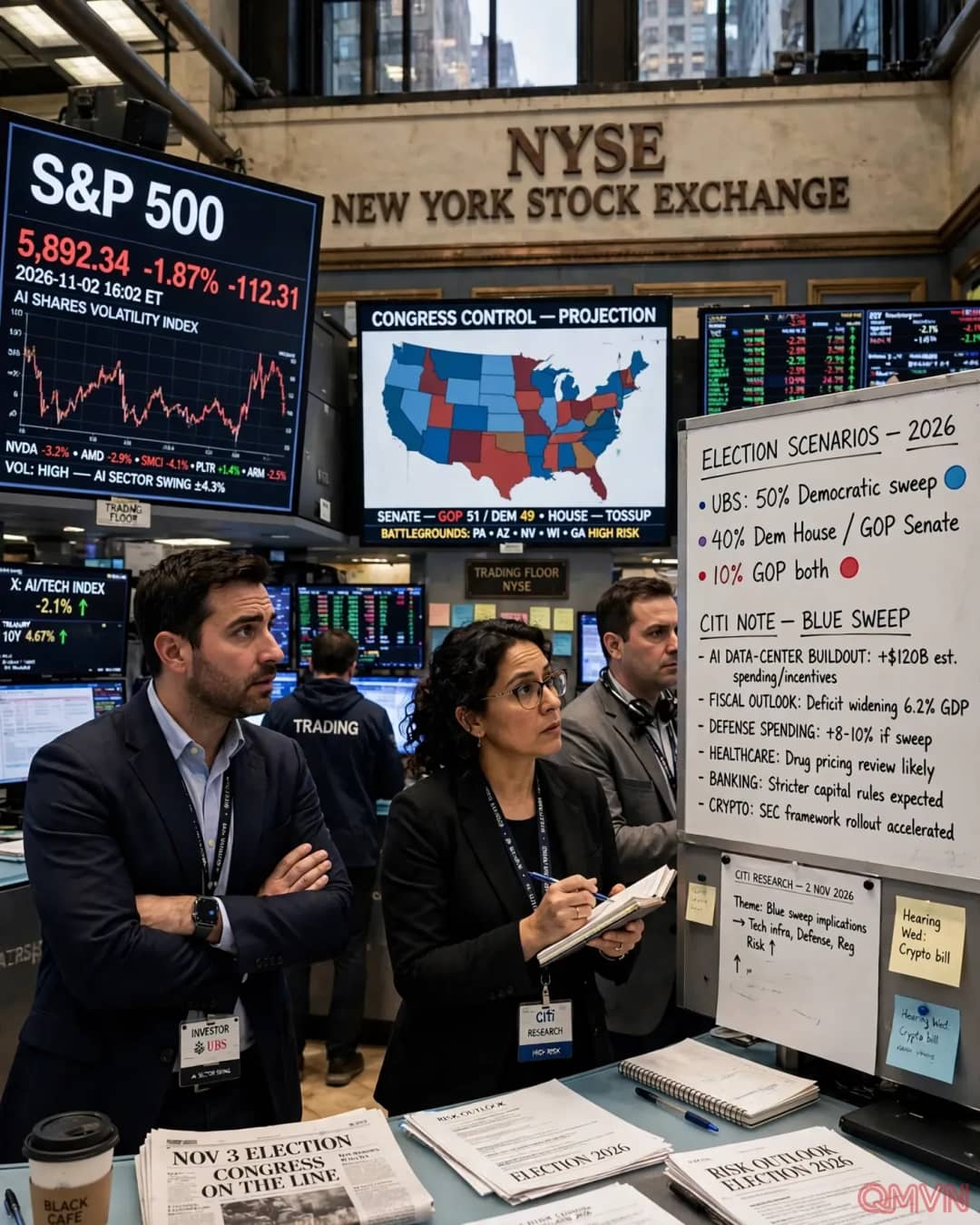
As voting booths opened across the United States on Tuesday for the pivotal 2026 midterm elections, institutional investors on Wall Street actively weighed the market ramifications of a potential transfer of power in Congress, focusing on whether a decisive Democratic resurgence could catalyze heightened volatility across asset classes—particularly the artificial intelligence trade that has served as the equity market’s primary engine. The balloting arrives during a precarious period for financial markets, following a recent pullback in tech shares triggered by mounting capital expenditure scrutiny that could be compounded by political shifts in Washington. With legislative outcomes poised to directly impact federal fiscal policy, AI data center development, defense procurement, and regulatory enforcement spanning healthcare, banking, and digital assets, major investment brokerages are positioning portfolios for competing governing scenarios.
Edite QUANG MINH·2 min read · 4 min listen·3 November 2026, 05:29 EST·
AI-generated illustration
MAIN BODY
Congressional power allocation scenarios and equity market valuation outlooks
Following two years of unified Republican legislative control during President Donald Trump’s second term, nonpartisan polling indicates Democrats are positioned to capture the House of Representatives, while the Senate balance remains deadlocked. Investment strategists emphasize that equity price reactions will hinge upon whether the upper chamber flips or remains split.
Advertisement300 × 250
*
"While probabilities increasingly favor a Blue sweep, several tightly contested Senate races leave open some possibility of Republican control of the Senate or, conversely, a greater than expected Democratic foothold in the Senate; equity market reaction is likely positive in the former case and negative in the latter." — Scott Chronert, US Equity Strategist at Citigroup
*
Macro strategists at UBS Global Wealth Management assigned a 50% probability to a full Democratic sweep across both chambers, a 40% probability to a divided government featuring a Democratic House and Republican Senate, and a 10% chance that Republicans retain unified legislative control. A Democratic-led Congress is widely expected to intensify regulatory oversight and complicate statutory debt negotiations.
UBS Global Wealth Management assigns a 50% probability to a full Democratic sweep of both congressional chambers.
A divided legislative structure with a Democratic House and Republican Senate carries a 40% likelihood.
The probability of Republicans maintaining unified control across both chambers is estimated at just 10%.
Antitrust scrutiny over AI infrastructure and measured derivatives volatility
The primary vulnerability facing market momentum centers on the massive artificial intelligence capital expenditure boom, which confronts mounting public and local regulatory friction over electrical grid and water consumption. Equity analysts anticipate that a full Democratic sweep would immediately precipitate legislative hearings and antitrust inquiries into big tech providers.
*"We could see some volatility come out once there is a clear result, but I wouldn’t assume all that uncertainty disappears Wednesday morning; election hedges can expire, but geopolitical risk doesn’t have an expiration date." — Joe Tigay, Portfolio Manager at Equity Armor Investments*
Despite these regulatory headwinds, options market data compiled by ORATS indicates derivatives traders are pricing in an S&P 500 move of approximately 0.8% in either direction on Wednesday, only marginally above the monthly average of 0.6%. Historical data from Edward Jones confirms that since 1970, the benchmark S&P 500 index has advanced across every six-month period following midterm elections.
A Democratic congressional majority is expected to mount regulatory inquiries into artificial intelligence data centers.
ORATS data shows S&P 500 index options pricing in a modest 0.8% implied post-election move on Wednesday.
Historical market data since 1970 demonstrates positive S&P 500 performance across all six-month post-midterm intervals.
EVENT BACKGROUND
This financial assessment transpired on Tuesday, November 3, 2026, as nationwide polling commenced for the United States midterm elections, serving as an unsparing referendum on the legislative agenda of President Donald Trump’s second administration. Unified Republican majorities in the House and Senate since January 2025 had enacted business-friendly deregulation and supported traditional energy outlays. However, persistent consumer price inflation, aggressive trade tariffs, and ongoing Middle Eastern military operations eroded congressional margins, thrusting competitive seats into razor-thin territory. The core crux of financial anxiety lies in the tension between market preferences for divided government—which traditionally prevents disruptive statutory overhauls and checks executive fiscal deficits—versus the acute risk that a unified Democratic majority could implement aggressive antitrust oversight, corporate tax hikes, and regulatory restrictions on the high-valuation AI infrastructure buildout underpinning modern market liquidity.
KEY LESSONS LEARNED
Electoral shifts directly reshape asset pricing baselines by altering federal tax, regulatory, and antitrust enforcement priorities.
Financial markets inherently favor procedural clarity and predictability over political rhetoric and prolonged electoral ambiguity.
Prudent investment management requires distinguishing between temporary election cycle hedging and persistent structural macroeconomic risks.
Subscribe to the QMVN newsletter
A daily morning digest - only stories worth reading, no spam.