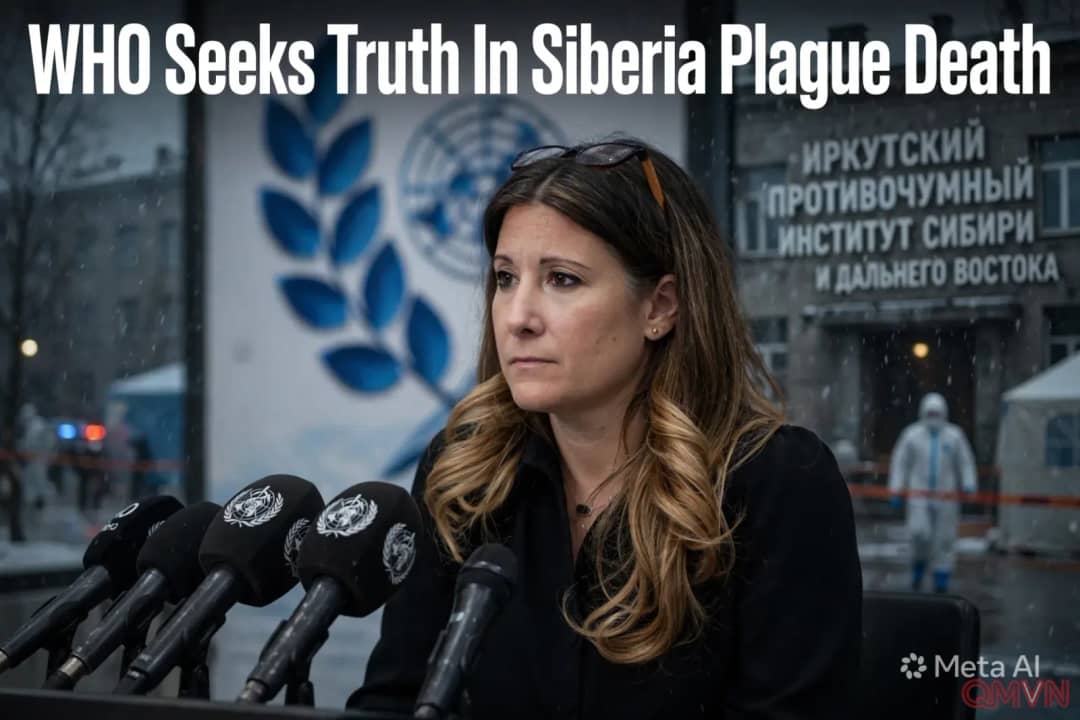
World Health Organization urges Russia for transparency as Siberian anti-plague institute researcher dies under mysterious circumstances
In Geneva, a senior World Health Organization (WHO) official stated on Wednesday that the United Nations health agency has been unable to ascertain how a laboratory researcher in Siberia died amid rising global concerns over pneumonic plague. Maria Van Kerkhove, WHO Director of Epidemic and Pandemic Management, confirmed that international health authorities do not know the 'causative agent' behind the October 2 fatality and urgently requested detailed epidemiological data from Moscow. While Russian public health watchdog Rospotrebnadzor asserted that the 28-year-old researcher died of conventional viral pneumonia and denied any presence of plague, strict hospital quarantines, aggressive chemical disinfections, and tight state media censorship have triggered international alarm over biosecurity and transparency.
Edite QUANG MINH·2 min read · 3 min listen·7 October 2026, 12:40 EDT·
AI-generated illustration
World Health Organization Demands Pathogen Clarification from Moscow
A top official with the World Health Organization confirmed on Wednesday that the global health agency remains uncertain regarding the precise cause of death of a laboratory specialist in southeastern Siberia, prompting an urgent international demand for Russian authorities to supply comprehensive diagnostic data.
Maria Van Kerkhove, WHO Director of Epidemic and Pandemic Management, emphasized that the agency cannot identify the 'causative agent' responsible for the October 2 fatality.
Advertisement300 × 250
Russian public health authority Rospotrebnadzor maintained in tersely worded statements that extensive screening detected no pathogen linked to the Irkutsk Anti-Plague Research Institute of Siberia and the Far East, diagnosing the case merely as pneumonia of unknown etiology.
We don’t understand how she was infected, and we don't know the causative agent. This is why we need more information.
The remarks underline that the UN health agency possesses far more questions than answers concerning the century-old specialized facility, which is dedicated to monitoring endemic plague reservoirs across the region.
Hospital Quarantines, Official Secrecy, and International Repercussions
Following the suspicious death, Russian state authorities imposed strict information blackouts, leaving the incident surrounded by secrecy. National state-controlled broadcasts completely avoided the subject, while certain regional outlets withdrew earlier investigative bulletins.
Key public health developments and geopolitical dimensions surrounding the case include:
The deceased researcher was identified as 28-year-old Darya Shipilova, a dedicated scientist who fell ill with respiratory symptoms on September 29 and succumbed three days later in Shelekhov.
The municipal hospital where she died was placed under strict quarantine, barring patient admissions and discharges while disinfection teams repeatedly cleaned her apartment.
Irkutsk Regional Governor Igor Kobzev publicly acknowledged that the researcher died from a 'particularly dangerous infection,' keeping all direct contacts under strict medical surveillance.
US President Donald Trump stated he planned to discuss the suspected plague case directly with Russian President Vladimir Putin, noting deep US intelligence engagement.
Medical epidemiologists emphasize that pneumonic plague caused by Yersinia pestis is a virulent pulmonary infection capable of rapid human-to-human transmission with an incubation period as short as 24 hours.
What we are watching is less a failure to respond than a failure of candor.
Public health scholars warn that institutional secrecy and the criminalization of unapproved health reports erode domestic and international credibility, jeopardizing collective defense against potential high-consequence biological hazards.
BACKGROUND
This development stems from the sudden death on October 2, 2026, of 28-year-old Darya Shipilova, a laboratory researcher at the Irkutsk Anti-Plague Research Institute of Siberia and the Far East—a specialized scientific establishment founded a century ago to study endemic bacterial reservoirs across southeastern Siberia. Pneumonic plague, caused by the bacterium Yersinia pestis, represents the most lethal manifestation of plague; unlike flea-borne bubonic plague, it infects the lungs directly and transmits rapidly between humans via respiratory droplets, carrying near-total mortality if untreated with antibiotics within 24 hours. The central structural bottleneck generating international friction is the acute disparity between official narratives and operational containment: while regional authorities enforced high-level biohazard protocols, closed hospital facilities, and monitored dozens of quarantined contacts, federal agency Rospotrebnadzor officially denied any plague involvement, framing the death as ordinary viral pneumonia. This opacity, coupled with state media suppression and historical Soviet-era secrecy surrounding pathogen outbreaks, rapidly elevated the incident into an international biosecurity concern requiring high-level diplomatic and WHO intervention.
Key takeaways
Complete institutional transparency is an essential prerequisite for global biosecurity and effective containment of high-consequence pathogens.
Specialized microbiological research facilities handling dangerous biological agents require uncompromised safety redundancies and open incident reporting mechanisms.
Ancient bacterial pathogens such as Yersinia pestis remain active in wildlife reservoirs, demanding sustained clinical vigilance and rapid diagnostic capabilities worldwide.
Subscribe to the QMVN newsletter
A daily morning digest - only stories worth reading, no spam.