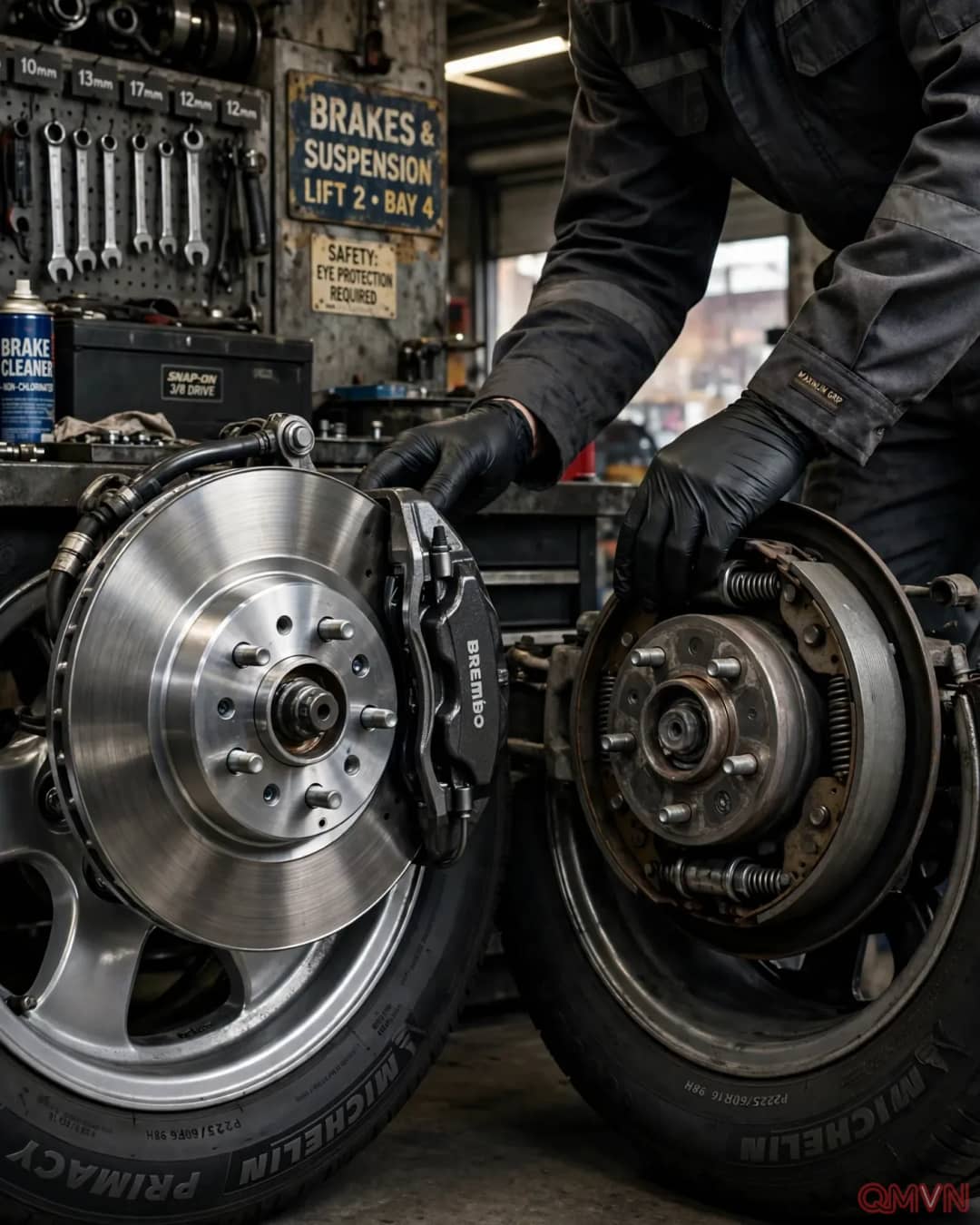
The Honda City controversy
The dissatisfaction of some Malaysian customers stemmed from the gap between advertised information and reality: the catalogue listed disc brakes on all four wheels, but the delivered cars had drum brakes at the rear. Under public pressure, Honda said the braking system was up to the task and fully complied with safety and quality standards. Even so, the episode shows that transparency in product information matters as much as technical quality.
Two technologies, one task
A disc brake consists of a flat metal plate with a clamp-like device wrapped around part of its edge, while a drum brake looks like a metal bowl from the outside. Although they differ in design, their basic task is the same: to reduce the vehicle’s motion. The core principles are:
- When the brakes are applied, the car’s kinetic energy is converted into heat energy.
- The higher the speed, the greater the kinetic energy, so speed is the most decisive factor in braking demand.
- The mass of the vehicle is a second, less crucial factor.
The difference between the two types lies in braking effectiveness, not only the ability to slow down but also how well that ability holds up under heavy use.