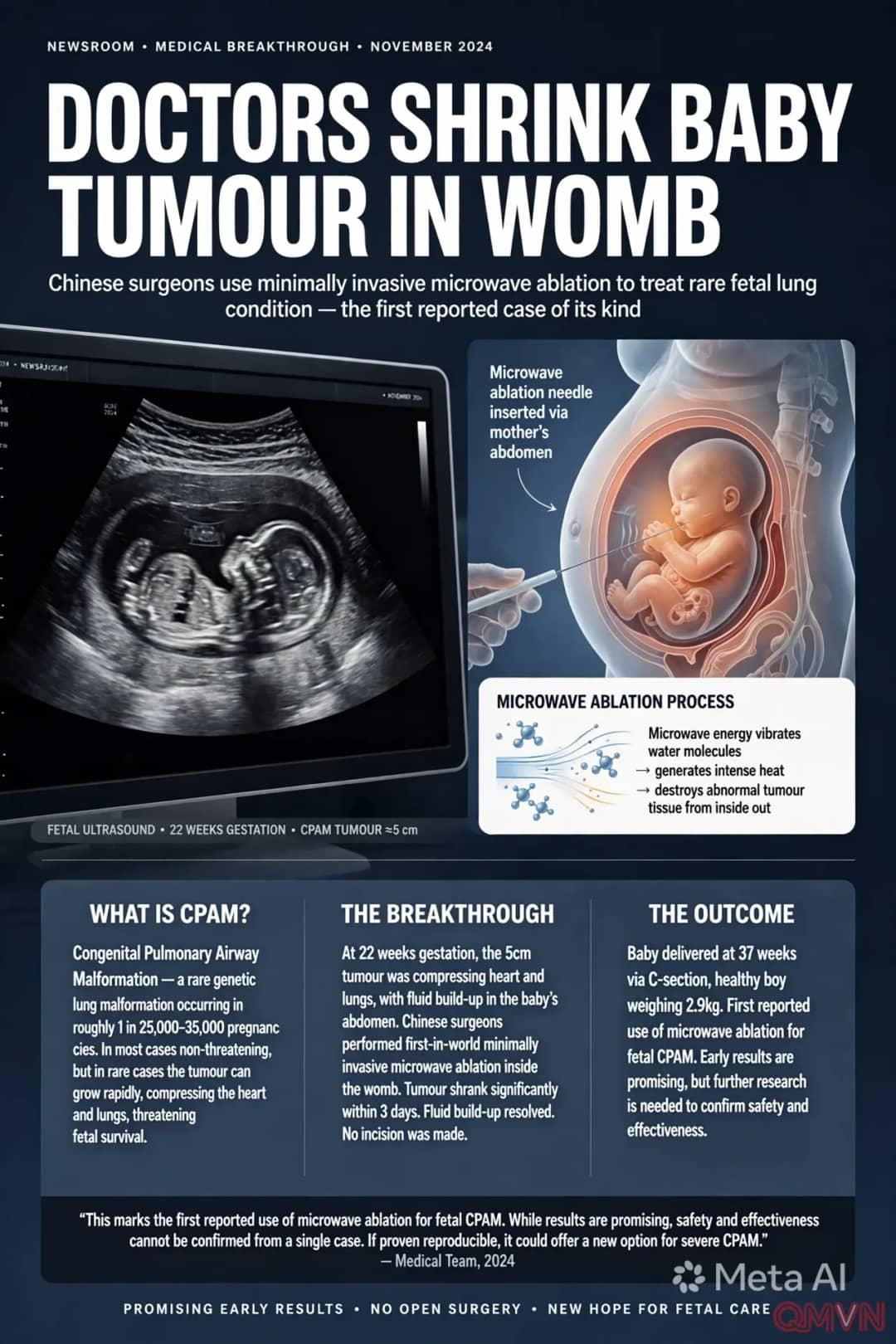
An intervention without an incision
According to The Independent, citing a report in the journal Ultrasound in Obstetrics & Gynecology, Chinese doctors used a minimally invasive technique to shrink a large chest mass in a foetus still in the womb of a 40-year-old mother.
They inserted a small needle through the mother’s abdomen into the foetal lung mass and delivered microwave energy through it. The energy vibrates water molecules, creating intense heat that destroys the abnormal tissue from the inside out.
Encouraging results
The case showed positive results:
- At 22 weeks, the mass had grown to about 5cm, enough to compress the heart and lungs, with a dangerous build-up of fluid in the baby’s abdomen.
- Within three days of the procedure, the mass shrank significantly and the abdominal fluid was completely gone.
- The baby was delivered by caesarean section at 37 weeks, weighing about 2.9kg.
A new milestone.
What is CPAM?
CPAM is a congenital lung malformation that, according to the doctors, occurs in roughly 1 in 25,000 to 35,000 pregnancies. Most cases are not life-threatening, but a small minority can grow very large very quickly, severely compressing the heart and lungs and potentially causing foetal death.
There is no standard treatment for every case. Doctors may give the mother steroids, place drainage tubes in large fluid-filled cysts, often linked to preterm birth, or perform open foetal surgery to remove the mass, a major operation after which about 50% of babies survive according to one study.
Caution over a single case
Although this is the first reported use of microwave ablation for foetal CPAM, the doctors stressed that its safety and effectiveness cannot be conclusively established from a single case.
If further studies show it is safe, reproducible and effective, they said, the technique could become another option for severe CPAM cases.
New hope for foetal medicine
Minimally invasive techniques such as microwave ablation may reduce risks for both mother and foetus compared with open uterine surgery, a major operation with many potential complications.
The successful procedure offers hope to families facing a diagnosis of severe CPAM and shows the growing role of foetal medicine in treating conditions before birth.