MAIN ARTICLE
Political clocks are running at different speeds
US Vice President JD Vance has said his country will not turn the campaign into another endless war, or even a two-year undertaking. He provided no specific date, however, and was describing American participation rather than the entire regional conflict. President Donald Trump has suggested that the fighting could end fairly soon while also saying that Washington no longer necessarily needs an agreement with Tehran. Those messages leave space for withdrawal, escalation or intermittent confrontation.
On November 18, Iran said it had fired on American military-related sites in Kuwait after Washington struck Qeshm Island. Bahrain said it intercepted attacks from Iran for a third time in a week. Reuters, AP and other outlets described renewed exchanges even as diplomacy continued. Each reported strike and claim of responsibility must be attributed carefully: battlefield assertions do not automatically establish the full circumstances or consequences of an incident.
Two straits and one interconnected security crisis
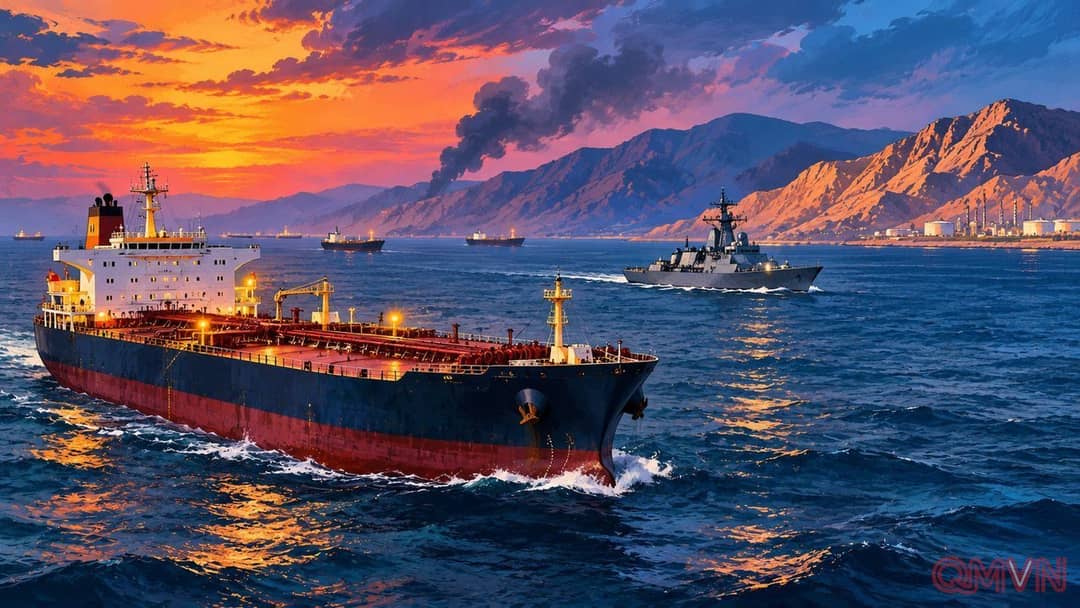
The Strait of Hormuz is a crucial outlet for Gulf oil and liquefied natural gas. Bab el-Mandeb, at the entrance to the Red Sea, connects shipping to the Suez Canal and European markets. Threats at both passages force shipowners to weigh detours, delays, crew safety and more expensive protection. The geography turns several overlapping conflicts into a common problem for global trade.
According to Reuters, Saudi officials are considering the possibility that their confrontation with Yemen's Houthi movement could persist for months, potentially into next year. The Houthis' recent territorial advances and pressure around Aden complicate Riyadh's calculations. AP has also reported renewed civilian suffering in Yemen. The strategic importance of a sea lane cannot be separated from the communities whose daily lives are affected by the fighting along its shores.
Insurance prices and refinery repairs tell another story
War-risk insurance offers a less rhetorical measure of concern. Reuters reported that a quotation for a Saudi-linked tanker loading at Yanbu had climbed to around 3% of a vessel's value, compared with less than 1% earlier in the year; some higher-risk routes carried still steeper quotations.
These were situational estimates, not a universal tariff. Even so, the increase illustrates how traders price the chance of a further attack long after political leaders start discussing an exit.
Bahrain offers a more hopeful but incomplete sign. Bapco Energies chief executive Mark Thomas said the country's refinery was operating above 80% of capacity and could return to full output by year-end, following six direct wartime strikes. Bringing a plant back online matters for regional fuel supplies. Yet physical recovery and maritime security proceed on different schedules: a repaired processing unit does not itself ensure safe shipping or a lasting ceasefire.
From Iraq to Qatar, the shock waves travel
In Iraq, Prime Minister Ali al-Zaidi's government has moved against an alleged oil-smuggling network that officials cited by Reuters associate with Kataib Hezbollah. The group denies the allegations. The dispute demonstrates that regional fighting is also entangled with state revenue, militia influence and control of strategically important territory, rather than only conventional battles between national armed forces.
QatarEnergy, meanwhile, has been seeking longer-term LNG supplies from abroad, including the United States. Chief executive Saad al-Kaabi calls the strategy a form of insurance against further disruption at Hormuz. Analysts warn that alternative supply contracts can create substantial fixed obligations and concentrated risks of their own. The approach reveals a broader shift in thinking: energy companies are designing portfolios for another interruption, not assuming the present crisis has passed.
Why a pause is not the same as peace
Prediction-market contracts may capture short-term sentiment, but cannot supply a peace calendar. A bet that the United States will refrain from striking Iran for a fortnight could pay out even if fighting continued in Yemen or elsewhere. More meaningful indicators would include a verifiable cessation of attacks, safe commercial navigation, restrained allied armed groups and security talks that produce enforceable commitments.
The end date therefore depends on which clock is being watched. Washington counts the cost of military involvement; Riyadh measures the threat to its territory; shipowners calculate premiums; civilians wait for attacks to stop. The conflict will truly seem closer to ending only when those clocks begin to move together.