A building returns home
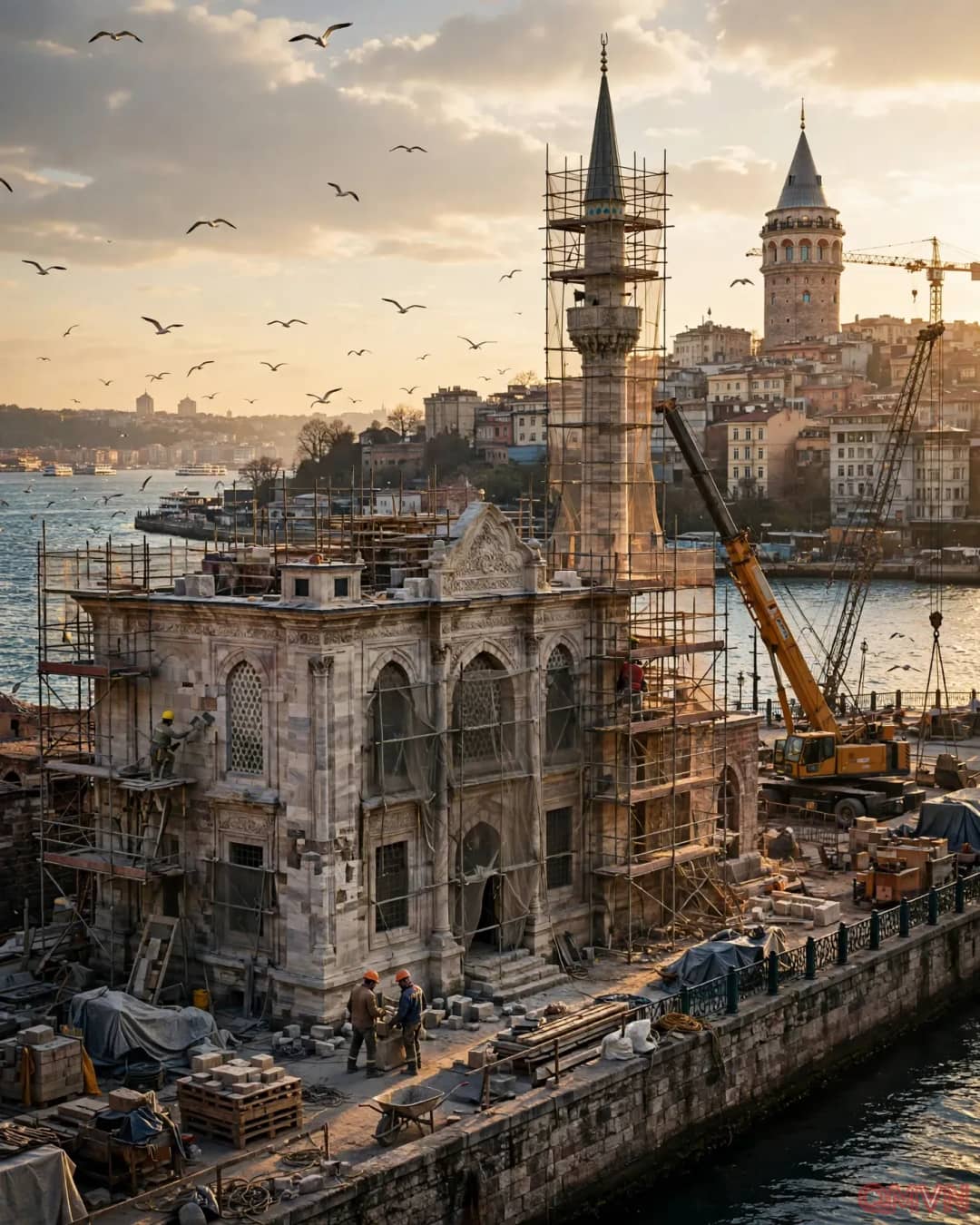
According to the General Directorate of Foundations, the body that manages Türkiye’s religious buildings and historic heritage, a decision to restore the mosque through restitution and reconstruction was taken in 2010. Architectural plans were then prepared, and construction has now officially begun.
The aim of the project is not simply to put up a building, but to recreate, on the very same spot, a space as close as possible to the original design, giving Karaköy back a piece of memory that has been missing for generations.
Four layers of history on one plot of land
Few sites in Istanbul reflect the layering of history as clearly as this one. According to historical records, the plot has changed hands many times:
- In the Byzantine era, a small church stood here.
- After the Ottoman conquest of Constantinople in 1453, it was converted into a mosque and later into a Sufi lodge.
- In 1670, Grand Vizier Merzifonlu Kara Mustafa Pasha had the lodge demolished to build an elevated-style mosque.
- The mosque was destroyed in an 1894 earthquake and replaced in 1903 by a building designed by D’Aronco.
The mark of an Italian architect
Raimondo D’Aronco served as chief palace architect during the reign of Sultan Abdulhamid II. The building he designed in Karaköy stood out for its elevated architecture, its minaret and its richly decorated interior.
The carpet woven especially in Hereke, the chandeliers made of Murano glass from Venice, the minbar used for Friday sermons and the mihrab indicating the direction of Mecca were all uniquely designed.
The missing pieces
During the 1957 redevelopment campaign, the mosque was dismantled piece by piece, with plans to reassemble it on Kınalıada in the Princes’ Islands. However, according to accounts of the demolition, some components fell into the sea while being transferred between vessels, while others were reportedly taken to different mosques. The original minbar, mihrab and chandeliers were never recovered.
The new building will therefore be a recreation based on records and drawings rather than a reassembly of what was lost. Even so, its return carries meaning as a reminder that a city’s memory can be mended.