Thermal Transformation and the Depletion of Cryospheric Storage
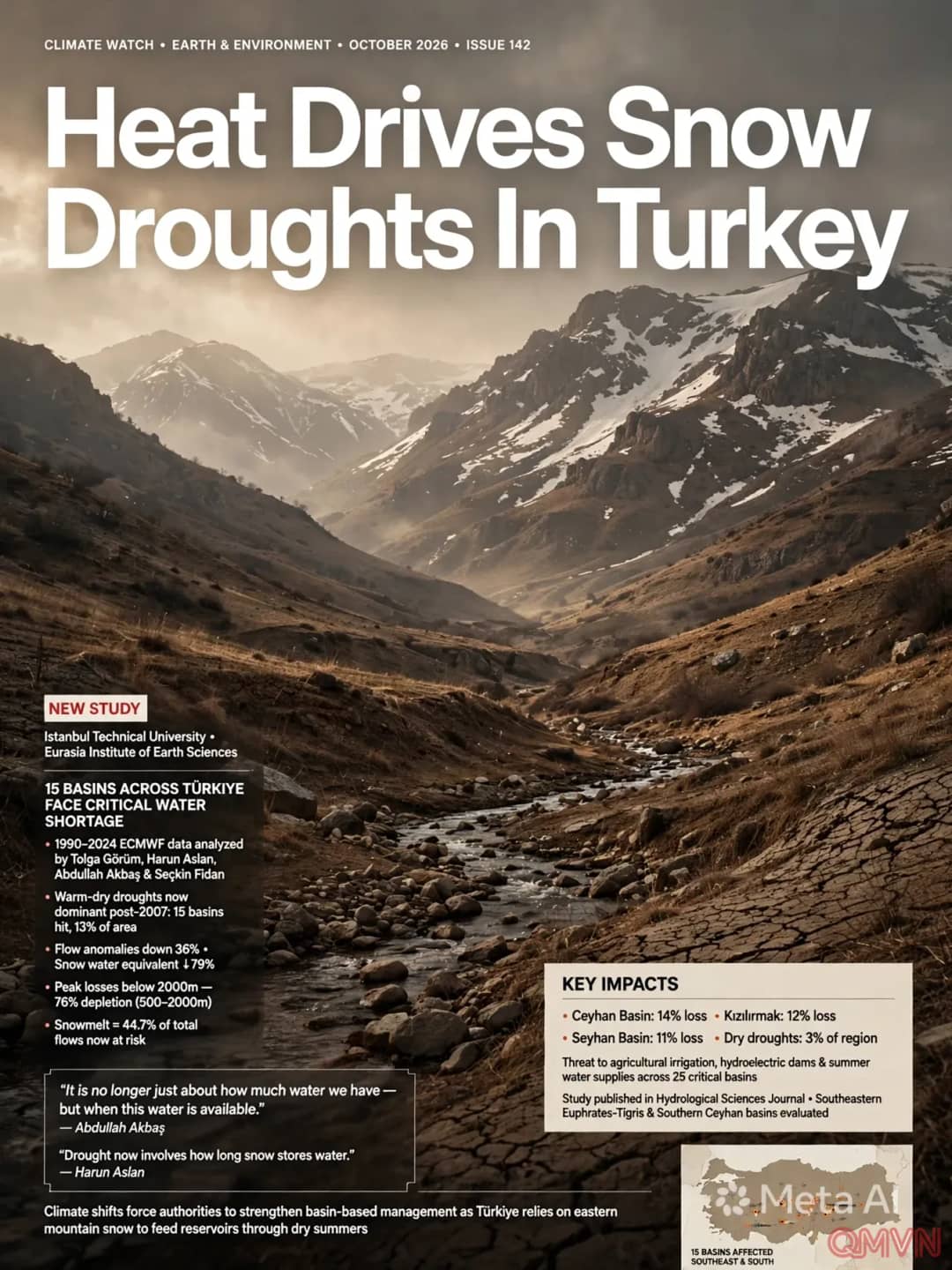
Led by Harun Aslan alongside Istanbul Technical University Eurasia Institute of Earth Sciences Director Tolga Görüm, Abdullah Akbaş, and Ankara University’s Seçkin Fidan, the investigative team evaluated multi-decadal climatic data between 1990 and 2024. Their findings establish that a structural post-2007 regime shift fundamentally transformed hydrological mechanics, elevating extreme heat into the dominant driver of snowpack depletion.
The cryospheric degradation is acutely concentrated below 2,000 meters in elevation — the critical altitudinal zone where 70 percent of Türkiye's natural snowpack is seasonally preserved. Between 500 and 2,000 meters, snow water equivalent depletion reached a catastrophic 76 percent:
It is no longer just about how much water we have, but when this water is available.
Basin-Level Vulnerability and Severe Runoff Degradation
The scientific investigation classified emerging arid phenomena into three distinct regimes: dry, warm, and compound warm-dry droughts. Among these, warm-dry conditions registered as the most damaging, hitting 15 major basins, encompassing 13 percent of national geographic surface area, and slashing historical runoff anomalies by 36 percent.