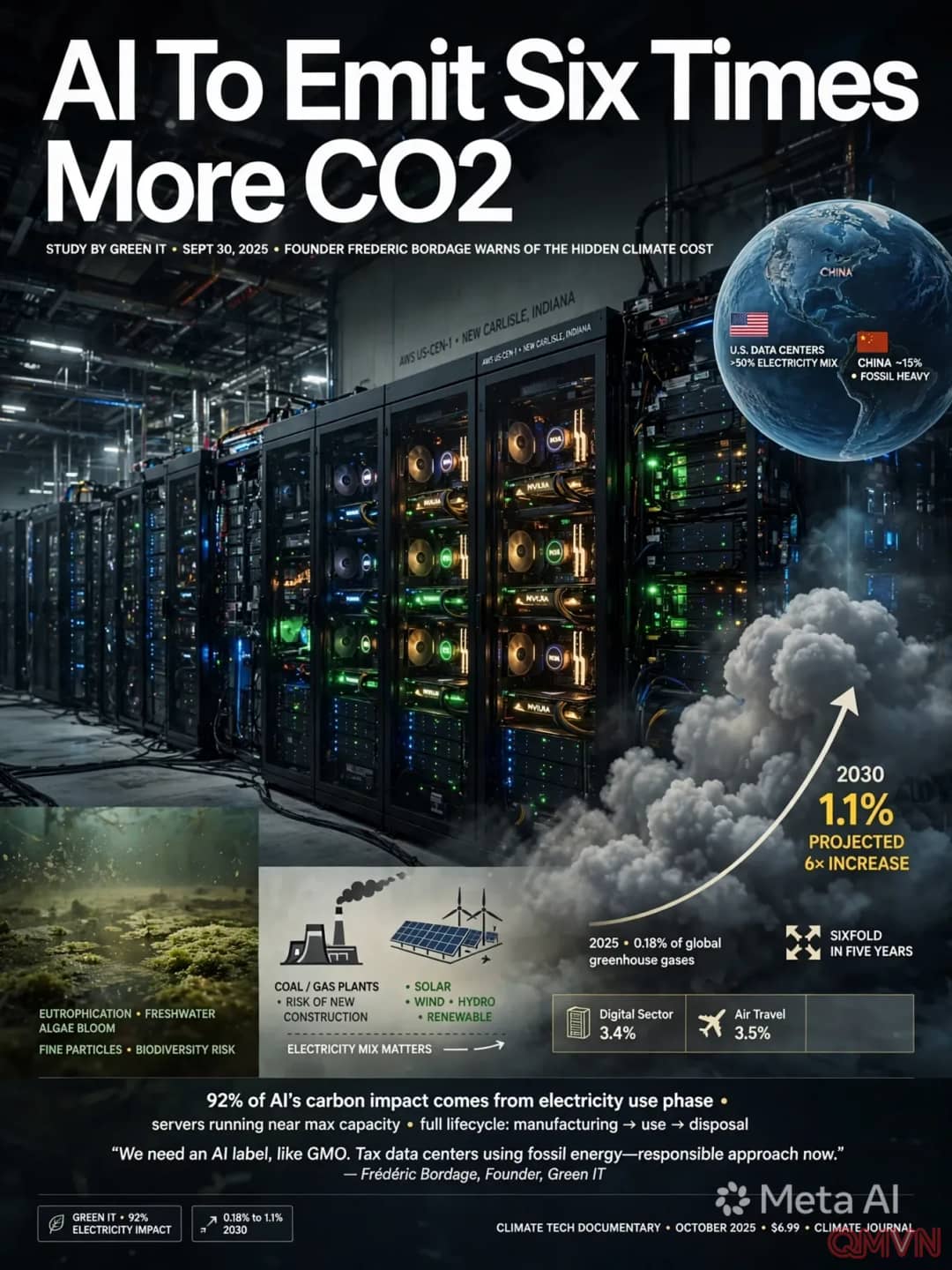
A small figure on a worrying trajectory
In 2025, AI accounted for 0.18% of global greenhouse gases from human activity, according to the study by Green IT, a French collective of experts that assesses technology's environmental impact. That remains low compared with 3.4% for the digital sector as a whole and 3.5% for air travel.
But the trend is clearly upward: by 2030, AI's share could reach 1.1%. The experts caution that this figure should be viewed carefully because it relies on inherently uncertain market forecasts. AI is evolving so fast that its technology, regulation or patterns of use could change significantly, especially if "swarms" of AI agents become widespread.
How the assessment was made
While the 2030 forecast involves many unknowns, the 2025 estimates rest on a solid basis. The experts modelled the impact of servers in AI data centres as follows:
- Servers were classified into three categories: entry-level, mid-range and high-end.
- The modelling relied on the technical specifications of each component, from communication systems, memory chips and processors to graphics processing units, often made by Nvidia.
- The entire server lifecycle was assessed: design, manufacturing, use and end of life.