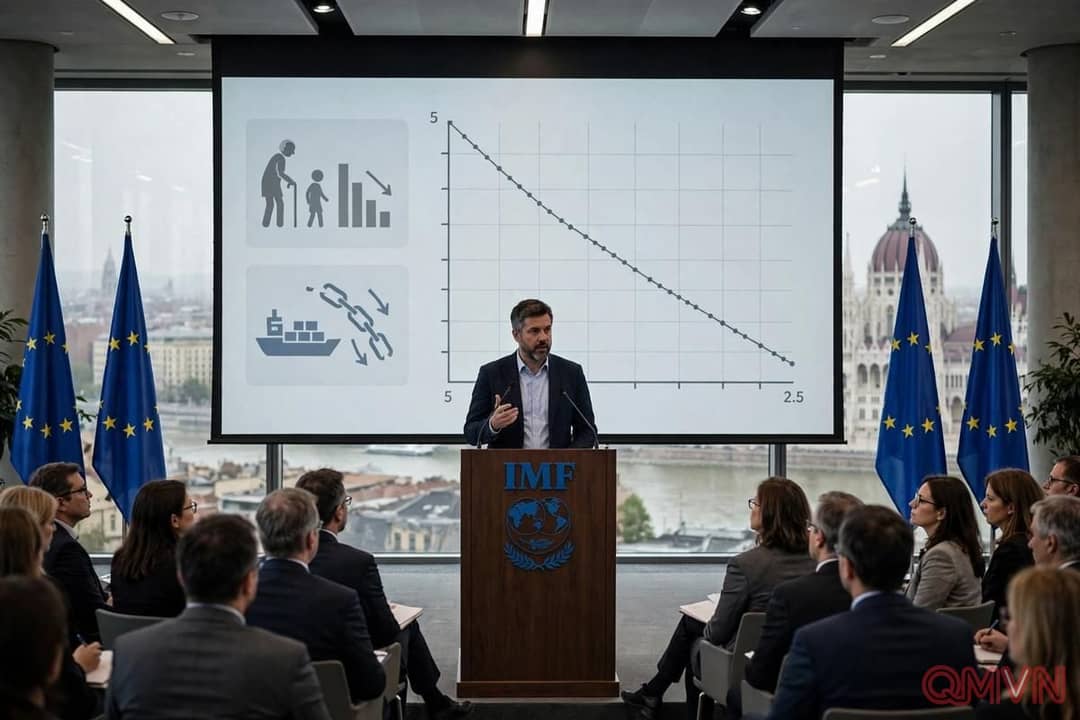
Half the speed of two decades ago
The central figure in the speech is a comparison between two periods. Before joining the European Union, the countries of central and eastern Europe grew at around 5 percent. The medium-term outlook is now 2.5 percent, which is half. That does not only mean a slower economy; it means the time needed to close the gap with western Europe is considerably longer.
This is a change in the nature of the story. For two decades, the region’s development model rested on a simple promise: keep up this pace and one generation will live at western European standards. When the pace halves, that promise has to be rewritten.
"The growth outlook is less favourable. The time it takes to close the convergence gap to western Europe is much longer." — Carlos Mulas-Granados
Two pressures from two directions
The first pressure comes from the west. Germany is central Europe’s main trading partner, and when German export prospects weaken, the factories sitting inside German industry’s supply chains in Poland, the Czech Republic, Slovakia and Hungary feel it immediately.