MAIN CONTENT
From a tiny niche to a half-million-vehicle fleet
Türkiye counted only 565 registered electric cars in 2015. The fleet grew to 183,776 in 2024, reached 370,591 in 2025 and crossed the half-million mark in October 2026. That trajectory describes a sustained change in the market rather than a brief sales fashion. Compared with October 2025, the registered stock increased by nearly 169,000 vehicles, illustrating how quickly alternatives to combustion engines are entering everyday traffic.
Fleet share is not the same as the share of newly registered vehicles. The 501,005 electric cars represented 2.75% of the country's 18,191,090 registered passenger cars. TÜİK separately reported that electric models accounted for 19.1% of passenger cars registered during the first ten months of 2026. The two measures can both be correct: one reflects decades of accumulated ownership, while the other is a flow of recent registrations. Confusing them can distort expectations about how quickly the roads themselves will change.
Hybrids offer a bridge as battery-electric cars accelerate
Hybrid registrations climbed from 391,296 in 2024 to 697,027 in 2025 and 938,008 by October 2026. Hybrids now make up 5.16% of registered passenger cars, a larger portion than fully electric models.
Their appeal is understandable: drivers can reduce fuel use in some settings without depending entirely on a charging network, an advantage for households worried about long trips or access to plugs.
The comparison is more nuanced than a contest between two winners. Hybrids still burn fossil fuel, even if their efficiency can be better under particular driving conditions. Battery-electric cars produce no tailpipe emissions, but their environmental footprint also depends on electricity generation, manufacturing and battery life cycles. In practice, ownership costs, daily distance, charging access and the vehicle's actual use matter more than the technology label alone.
Togg and chargers reshape the buying decision
Togg has given electric mobility a domestic industrial identity, while an increasing number of international models broaden choice and intensify competition over price, range and features. Anadolu Agency has reported on plans for further models and battery-related cooperation. Such announcements offer a picture of future ambition, not a guarantee of adoption: manufacturing quality, service networks and price points will decide whether buyers outside the early-adopter market follow.
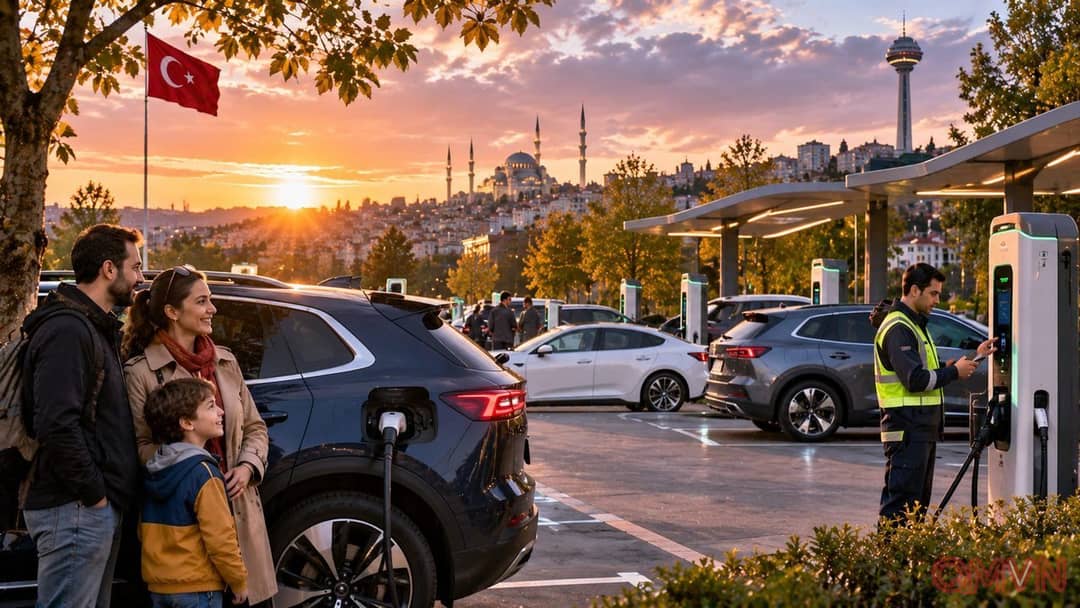
Charging is the other essential piece. A growing network of public plugs can lessen range anxiety, but a charger's presence on a map does not guarantee a smooth stop. Drivers also need dependable equipment, sufficient power, transparent payments and useful geographic coverage. Families with private parking in large cities may find the transition easier than people in rural districts or apartment buildings without dedicated charging. Making infrastructure genuinely inclusive is the next measure of progress.
Industrial opportunity meets the policy test
The expansion opens opportunities across Türkiye's automotive supply chain, from vehicles and components to software, power systems and battery services. A larger home market can support investment and specialist skills. Yet manufacturers also face volatile input costs, global competition and evolving trade requirements, particularly because Türkiye's automotive factories are deeply tied to European production and export networks.
For policymakers, half a million cars should be treated as a checkpoint rather than a finish line. Purchase affordability, finance, electrical grid readiness, battery safety and recycling capacity all deserve attention. Policies that concentrate only on purchase incentives risk overlooking the daily experience of ownership. A durable transition requires vehicles that people can afford to buy, charge, maintain and eventually resell without placing disproportionate burdens on less-connected communities.