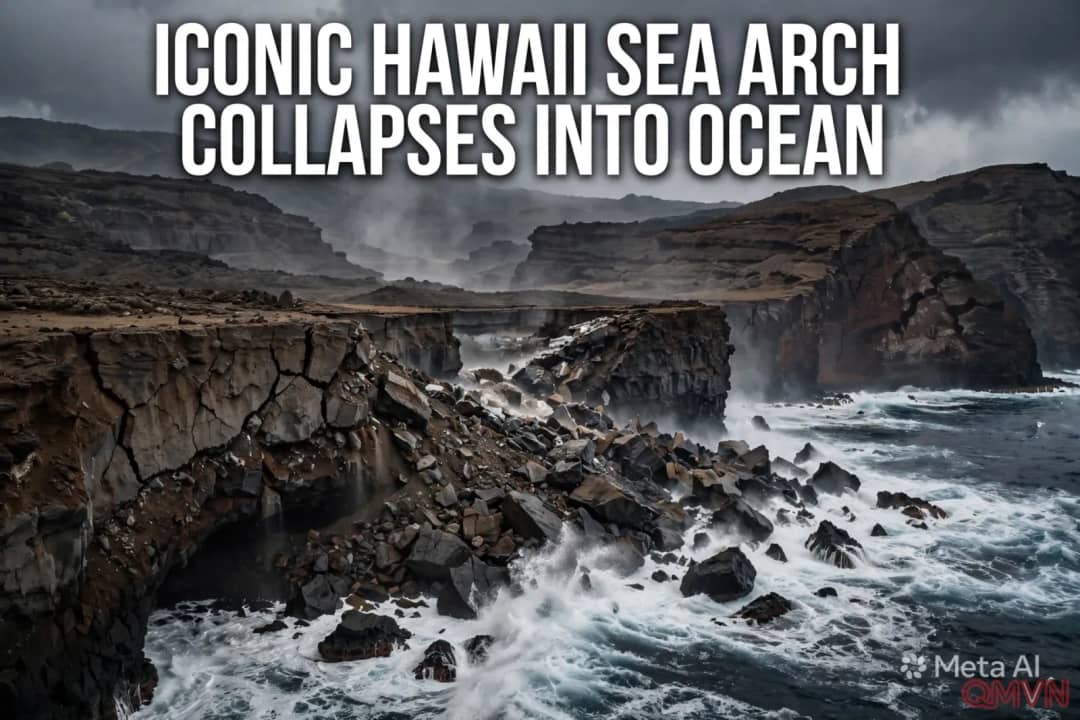
Hawaii's famed Hōlei Sea Arch collapses into the Pacific as park officials warn visitors to stay away from dangerously unstable cliffs
In the United States, one of Hawaii's most photographed natural landmarks has disappeared. The US National Park Service says the Hōlei Sea Arch, a roughly 90-foot (27-metre) lava rock arch on the wave-battered southern coast of the Big Island, collapsed into the Pacific Ocean between September 23 and 27, possibly while Hawaii Volcanoes National Park was temporarily closed for Tropical Storm Nolo. The arch, formed about 550 years ago and named after a small native plant, had long been expected to fall, as relentless waves wore away its base. Park officials called the collapse the latest transformation of the park's remote and rugged coastline and bid it farewell on social media with a simple "RIP." But they also issued a stern warning: photos online show people entering the closed area near the former arch, putting themselves and rescuers at risk of falling from vertical cliffs into rough seas. The loss is a reminder that even landscapes that seem permanent are constantly being reshaped by fire, water and time.
Tiếng Nói QUANG MINH·2 min read · 4 min listen·3 October 2026, 12:21 EDT·
AI-generated illustration
Farewell to a landmark
According to the National Park Service, the Hōlei Sea Arch was still standing on September 23 but had collapsed by the night of Sunday, September 27. The exact time is unknown and may have coincided with the temporary closure of Hawaii Volcanoes National Park during Tropical Storm Nolo.
Yes, it's true. RIP Hōlei Sea Arch.
Officials said the collapse, while anticipated, marks the latest transformation of the park's remote coastline.
Advertisement
300 × 250
Many members of the public responding online described it simply as nature taking its course, while others mourned the loss of a place that held special meaning for countless visitors.
A stern warning to visitors
The park service urged people to keep their distance from the site, citing a serious risk of falls.
Photos on social media show people entering the closed area near where the sea arch once stood, putting themselves and first responders at great risk of falling and drowning off the rough, wave-swept coast.
The coastal cliffs drop vertically into the ocean and remain unstable after the collapse.
Waves along this stretch of coast are powerful and unpredictable.
Anyone entering closed areas endangers not only themselves but also the rescuers who may have to reach them.
Officials stressed that respecting closures is essential to keeping both visitors and park staff safe.
Five and a half centuries in the making
The Hōlei Sea Arch was formed around 550 years ago from lava that cooled into rock along the coast. Its name comes from hōlei, a small plant found only in Hawaii and belonging to the milkweed family.
Sea arches are born and die through erosion. Waves exploit weaknesses in coastal rock, carving caves that eventually break through to form an arch. Over time, the pounding surf and weathering weaken the span until it collapses, often leaving isolated pillars behind. The fall of Hōlei was therefore a natural, if poignant, final chapter.
A coastline in constant change
Hawaii Volcanoes National Park is one of the most dynamic landscapes on Earth. Volcanic eruptions add new land as lava flows reach the sea, while the ocean steadily erodes the shoreline, building and destroying in an endless cycle.
Hōlei joins a list of famous natural arches lost in recent years, including Malta's Azure Window, which collapsed in 2017, and Darwin's Arch in the Galápagos Islands, which fell in 2021. Each loss reminds visitors that the landscapes they admire are temporary moments in a much longer geological story.
BACKGROUND OF THE EVENT
The story of Hōlei begins with Kīlauea, one of the world's most active volcanoes, on the south-eastern flank of Hawaii's Big Island. For centuries, lava flows from Kīlauea have poured down to the coast, cooling into black cliffs that the Pacific then attacks. Hawaii Volcanoes National Park was established in 1916 and later designated a UNESCO World Heritage Site, protecting both its volcanic wonders and sites of deep cultural importance to Native Hawaiians.
The sea arch became a highlight for visitors driving to the end of the park's Chain of Craters Road, where it stood as a dramatic symbol of the meeting between fire and water. As tourism to natural landmarks has grown, so has the problem of visitors ignoring safety warnings in search of photographs, sometimes with tragic results. Supporters of open access argue that people should be free to experience wild places; park managers stress that some areas are simply too dangerous. The central knot is how to let people enjoy nature's beauty while respecting both its power and its impermanence.
Key takeaways
Nothing in nature is permanent; even rock is only a moment in time.
Beauty that draws us close must never make us forget its dangers.
Respecting warnings protects not only ourselves but those who would risk their lives to save us.
Subscribe to the QMVN newsletter
A daily morning digest - only stories worth reading, no spam.