MAIN STORY
An old task returns to the fairground
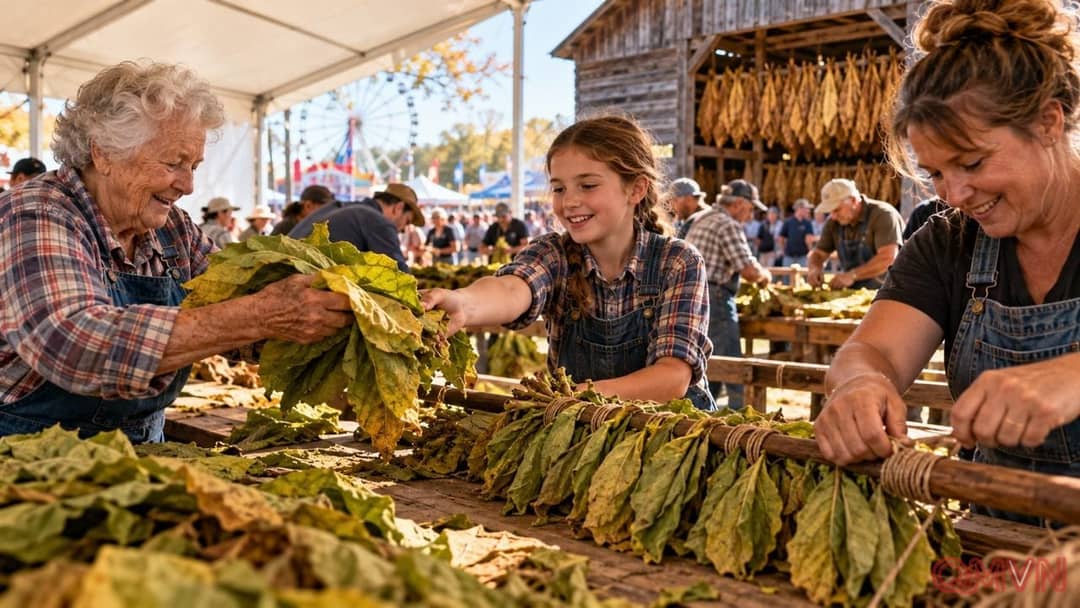
On October 16, hands moved rapidly across a table in Heritage Circle, passing leaves, gathering stems and looping twine around wooden sticks. People in some parts of North Carolina call the task “stringing”; in eastern areas, “looping” is the familiar term. The regional vocabulary reflects the distinct local traditions of a crop whose harvest once required teams working in close coordination.
Historically, workers picked tobacco leaves by hand, tied them onto long sticks and hung them in curing barns. Keeping the heat under control demanded constant attention while the green leaves turned golden brown. Today, mechanized harvesting and modern bulk curing barns have displaced much of that work. The contest therefore does more than demonstrate a technique: it makes an increasingly distant agricultural world visible to visitors.
A race where craftsmanship matters
Three-person teams work as a compact assembly line: two “handers” supply bundles while a stringer secures them with twine. State agriculture officials say judges consider both the clock and the finished stick, including 36 to 38 bundles, evenness, tight wrapping, neatness and the ability to withstand shaking. A quick performance means little if the leaves slip loose.