MAIN ARTICLE
An unusual ally in a familiar mosquito
Aedes aegypti thrives around homes and carries viruses responsible for dengue, chikungunya and Zika. Wolbachia, however, is a bacterium already common in many insects. It is not normally found in this mosquito species. Researchers introduce it through breeding so that the mosquitoes become much less capable of passing certain viruses to people. The goal is to change the vector population, not to eradicate every insect.
Because female mosquitoes pass Wolbachia to their offspring, releasing sufficient numbers of both sexes can establish the bacterium across successive mosquito generations. This distinguishes the method from repeated insecticide spraying: its protective effect may persist after the initial releases. Its effectiveness still depends on local ecology, successful establishment and continued observation of mosquito populations.
The intervention is sometimes called “specially bred mosquitoes,” but it is important not to confuse Wolbachia deployment with genetically modified mosquitoes. The reported program uses an insect-associated bacterium, while researchers monitor its spread and impact. For residents, the public-health benefit is meant to arise indirectly, through fewer infectious bites.
What the Brazilian trial actually found
The trial enrolled more than 5,700 children in Belo Horizonte and followed them for four years. Neighborhoods were randomly assigned either to receive Wolbachia-carrying mosquitoes alongside standard mosquito-control activities or to continue those standard activities alone.
That comparison matters: both sets of communities were exposed to routine prevention, making the additional contribution of Wolbachia easier to assess.
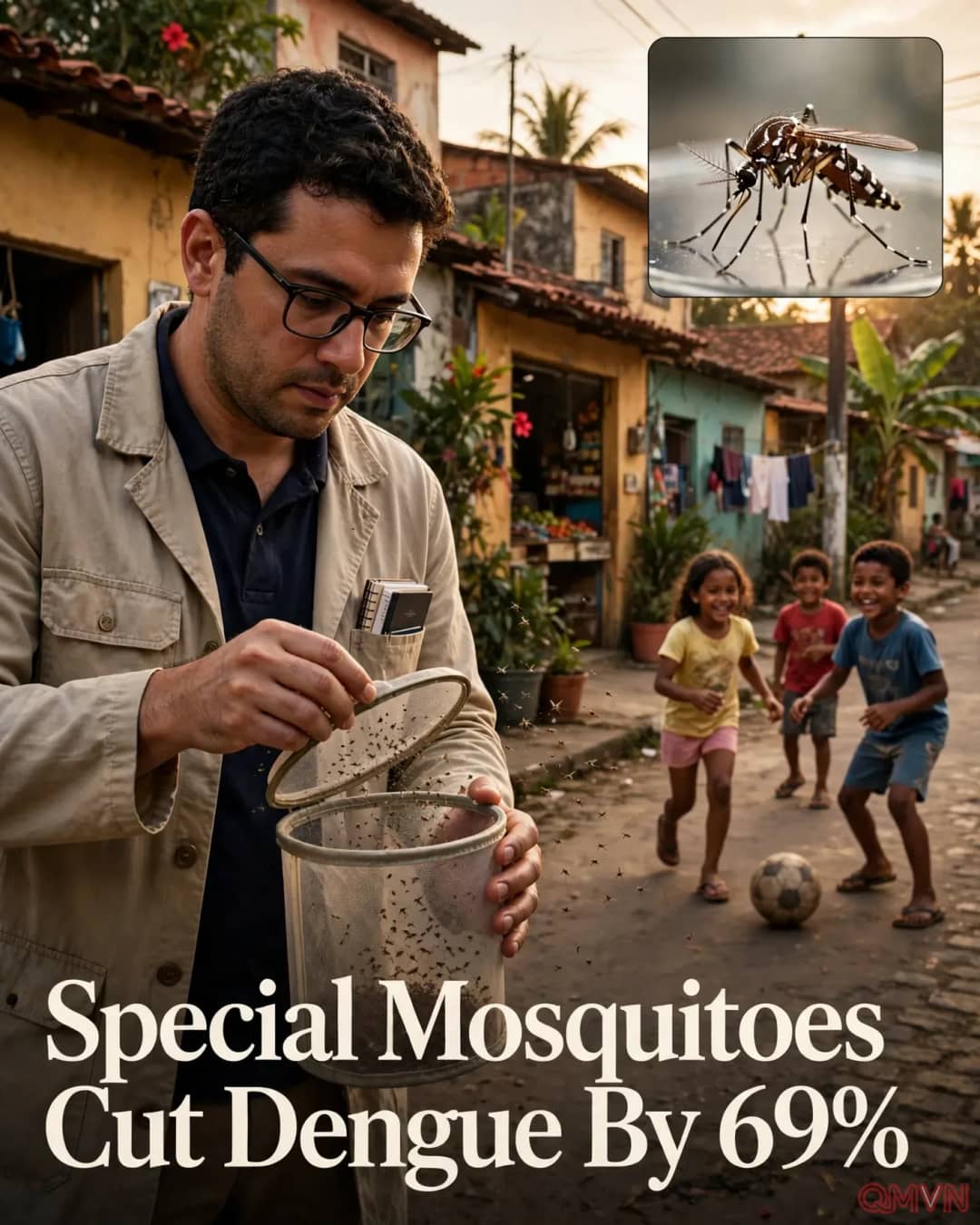
Instead of counting only diagnosed patients, investigators examined blood samples for evidence of infection. That approach can reveal infections that never generated a doctor’s visit or a recognized illness. According to the team, the measured reduction in dengue and chikungunya infections was approximately 69%. The advantage remained visible during Brazil’s severe 2024 dengue epidemic, an especially demanding test of any intervention.
The finding was presented at a scientific meeting, and the short news account does not provide every statistical detail, such as full confidence intervals or the complete peer-reviewed analysis. It also reported too few Zika infections to establish whether Wolbachia prevented that disease in this cohort. Those limits should accompany the headline percentage when health officials assess whether to reproduce the program elsewhere.
A strategy with precedent beyond Brazil
The Belo Horizonte result follows years of experimentation by the World Mosquito Program and its partners. In Yogyakarta, Indonesia, a cluster-randomized trial published in the New England Journal of Medicine in 2021 found approximately 77% fewer virologically confirmed dengue cases in Wolbachia-treated neighborhoods and an 86% reduction in dengue hospitalizations. The different figures do not represent a head-to-head contest; the studies measured different populations and outcomes.
That Indonesian trial helped transform Wolbachia from an intriguing laboratory observation into a public-health intervention with real-world evidence. Brazil’s newer findings broaden the case by examining children through repeated seasons and testing for infection rather than relying exclusively on the medical system’s count of symptomatic cases.
Expert caution remains essential. Climate, dense housing, sanitation and the seasonal abundance of breeding sites can influence how quickly mosquitoes reproduce and how widely a virus spreads. Communities also must understand why mosquitoes are being released before they can trust a project intended to protect them. Scientific success is therefore intertwined with communication, reliable monitoring and local consent.
Why prevention still requires many tools
Dengue can cause fever, severe pain and, in some patients, life-threatening complications; chikungunya can leave prolonged joint pain. During outbreaks, hospitals can be stretched even when most infections are not severe. Reducing transmission at the mosquito stage could lighten this burden, particularly where repeated spraying has failed to produce durable control.
Still, Wolbachia cannot clear blocked drains, remove standing water or guarantee protection against every mosquito-borne infection. Communities need surveillance that identifies areas where mosquito populations remain vulnerable, as well as public education, clinical diagnosis and access to appropriate care. The Brazilian trial itself maintained standard mosquito-control activities in both intervention and comparison areas.
For policymakers the central question now moves from whether the biology can work to how well it can be sustained, measured and financed. Transparent evaluations, especially across different climates and socioeconomic conditions, will help determine where the approach delivers the greatest benefit. The promise is substantial precisely because it complements interventions people already know.