MAIN ARTICLE
Fourteen orbits, followed by a precise homecoming
The two-stage Starship vehicle lifted off from Starbase on November 13. Super Heavy provided the initial thrust before separating; the upper spacecraft then continued into orbit. Over roughly 22.5 hours, the ship circled Earth 14 times while releasing 26 next-generation Starlink satellites. The flight combined a practical delivery mission with a demanding experiment in guidance and recovery. Instead of merely reaching space, the upper stage had to return to the precise structure from which its journey began.
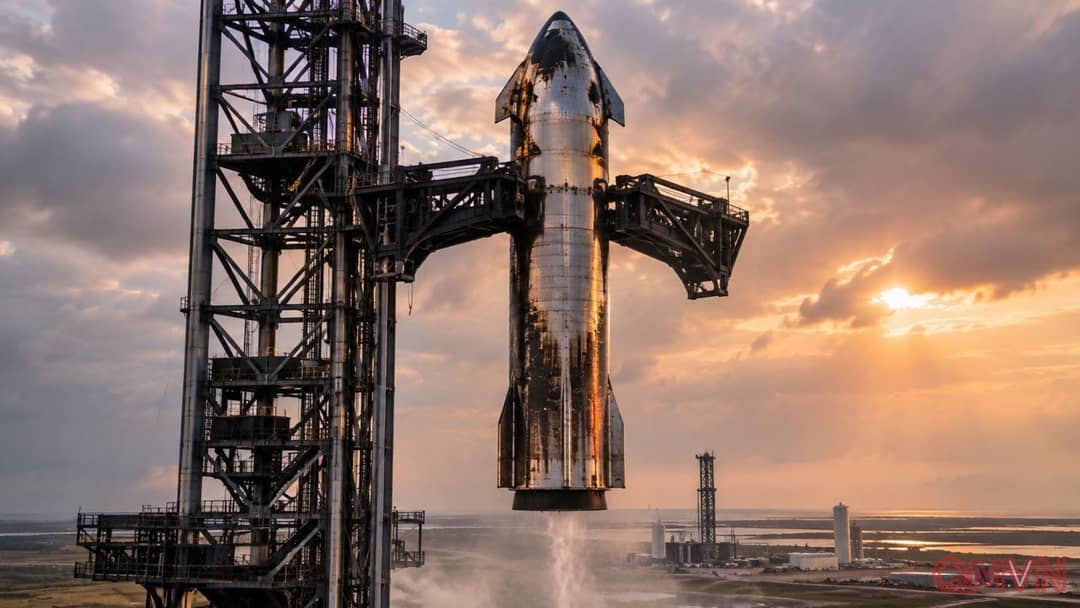
A deorbit engine firing sent the spacecraft down from an altitude of about 260 kilometers. Moving at roughly 27,000 kilometers per hour in orbit, it faced ferocious heating while plunging through the atmosphere. Its thermal protection tiles, control surfaces and engines worked in sequence to slow and orient the vehicle. Near the Texas coast, Starship rotated upright, lit its engines and descended beside the tower. The Mechazilla arms closed beneath attachment points on its sides, holding the scorched ship in the air rather than requiring an ordinary ground landing.
A genuine breakthrough, not yet complete reusability
For SpaceX engineers, this was a first: an upper-stage Starship had completed an orbital flight and been caught at its launch site. Company commentator Dan Huot described the catch as the missing link in the quest for reusable spaceflight. But the lower stage told a different story.