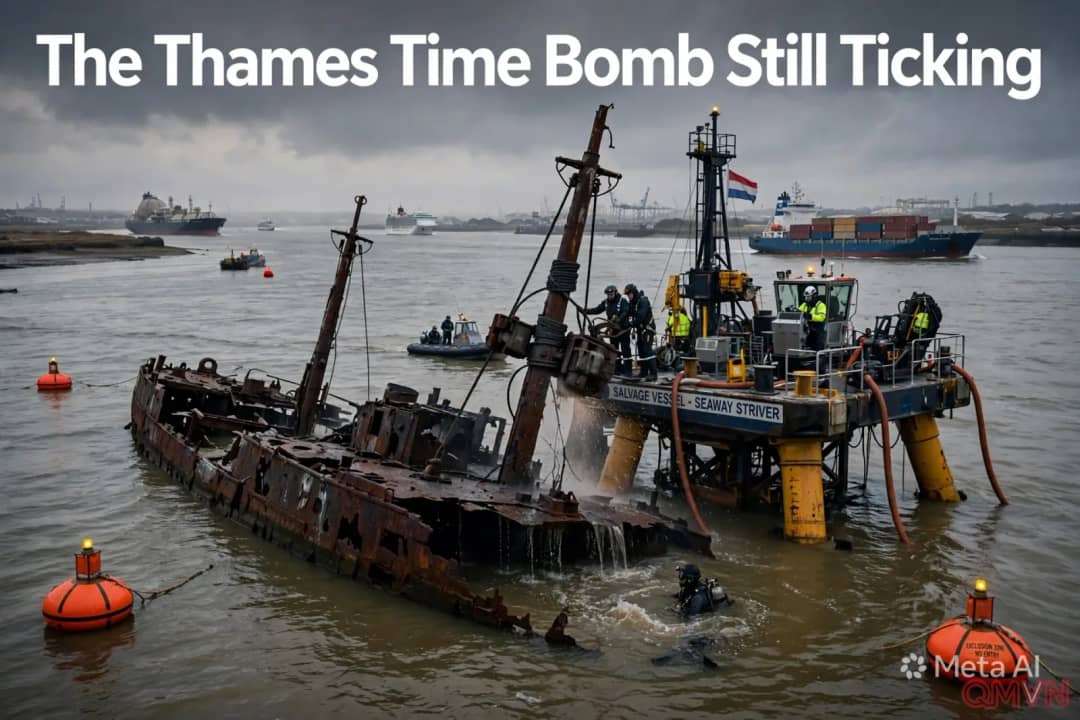
A time bomb at the mouth of the Thames
The ship locals call “the Monty” dragged anchor, broke her back on a sandbar, flooded and sank in late summer 1944, just months after the Normandy landings. For 82 years she has slowly disintegrated on the shallow seafloor. Although no precise manifest exists, thousands of munitions remain inside the broken hull: 2,000-pound blockbusters, fragmentation bombs, white phosphorus smoke ordnance and crates of pressure fuzes. Old bombs, even underwater, can still detonate under certain conditions, and conditions around the wreck constantly change with fast tides and shifting sands.
For decades, three masts rising above the water have turned the wreck into a kind of war memorial, clearly marked on nautical charts and visible from shore. Tour operators take day-trippers out to circle it. Local communities remember the sacrifice, bravery and terror of earlier generations. The ship is also a reminder that the lethal debris of war often lingers, whether off the English coast or in the Persian Gulf.
The operation to remove the masts
The British government launched the roughly $12 million project after experts concluded that the steel masts, the remains of derrick cranes once used to handle the cargo, could collapse onto the rotting decks. The job went to Resolve Marine, a company based in Fort Lauderdale, Florida, led on site by Nolan Conway. His team has dealt with a torpedo-room fire on an Indian navy submarine and, in 2024, was hired to free the container ship that struck Baltimore’s Francis Scott Key Bridge. To work safely, they relied on special measures: