MAIN ARTICLE
A difficult arrival beside the Sun
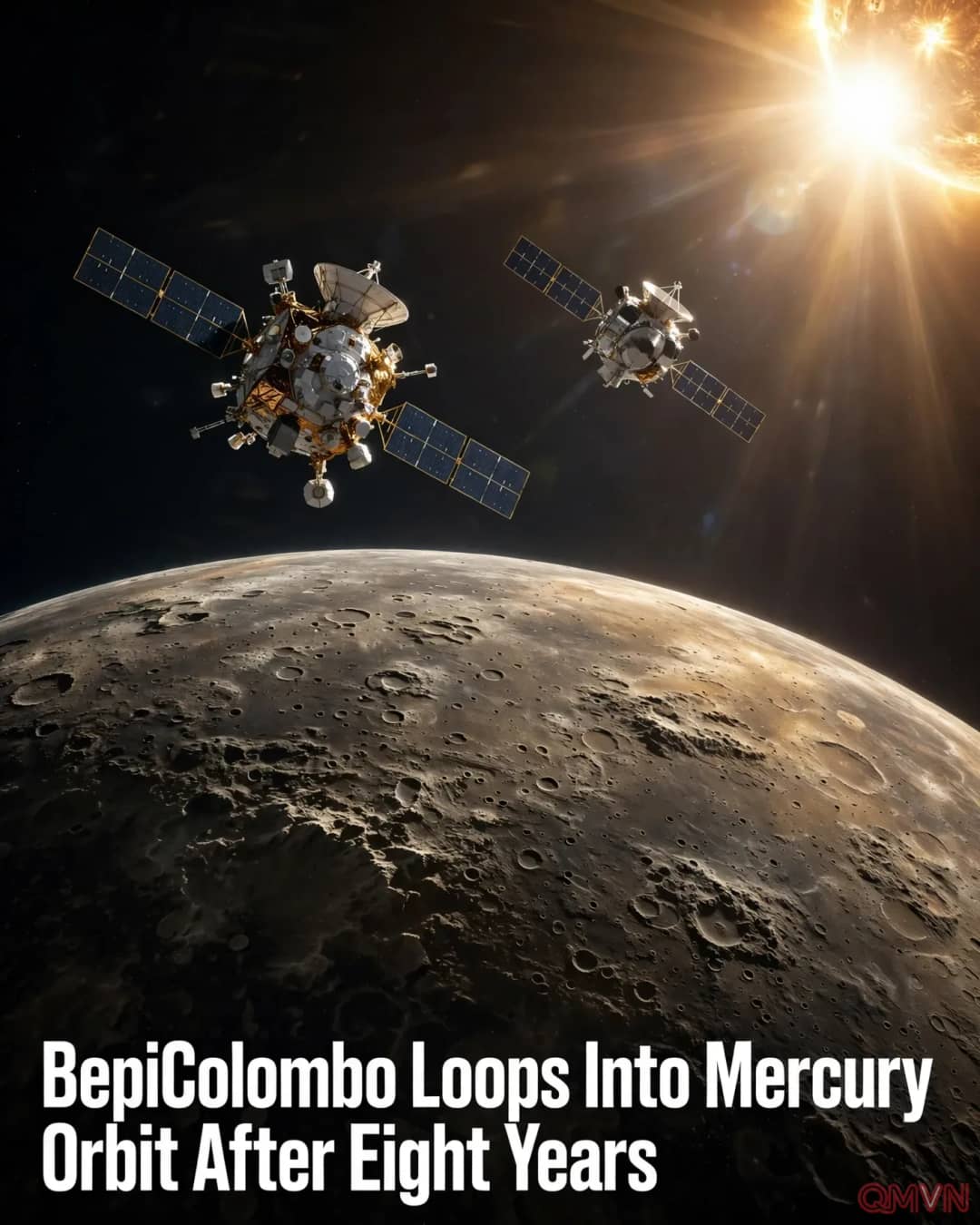
Getting close to Mercury is not as simple as flying toward the Sun. A spacecraft approaching the inner solar system gains speed in the Sun’s gravitational field, making it unusually hard to slow down enough for Mercury to capture it. BepiColombo therefore used a carefully planned chain of gravity assists: one encounter with Earth, two with Venus and six with Mercury. The seemingly indirect voyage reduced the energy needed for orbital insertion while allowing engineers to test instruments during the long cruise.
On November 21, a sequence of engine manoeuvres finally placed the paired probes in a polar orbit. Mission controllers at ESA’s operations centre in Darmstadt, Germany, waited for tracking and telemetry to confirm success across an enormous distance. The moment represented a transition rather than a finish line. Further orbit adjustments are planned over the coming months, and the mission’s scientific promise depends on those next steps being completed safely.
Two perspectives on one extraordinary planet
The two spacecraft will not do identical jobs. ESA’s Mercury Planetary Orbiter, or MPO, is designed to observe the planet itself, including its mineral-rich crust, geological features, tenuous exosphere and deep interior.