When the pumps run dry, EVs take over
Sergei Tselikov, Russia's leading auto industry expert and head of the research agency Avtostat, has owned more than 20 cars, from a Volvo and a Volkswagen to a Range Rover, all with petrol engines. But in July, as strikes on refineries left drivers across Russia waiting for hours at petrol stations, he bought a fully electric hatchback made by China's Great Wall Motor. He had to move fast: within days, the price rose by about $2,000 as demand surged.
I tried to fill up one of my cars and drove around to five nearby gas stations, but they had only diesel or lower-grade petrol. I was just too lazy to stand in line.
His GWM Ora 03 GT, previously known as the Ora Funky Cat, has been nicknamed Kotya, Russian for “kitty”. Still, he says fully electric cars remain somewhat unusual in Russia, mainly because of their cost, and predicts that hybrids will keep gaining market share.
Numbers that speak for themselves
The EV boom is clear in official data. Most electric vehicles sold in Russia are Chinese, a testament to Moscow's economic pivot in response to Western sanctions.
- According to Russia's Ministry of Industry and Trade, sales of electric vehicles, including hybrids, in the first eight months of the year rose from 43,000 in 2025 to more than 83,000 in 2026.
- According to Avtostat, by the end of September fully electric and plug-in hybrid cars accounted for 11.5% of the market, slightly above the United States but far below China's 45%.
- According to the International Energy Agency (IEA), EVs are on track to account for a record 29% of new car sales worldwide this year, with sales rising in more than 90 countries.
The IEA says the energy crisis caused by the US-Israeli war with Iran has clearly reinforced the case for EVs. In Russia, however, the immediate driver is a very specific one: Ukrainian strikes.
Long lines at the pumps
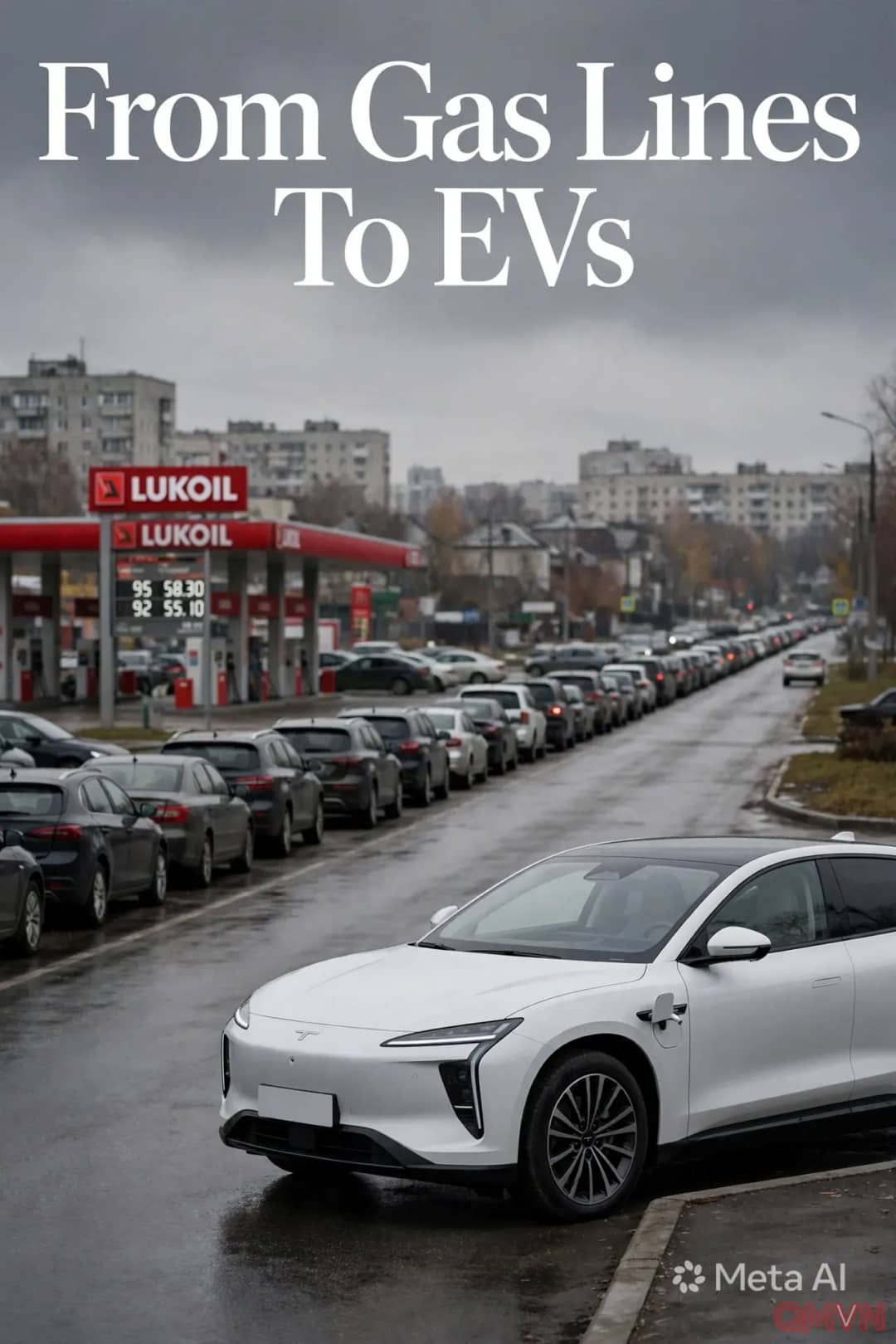
According to Gdebenz, a crowdsourced fuel-market tracker, on Friday only 46% of petrol stations across Russia were selling fuel; in Moscow it was 53%, and in the major city of Nizhny Novgorod just 27%. The situation in the capital was worse in early July and mid-August, when only a quarter of stations had fuel, causing gridlock across the city and on highways linking Moscow with St. Petersburg, Kazan and the south.
To ease the crisis, the government allowed the sale of lower-grade petrol and diesel, but some cars began to break down. Aleksandr, who manages a Volvo repair shop in Moscow, said that within two weeks in August he received 15 vehicles with clogged diesel soot filters. The shortage has become so much a part of daily life that even clowns at Moscow's circus joke about it, and it threatens to become a serious political issue for the authorities.
Chinese cars fill the gap
At a sprawling dealership complex northwest of Moscow, a manager at Evolute, a brand of Russian-assembled EVs based on Chinese designs, said the lot was empty and there was no way to join a waiting list. The complex of more than 40 dealerships, which once mainly sold Western, Japanese and South Korean brands, now has more than 25 Chinese showrooms. Many Russian car plants that used to produce Western brands, abandoned after the invasion of Ukraine, now mostly assemble Chinese cars.
Overall, the infrastructure is lacking.
The 40-year-old was charging a red Moskvich, an iconic Soviet brand revived with a rebadged Chinese design, and had to drive around central Moscow to find a working charger with no queue. He said he would never buy an EV for himself because of the cost and the lack of charging stations. Others have switched to e-bikes and scooters, converted their cars to natural gas or turned to public transport.
Charging infrastructure races to keep up
Russia began preparing for EVs in 2022, when the government started subsidising fast chargers and grid connections; in 2023, updated codes required EV infrastructure in new buildings. Public charging stations have grown from fewer than 1,500 in 2022 to more than 8,000 this year. Fully electric cars are exempt from transport tax in many regions and park free in Moscow and other big cities, while Russian-made EVs receive subsidies and can use most toll highways free of charge.
We don't consider Russia to be some kind of cursed country. The main blocker wasn't any kind of natural barrier. There was the standard chicken-or-egg problem: when there were no electric vehicles, there was no infrastructure.
According to the chief executive of Punkt E, Russia's largest charging operator, demand at its stations has doubled in recent weeks, and the company has decided to speed up construction of 100 more chargers, despite lengthy permit procedures. Yet EVs still face prejudice: waiting in a long fuel queue outside Moscow, Igor, 51, said he would never buy one, calling them too expensive and not manly enough.