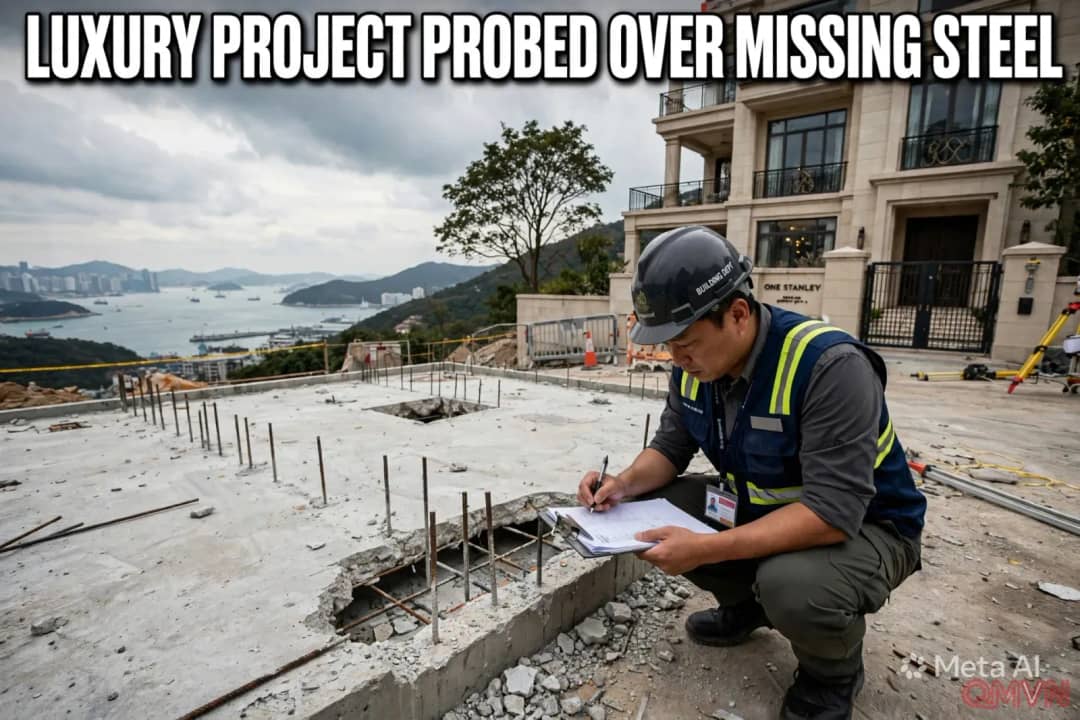
Hong Kong launches probe into luxury One Stanley development after an owner alleges up to 75% fewer steel bars than approved plans required
In Hong Kong, China, the Buildings Department has launched an investigation into the luxury residential development One Stanley in the exclusive Southern district, after a homeowner complained that too few steel reinforcing bars had been used during construction. According to a report by property news platform WuChatProp, engineers hired by the owner of a HK$100 million house found during renovation that some parts contained up to 75% fewer steel bars than shown in approved building plans. The department said it was "very concerned" and would summon the developer, K&K Property, along with contractors and engineers, but stressed its earlier inspections had found no imminent danger. Since receiving the complaint in January, officers found that one beam lacked required wire mesh and some floor slabs did not match drawings, though they judged these posed no obvious danger. The department warned it would prosecute and take disciplinary action if any professional or contractor had broken the law. The case comes amid heightened public sensitivity over building safety and construction standards following the deadly Tai Po fire, and raises questions about oversight of what lies hidden inside concrete.
Tiếng Nói QUANG MINH·3 min read · 5 min listen·3 October 2026, 11:36 EDT·
AI-generated illustration
A complaint behind a HK$100 million door
The Buildings Department said on Saturday that it was very concerned about the matter at One Stanley and would call meetings with the developer, contractors and other responsible parties. It stressed, however, that previous inspections had not found any imminent danger.
Public concern grew after WuChatProp reported on Friday that an inspection of one house had found insufficient steel bars in parts of the structure, with shortfalls of up to 75% compared with approved plans.
Advertisement300 × 250
The property is a four-bedroom house of about 3,000 square feet, reportedly bought by its owner in 2024 for about HK$100 million.
According to the report, the irregularities were discovered by engineers and contractors hired by the owner during internal renovation. The owner reported the case to the department but accused officials of failing to act quickly enough.
What inspectors found
In its statement, the department set out the steps it had taken since the complaint was lodged:
In January, it received a complaint about the structural safety of the floor slabs.
In March, officers inspected the house, concluded the overall structure posed no significant danger, and asked the project's registered structural engineer to submit a report with material test results and certificates.
Inspections between June and September found that an area of a beam lacked the required wire mesh and that some floor slabs did not conform to the approved drawings.
The department said it was satisfied these irregularities would not pose an obvious danger, but that it had continued to monitor the situation and was carrying out further investigations, including requesting meetings with authorised persons, structural engineers, contractors and the developer.
If the investigation found that any building professionals or contractors had violated the Buildings Ordinance, the department will definitely follow up in a serious manner, including prosecuting and taking disciplinary action.
The project and its builders
One Stanley sits at No 128 Wong Ma Kok Road, in one of the city's most expensive neighbourhoods. Developed by K&K Property, it comprises 32 detached houses and 11 low-rise blocks with 50 flats, most with sea views, ranging from about 1,800 to more than 7,000 square feet.
The building contractor is Treasure Construction Engineering, a wholly owned subsidiary of China State Construction Development Holdings. In mid-August, K&K Property's website reported strong sales, including one buyer purchasing two apartment units for a combined HK$47.4 million, and news reports in late August said more than 50 units had been sold.
A spokesman for K&K Property could not be reached for comment on Saturday night. The allegations have yet to be confirmed by the department's investigation, and no wrongdoing has been established.
Trust in what lies beneath
The case comes at a time of heightened public sensitivity over building standards in Hong Kong. Since the deadly fire in Tai Po, lawmakers have flagged gaps in proposed building management rules, and the Independent Commission Against Corruption has reported a 1.5-fold surge in corruption complaints related to building renovation.
Steel reinforcement is invisible once concrete is poured, which means buyers must rely on engineers, contractors and regulators to ensure that what is built matches what was approved. For residents of even the most expensive homes, the One Stanley case is a reminder that safety depends on the integrity of every link in the construction chain.
BACKGROUND OF THE EVENT
Hong Kong's concern over hidden construction defects has a long history. In 1999, short-piling scandals at public housing estates in Tin Shui Wai and Sha Tin forced the demolition of newly built blocks after foundations were found to be shorter than required, shaking confidence in the construction industry. In 2018, the city was again rocked when it emerged that steel bars at the new Hung Hom station on the Sha Tin to Central Link railway had allegedly been cut short to appear properly connected, triggering a commission of inquiry and costly remedial work.
More recently, the deadly Tai Po fire in late 2025 raised alarms about renovation practices, materials and supervision, prompting calls for tighter regulation of building works and management. Hong Kong relies on a system in which authorised persons and registered structural engineers certify that construction complies with plans, with the Buildings Department carrying out audits and inspections. Supporters say the system works when professionals act responsibly; critics argue it depends too heavily on self-certification and that enforcement often comes too late. The central knot is how to ensure that what is hidden inside concrete is as trustworthy as what appears on paper.
Key takeaways
The strength of a building lies in what cannot be seen, so honesty must be built in from the start.
Regulation earns trust only when it acts swiftly on complaints, not after confidence is lost.
No price tag can guarantee safety; only integrity and oversight can.
Subscribe to the QMVN newsletter
A daily morning digest - only stories worth reading, no spam.