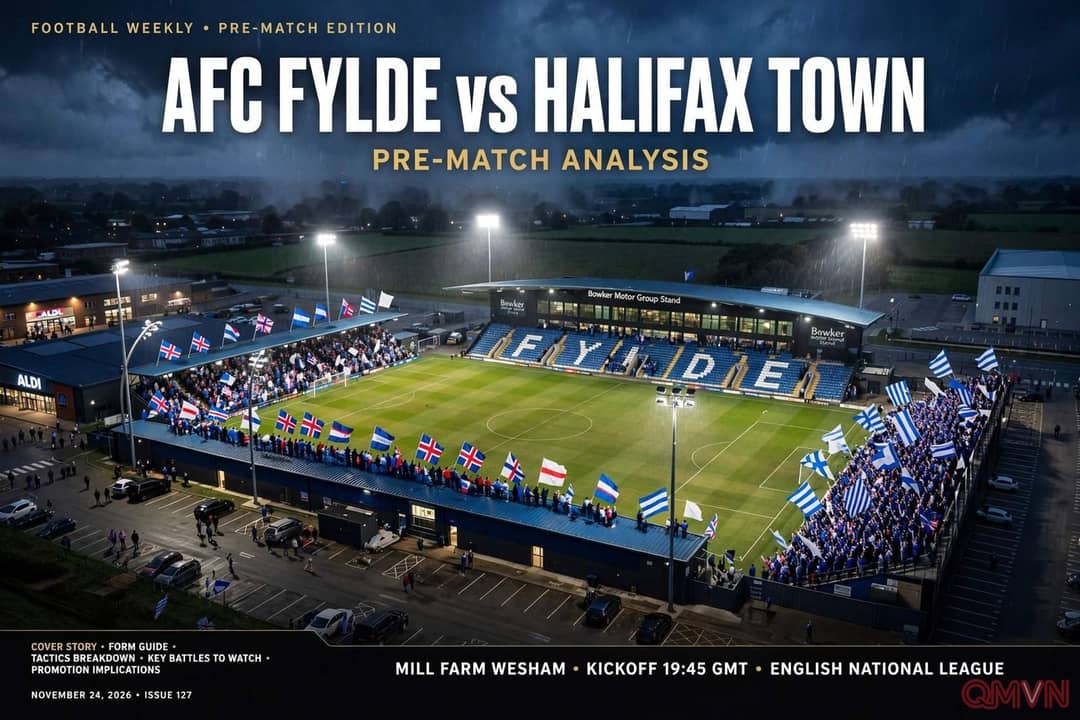
1. Match information
The 19th round of the 2026–27 National League takes place at Mill Farm, Wesham, Lancashire, England. Kick-off is 19:45 UTC on 24 November, or 02:45 in Vietnam on 25 November. Matthew McQuillan is the referee, assisted by Curtis Wood and Neil Evans; Kevin Mulraine is fourth official. FotMob lists DAZN UK as a broadcaster, although local availability should be checked.
2. Context and significance
Fylde have 33 points from 18 games, compared with Halifax’s 28. The visitors sit eighth, four points outside the play-offs. Three points would help Fylde defend their position in the promotion race, whereas an away victory would reduce their deficit to two points. Their two league meetings in 2024–25 produced one victory apiece, so historical superiority offers little reassurance. The match is a useful measure of whether Halifax can translate strong home performances into results on the road.
3. Form guide and team narratives
Fylde’s last five matches in all competitions brought four wins and a draw: 2–2 with Kidderminster, 2–1 against Eastleigh, 4–1 against Harrogate, and 3–1 victories over Hornchurch and Hartlepool. That represents 14 goals scored and six conceded. The regular production of multiple goals suggests an attack capable of sustaining pressure, although the lack of a clean sheet in that sample also leaves room for opponents. Their league home record is four wins, two draws and two defeats. Halifax’s last five were a 5–0 win over Woking, a 1–1 draw with Kidderminster, defeats of 0–2 at Cheltenham and 3–4 against Nottingham Forest U21, and a 2–0 win over Yeovil. They scored 11 and conceded seven. The Woking result demonstrates their attacking ceiling, but the two losses underline the danger of assuming that one emphatic result guarantees consistency. Halifax have not won away since beating Solihull 2–0 on 3 October. Both sides played at the weekend, so recovery and the quality of substitutions may influence the final half-hour. Luca Thomas and Ben Tollitt are particularly interesting attacking figures.
4. Team news and predicted lineups
Both teams could retain their recent 4-2-3-1 structures. These selections are editorial projections based on the latest starting elevens reported by FotMob, not confirmed team sheets. No reliable definitive injury or suspension list was available at the time of writing. Fylde’s midfield pairing offers a platform for the attacking trio, while Halifax may prioritize continuity after the Woking victory. The short turnaround could nevertheless prompt changes in wide positions or central midfield. Fresh attacking substitutes could be particularly useful if the match becomes stretched. Projected Fylde: Pickford; Drewe, Lancaster, Whelan (17), Broad; Whelan (8), Merrie; Thomas, McCormick, Morris; Matthews-Lewis. Projected Halifax: Grant; Houghton, Flint, Hobson, Conte; Johnson, McDermott; Douglas, Gilsenan, Tollitt; Carty.
5. Tactical analysis
Fylde should seek to circulate possession through their two deeper midfielders, using the attacking midfielder to receive between the lines. Width can pull Halifax’s full-backs away from their centre-backs, creating opportunities for runners into the box. If both home full-backs advance, however, the holding players must protect the central channels. Halifax could operate in a compact middle block, pressing when a pass travels towards the touchline or a receiver faces his own goal.
Upon regaining possession, quick service into Carty and support from Tollitt or Douglas could expose the space left by Fylde’s advancing defenders. Conversely, Halifax must retain enough players behind the ball to prevent immediate counters if their own attacks break down. Neither approach is a confirmed tactical plan; these are plausible adaptations to the recent formations.
6. Three decisive matchups
First, the double pivots: Whelan and Merrie against Johnson and McDermott. The pair that can receive under pressure and deny passes into the opposing number ten will influence the pace. Second, the wide battle: Thomas and Morris must test the away full-backs without neglecting recovery runs, while Tollitt and Douglas can exploit space on turnovers. Third, the strikers against the central defenders: Matthews-Lewis and Carty need to secure direct passes and create second-ball opportunities. At this level, a well-delivered corner or a loose ball after a clearance may also decide a match in which open-play chances are limited.
7. Exploitable weaknesses
Fylde conceded in each of their last five matches. Halifax can test the hosts by attacking immediately after turnovers rather than allowing the defensive shape to recover. A diagonal pass behind an advanced full-back could create a favourable crossing position. Halifax’s difficulty winning away, meanwhile, provides Fylde with a reason to apply sustained territorial pressure. If the visitors retreat too deeply, their striker could become isolated and the midfield may struggle to advance the ball. Fylde should switch play quickly rather than force central passes into a crowded block. Both teams must avoid needless fouls around the penalty area and protect the space at the edge of the box after clearances.
8. Potential match scenarios
Scenario one: Fylde score early after a quick switch or a second-ball recovery. Halifax must move higher, leaving more room for the hosts to attack. Scenario two: both midfield pairs protect the centre effectively and the match stays level deep into the second half. A set piece, substitute or defensive mistake becomes decisive. Scenario three: Halifax survive the early pressure and score first through a transition, then defend compactly while threatening on the break. A red card or an injury to a central midfielder could alter any of these patterns. The timing of substitutions is important because a tired pressing line may leave gaps that were not present during the opening stages.
9. Analysis and score prediction
Fylde deserve a narrow advantage because of their higher league position, recent scoring output and home setting. Halifax have a stronger season-long defensive record, conceding 21 league goals to Fylde’s 27, and their victory over Woking shows that they cannot be treated as passive opposition. The hosts must convert territorial control into quality chances while avoiding exposed transitions. If Thomas and the supporting midfielders can repeatedly find space between the lines, Fylde should create enough opportunities to edge the contest. Halifax’s ability to manage the opening phase and deliver effective counters remains a credible route to a point or more. Editorial score prediction: AFC Fylde 2–1 FC Halifax Town.
Sources: https://www.afcfylde.co.uk/matches https://fchalifaxtown.com/news/afc-fylde-match-preview-11/ https://www.fotmob.com/en-GB/matches/fc-halifax-town-vs-afc-fylde/jnx3go4
Subscribe to the QMVN newsletter
A daily morning digest - only stories worth reading, no spam.