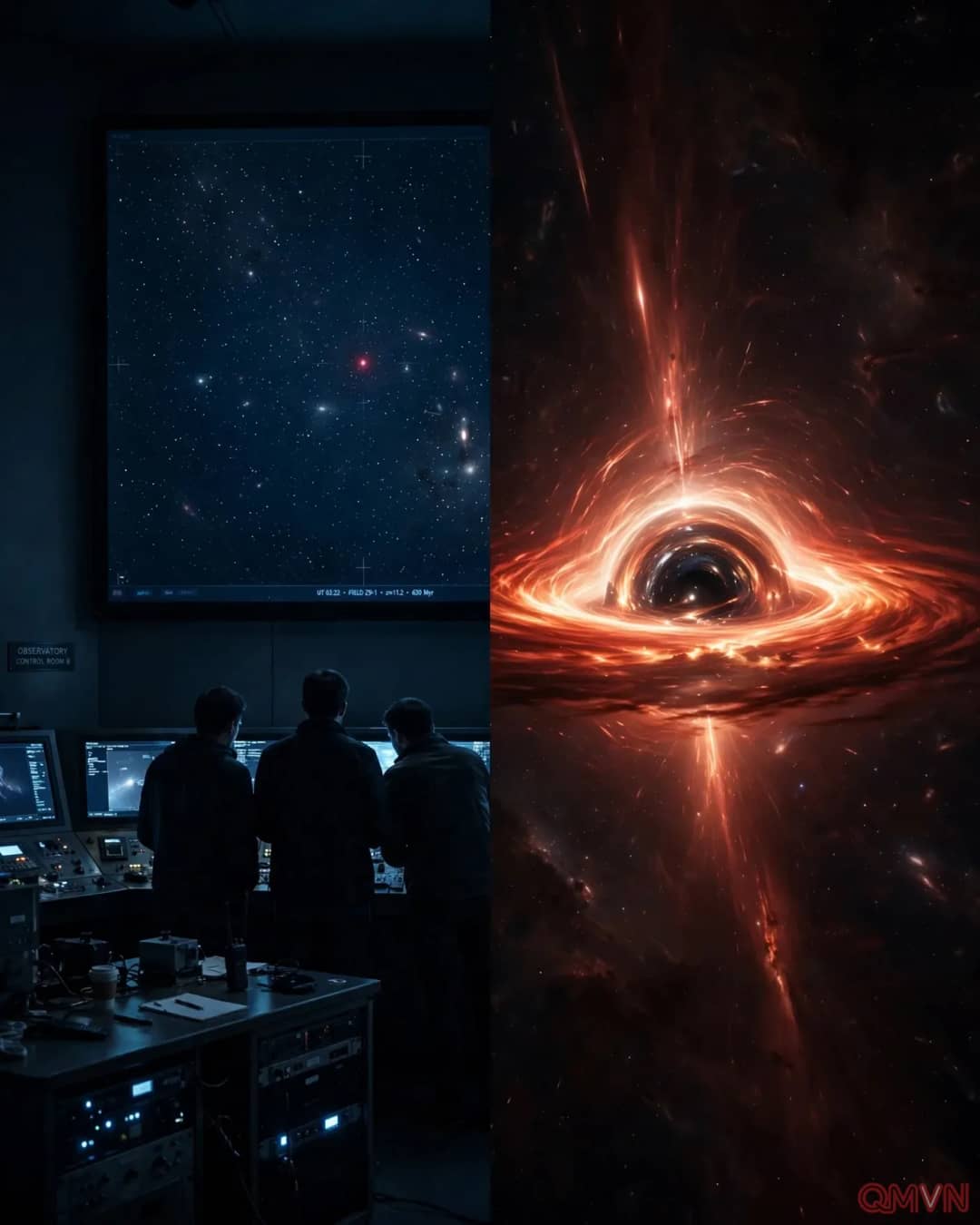
A big leap back in time
Julien Wolf of the European Southern Observatory, who led the study, said the two previous records each took us back by about 15 million years or less, while the new find takes us back by nearly 40 million years, the biggest advance in almost a decade.
This time the leap in cosmic time is huge!
Scientists are seeing the quasar as it was 13.1 billion years ago, when the universe was less than 5% of its current age.
A needle in a haystack of millions of observations
Wolf and his colleagues spotted the quasar while combing through millions of observations made by the Euclid telescope. Launched in 2023, Euclid is surveying galaxies to shed light on the dark matter and dark energy that make up much of the universe and keep it expanding.
The team's findings were corroborated by the Hubble and James Webb space telescopes as well as other observatories on and off Earth. The results appear in the journal Astronomy & Astrophysics.
A giant but slow-eating black hole
According to Wolf, finding a quasar so early is already rare. What makes this one even rarer is the huge size of its black hole, despite its relatively slow consumption of the matter around it. Thanks to Webb, scientists learned that the black hole has a mass equivalent to 360 million suns.
Wolf said the discovery sets a new deadline for the early universe. Only about 630 million years after the Big Bang, the black hole had already grown that large, and the question is how it managed to do so.
A name from an Irish fort
Wolf nicknamed the quasar Dun Aonghasa, after a prehistoric stone fort on Ireland's Aran Islands. His wife and daughter are Irish, and he was awestruck when the family visited the site.
To him, the fort is a frontier holding the promise of a vast horizon still to explore, just like the newly found quasar. The name is therefore not only a personal memory but also a symbol of the drive to reach new frontiers of knowledge.