From a daring idea to a telescope buried in ice
Neutrinos are nearly massless, electrically neutral particles that interact only weakly with matter. The same property that makes them extraordinarily difficult to detect also makes them valuable cosmic messengers: they can pass through dense environments and travel enormous distances without being absorbed or bent by magnetic fields. From the late 1980s, Halzen pursued the idea of using a vast natural medium as a detector, first through the AMANDA project and later through the much larger IceCube observatory at the South Pole.
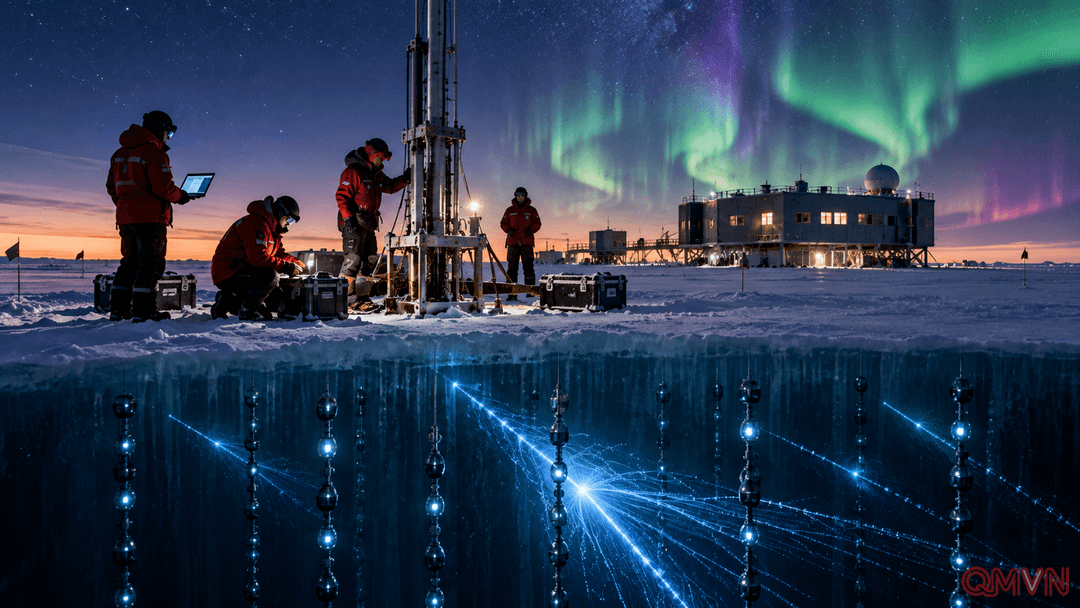
IceCube was built over several Antarctic construction seasons and completed at the end of 2010. It consists of 86 instrumented strings carrying 5,160 digital optical modules between roughly 1,450 and 2,450 meters below the surface. When a rare neutrino interacts in or near the detector, secondary charged particles can emit Cherenkov light. The sensor array records those flashes, allowing researchers to reconstruct the neutrino’s energy and direction and, in favorable cases, trace it back toward its cosmic origin.
The 2013 breakthrough opened neutrino astronomy
The turning point came in 2013, when IceCube announced the first compelling evidence for a flux of high-energy neutrinos originating beyond the solar system. The result demonstrated that a detector frozen into Antarctic ice could observe particles produced by some of the universe’s most violent processes.