Four Diplomats Declared “Persona Non Grata”
In its statement on Friday, Austria’s foreign ministry said the four Russian diplomats had been declared personae non gratae and ordered to leave the country. Three of them worked at Russia’s embassy to Austria, while the fourth belonged to the Russian delegation to the OSCE on military security and arms control.
Based on findings by the Austrian security authorities, the Austrian foreign ministry has taken measures against four Russian diplomats in Vienna.
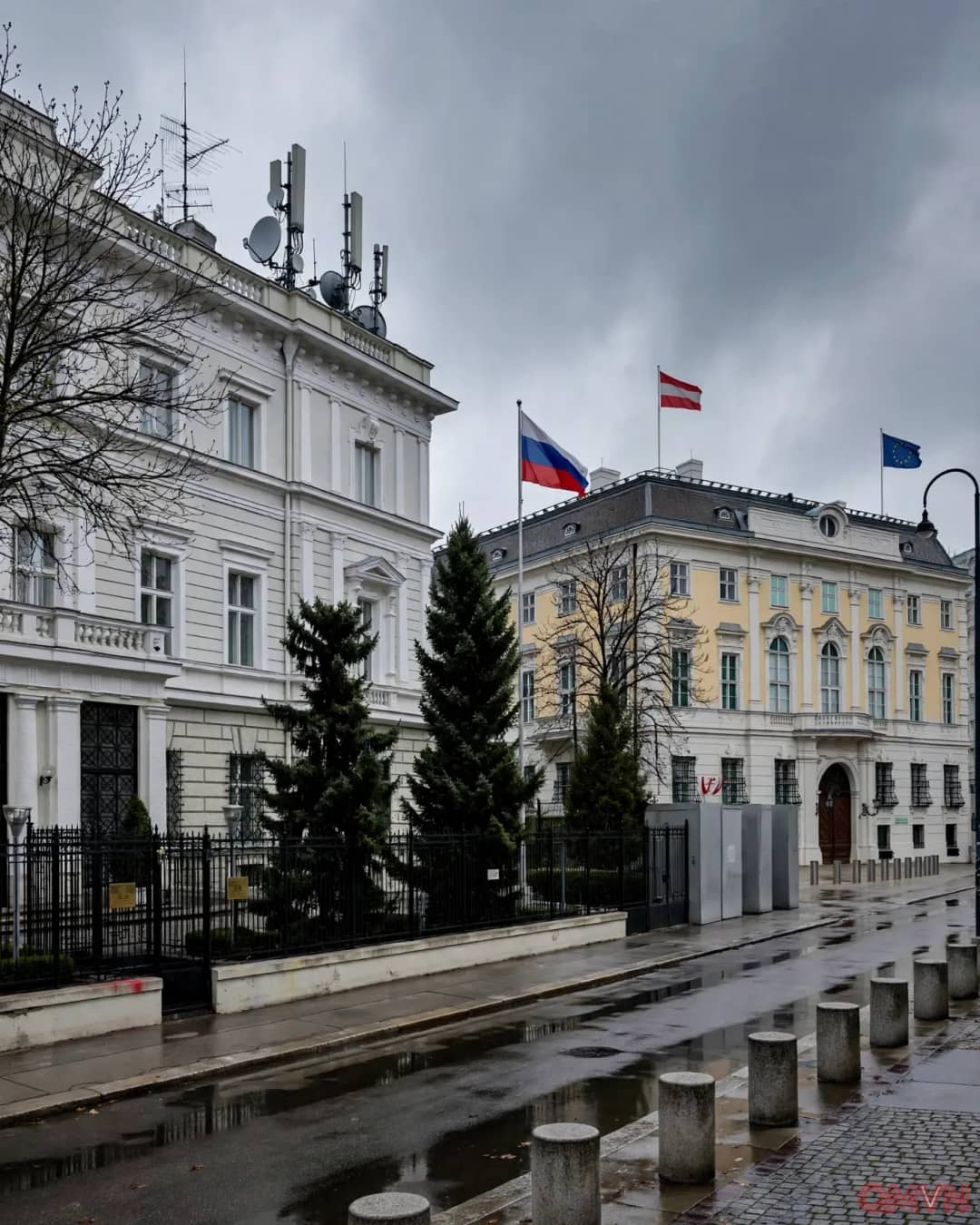
Vienna usually does not disclose details of such expulsions. During the previous round in May, however, when three Russian diplomats were ordered out, Austrian officials pointed to an “antenna forest” on the roofs of Russian diplomatic buildings that could be used to gather intelligence signals. With this latest move, Austria has expelled 18 Russian diplomats since 2020.
Moscow Hits Back
The Russian embassy in Vienna swiftly posted a statement on its website, describing Austria’s decision as “a further unfriendly step” towards Russia.
Vienna is thoughtlessly following the West’s anti-Russian policy, and there will inevitably be an appropriate response to such measures.
Although Austria is militarily neutral, its governments have politically sided with Ukraine since Russia launched its full-scale invasion in 2022.
Moscow routinely denies spying allegations and accuses Western countries of trying to stoke “anti-Russian hysteria”.
Vienna – a “Capital of Spies” Since the Post-War Years
Vienna is one of the world’s largest diplomatic hubs, hosting the OSCE and UN organisations such as the International Atomic Energy Agency (IAEA). Major powers like Russia and the United States often have separate ambassadors to Austria, the OSCE and UN bodies, each running its own mission. According to AFP, some 220 Russian embassy staff are accredited in Austria, one of Russia’s largest diplomatic missions in Europe. Three factors make the city attractive to intelligence services:
- A dense concentration of international organisations, providing legitimate diplomatic cover for intelligence officers.
- Diplomatic immunity, which shields them from prosecution.
- Austrian criminal law, which has long mainly punished espionage that directly harms Austria itself.
After World War Two, Vienna was divided into sectors controlled by the Allied powers – a setting immortalised in the classic 1949 film “The Third Man”. Ever since, the reputation of a “den of spies” has clung to the city on the Danube.
The Egisto Ott Case and the Push for Tougher Laws
Concern about Russian intelligence in Austria grew after the trial of former intelligence officer Egisto Ott. On May 20, he was sentenced to four years and one month in prison for helping Russia hunt down opponents and selling state phones and laptops at the behest of Jan Marsalek – the fugitive Austrian former Wirecard executive suspected of being a Moscow agent. It was Austria’s biggest spying case since a retired army colonel was convicted in 2020 of spying for Russia for decades.
The Austrian government now wants to tighten the law to crack down harder on espionage. For a country that once prided itself on being a “bridge” between East and West, the challenge is to preserve its neutrality and diplomatic hospitality without letting them become loopholes for activities that threaten its own security and that of its neighbours.