MAIN STORY
A photograph, 48 hours and a final farewell
As described by the South China Morning Post and the Chinese outlet The Paper, the man died after falling into an industrial mixer. His remains were severely damaged. His son had not seen him since a wedding two years earlier and asked only to recognize his father's face again. Zhou and his colleagues could offer no guarantee. Restoration is a skilled intervention with limits, not a promise that the violence of an accident can somehow be undone.
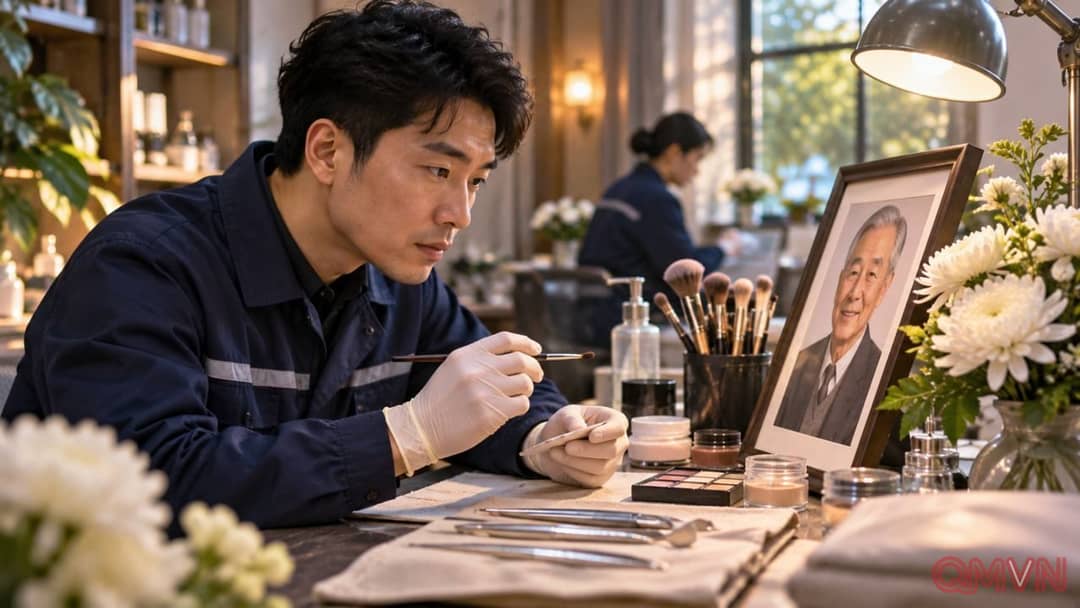
The three specialists worked in shifts over two days, cleaning, reconstructing, joining damaged areas and applying cosmetics. They repeatedly checked the contours against a photograph taken during the man's life. The brow, the nose and even small variations in expression mattered because recognition depends on familiar details. When the son said the face reminded him of his father, the achievement was not a competition prize; it was the possibility of a gentler goodbye. The family's own account is more meaningful than any exaggerated claim of flawless reconstruction.
A technical craft in the service of human needs
Mortuary restoration involves much more than ordinary makeup. Practitioners require knowledge of anatomy, hygiene, disinfection, suturing and shaping materials, along with careful occupational safeguards.
Zhou studied modern funeral technology and management at a vocational college in Beijing. After more than ten years at Hangzhou Funeral Home, he won a provincial mortuary cosmetics award in 2022 and received recognition as a municipal craftsman the following year.
In another case he recalled, a teenager had died from leukemia. The team tried to recreate the healthy, athletic appearance the boy had before his illness, offering his parents a memory less dominated by medical suffering. Such work is not simply about concealing signs of disease. It begins with listening to relatives and understanding which features express the person they loved. Professional limits, family preferences and accurate explanations all remain essential.
The worker who also has to grieve
Zhou says repeated exposure can make death less frightening, yet sudden losses remain especially painful. He has helped arrange funerals for members of his own family. When his mother-in-law died, he spent a long time alone in his workroom saying goodbye. She had supported his relationship with her daughter, a nurse, despite the stigma attached to his occupation. Professional familiarity offered no immunity from grief; it may have made the encounter with it more intimate.
He still practises suturing and learns new cosmetic techniques, sometimes from online beauty creators. Families increasingly request personalized details, from eyebrows and lipstick shades to the shape beneath the eyes. That change reflects an approach to funerals that sees the individual rather than a uniform ritual. It also puts real demands on staff: technical training, emotional resilience, unpredictable hours and an ability to discuss painful choices without making unrealistic promises.
From social taboo to a profession deserving recognition
Channel News Asia has reported growing interest among young Chinese people in funeral careers, even as prejudice persists. Training programs have expanded as the sector needs specialist skills in preservation, restorative cosmetics and grief support. Some funeral homes have also explored 3D printing to support facial reconstruction. Such technology may assist the craft, but it cannot replace a practitioner's judgment or the careful conversation with a bereaved family.
The broader lesson is that care does not end when treatment is no longer possible. Privacy, sensitive handling of images and remains, and honest explanations of achievable results are as important as tools and techniques. A final viewing cannot reverse loss, but a thoughtful process may prevent trauma from becoming the family's only lasting image of their loved one.