MAIN CONTENT
When the lab knocks on the Vatican’s door
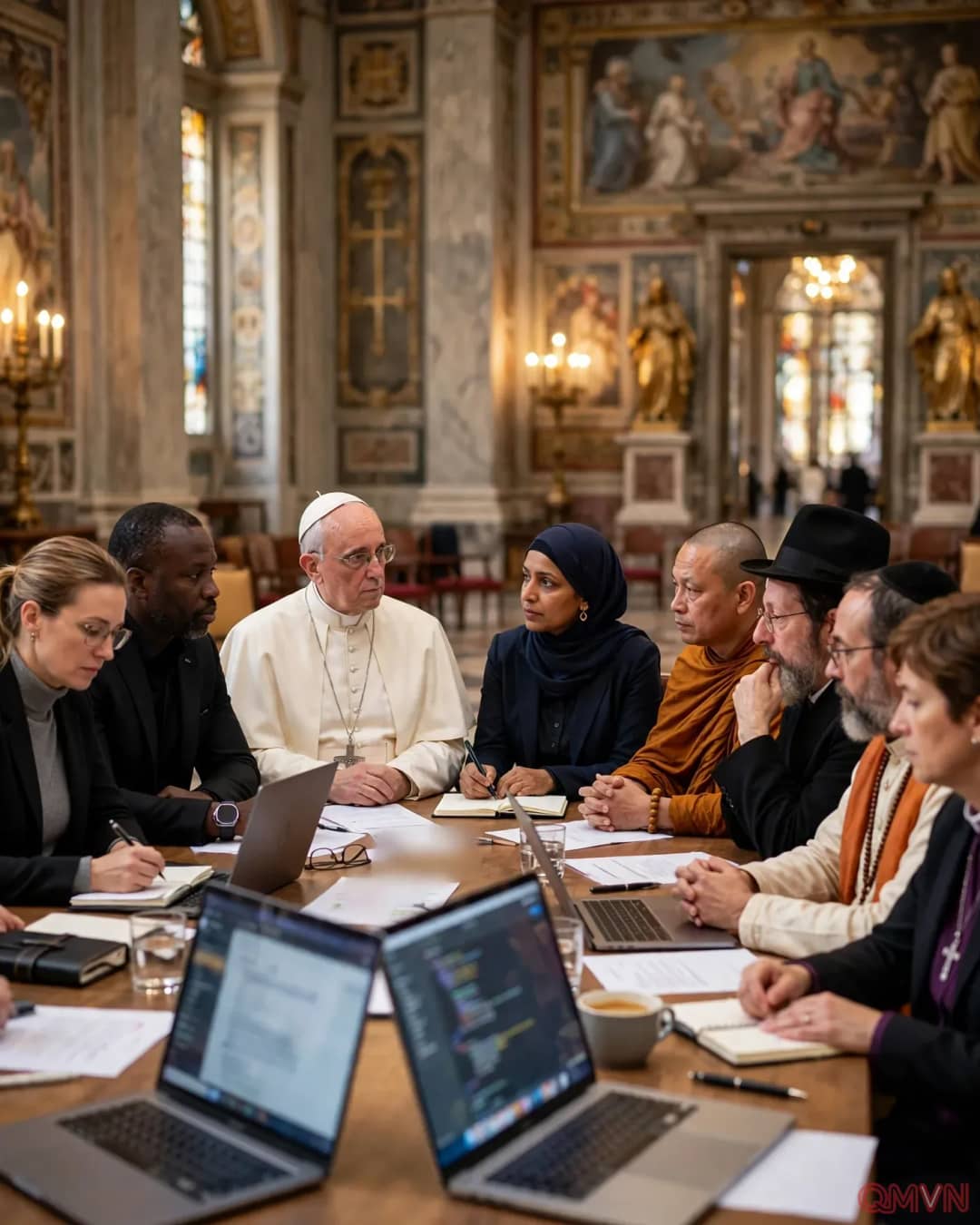
As tech executives sound the alarm about AI's destructive potential and debate the need for morally good models, they are increasingly seeking input from philosophers and faith leaders. Earlier this year, at the Vatican's presentation of Pope Leo XIV's encyclical on AI, Anthropic co-founder Chris Olah made a remark that has been widely quoted.
These are not questions a lab can answer. They are questions traditions like yours have carried for millennia.
Because these companies are not bound to a particular religion, their goal is often broad: an aggregate of moral ideas to guide their models. Last year, OpenAI CEO Sam Altman said ChatGPT should reflect a kind of “weighted average” of humanity's moral views. Representatives of Meta, Google and Amazon have also met with the Vatican, while Microsoft has been active in religious outreach. Yet few have publicly asked what exactly these companies think religion is, and what they hope to get out of it.
Religion is not a rule book
According to Webb Keane, an anthropologist at the University of Michigan, scholars have for decades pushed back against the widespread view of religion as a set of rules that can be separated from the “messy, practical, ad hoc” ways believers actually live. He worries that when AI companies ask faith leaders to answer ethical questions, they reinforce a theory that overlooks the importance of doctrine, ritual and relationships.
There’s a very conventional way of thinking of religion as a rule book. It is certainly very tied to scriptural religion, and the scriptural religions at the end of the day really turn out to be the Abrahamic religions.
The problem, Keane argues, is that if one assumes religion as a whole offers a distinct set of extractable moral principles, using it to train AI risks prioritizing certain traditions and distorting others – especially faiths that do not see themselves primarily as systems of ethics.
Moreover, religion has never truly been separate from culture and politics, even though that notion remains deeply entrenched.
Meetings that are “nerdy” in a good way
Still, participants say these encounters have been far from superficial. In a May blog post, Anthropic said it had met with “scholars, clergy, philosophers and ethicists from more than 15 religious and cross-cultural groups,” and hopes to broaden that pool. Meghan Sullivan, a philosopher of religion who leads an initiative on ethics and AI at the University of Notre Dame, attended one meeting that included Christians from different denominations. It came in two parts: the company explained its models in plain terms, then the faith leaders responded and discussed every moral question the technology raises – from “Do humans have souls?” to “Should third graders be able to access a chatbot for literacy education?”
The culture inside the company is similar to that on a good college campus in the sense that you’ve got a collection of very intellectually curious people. These meetings are pretty nerdy – in a good way.
Sullivan said she was impressed by the rigor of Anthropic's engagement with religion compared with conversations she had had with other tech companies. For its part, Anthropic says the work is not about aligning its Claude models with any one tradition's worldview, but about drawing on a full range of viewpoints – religious, secular and political – with equal depth and rigor, and seeking accumulated thinking on how good character forms.
The idea of “religion” is younger than we think
Religion is generally considered ancient and universal. But the scholar Jonathan Z. Smith wrote in 1982 that humanity has had its entire history to imagine deities, while Western man has had only the last few centuries to imagine “religion.” Tomoko Masuzawa, author of “The Invention of World Religions,” notes that Buddhism and Hinduism were not seen as clearly bounded traditions by their practitioners before European scholars arrived. Religion becoming a way of “mapping out the world,” she says, helps explain why Silicon Valley so readily uses it as a measure of diversity of thought.
Any living, sophisticated tradition over time is capable of interacting with others outside of it and absorbing some new knowledge and growing. But it does so in this organic way. What AI often does is not in an organic way, but in a way that just throws it all together, mixes it all up, and therefore makes sense of none of it.
Paolo Carozza, a member of Meta's independent Oversight Board and an expert on Catholic social thought, worries that in the quest for accumulation, each tradition's defining features may be homogenized, pulled toward the middle or even tilted toward Western religions. Since large language models learn patterns from a vast trove of human writing, including religious texts, the question is not only what AI learns, but what might be lost along the way.