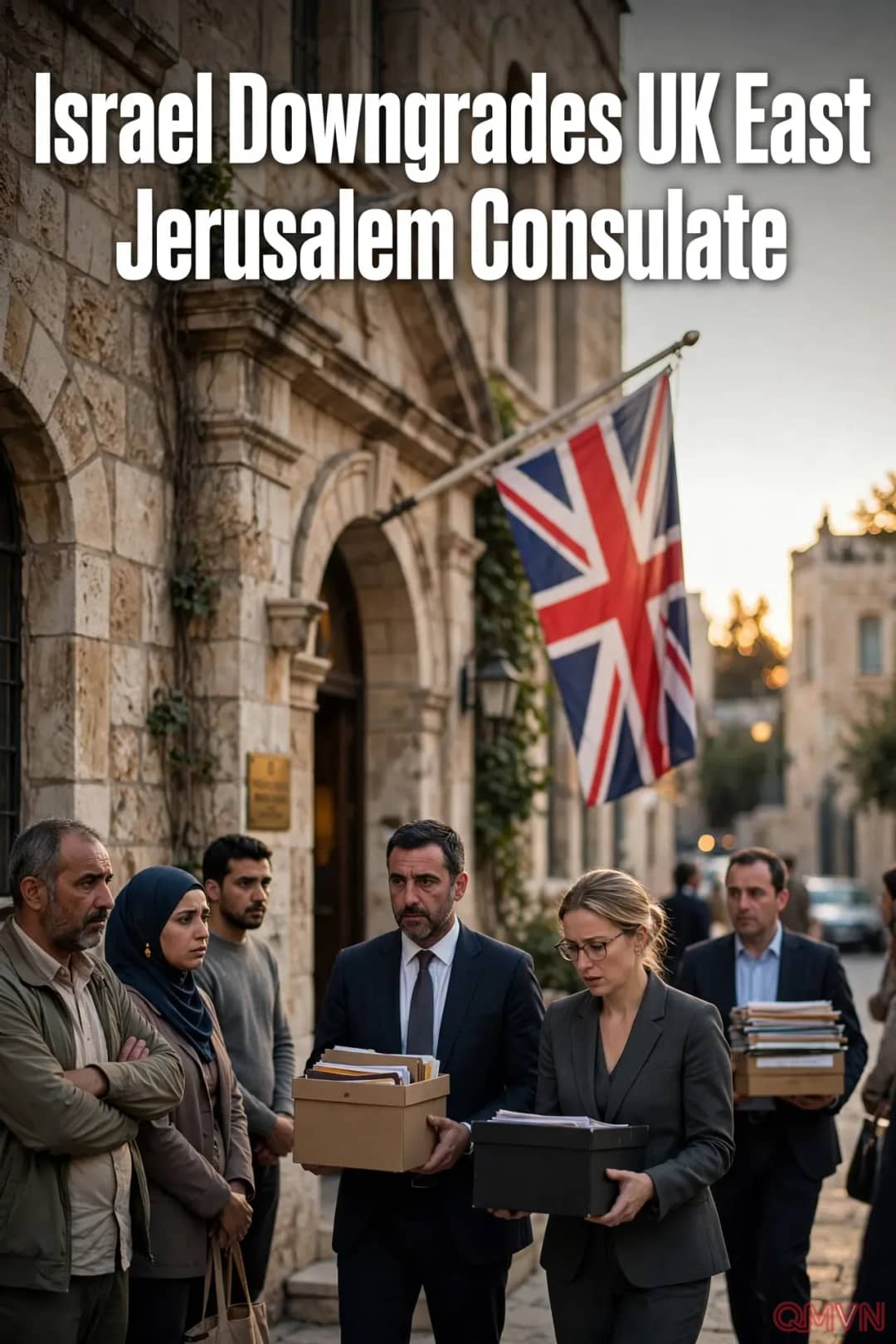
From consulate to “mission”
Under the last-minute compromise, the British Consulate in East Jerusalem will no longer have a consul general and will become the “UK Mission, Jerusalem,” operating on a smaller scale. Israel expelled 20 British diplomats and required services to Palestinians to be scaled back.
The office is separate from Britain’s embassy in Tel Aviv and handles London’s relations with Palestinians in Jerusalem, the West Bank and Gaza. Avoiding a full closure preserves an important channel between Britain and the Palestinians, albeit with reduced capacity.
London’s response
The British government sought to reassure that its diplomatic presence in Jerusalem continues despite the downgrade.
The UK Mission, Jerusalem is independent, operational, and will continue to deliver vital services and our work with the Palestinian people.
Earlier, there had been reports that Britain could respond by expelling Israeli officials from London. The compromise therefore heads off a serious escalation in the diplomatic dispute between the two countries.
Israel’s rationale
Israeli Foreign Minister Gideon Saar blamed Britain’s Labour government, which has condemned Israeli military actions in Gaza, sanctioned settlers and recognized a Palestinian state.
We did not want to reach this point, but the actions of the Labour government brought us here.
For Israel, sanctions on settlements amount to interference in security and sovereignty matters it considers core.
Downgrading the consulate signals that Israel is ready to respond with diplomatic tools to pressure from Western allies.
The steps that frayed relations
Tensions between London and Jerusalem did not arise overnight but built up through a series of British government decisions.
- Britain has repeatedly condemned Israeli military actions in the Gaza war.
- London imposed sanctions on settlers and settlements in the occupied West Bank.
- Britain formally recognized a Palestinian state.
- Last month, Miliband described the expansion of West Bank settlements as “ethnic cleansing,” as Britain moved toward banning imports from settlements.
Israel regards each of these steps as hostile, while for Britain they express its commitment to international law and the two-state solution.
A fragile compromise
The October 8 compromise shows that neither side wants relations to collapse entirely. Britain keeps its presence in Jerusalem, while Israel demonstrates its resolve to respond.
But as long as the core disagreement over settlements and the Palestinians’ future remains unresolved, the new mission is only a temporary point of balance in an increasingly strained relationship between two longtime allies.