MAIN STORY
An American endorsement moves to the center of the campaign
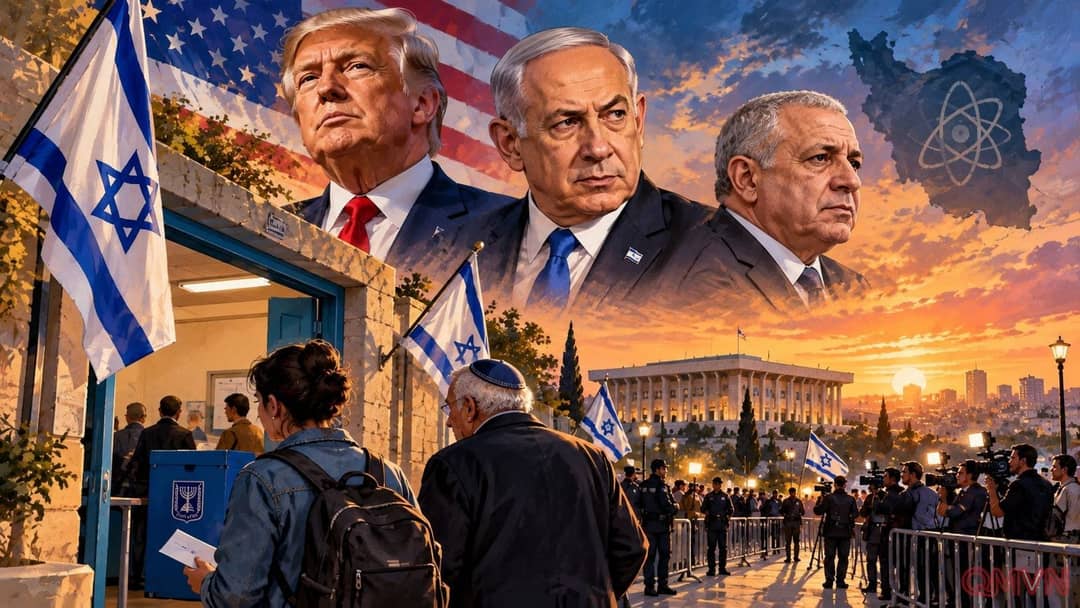
In televised remarks late Sunday, Netanyahu portrayed his relationship with Trump as an unusually close partnership and urged Israelis to see it as a reason to keep him in office. Trump has endorsed him twice this month. His latest social-media appeal called for another Netanyahu term so the allies could finish the work they had started, a reference to their military confrontation with Iran.
The timing matters. The United States and Israel launched attacks on Iran in February 2026, while large-scale hostilities have been suspended for months amid ceasefire diplomacy. Netanyahu said he had directed the Mossad intelligence service and the Israeli military to seek the removal of Iran’s government. The prime minister’s declaration is a statement of intent, not proof that Washington has decided to reopen the war.
White House deputy press secretary Anna Kelly said that the United States would not attack Iran before November 3, when Americans vote in congressional elections. The gap between campaign rhetoric and operational commitments is consequential: another regional escalation could quickly affect energy prices, civilian safety and international diplomacy.
Eisenkot rejects campaigning through fear
Gadi Eisenkot, a former military chief and leading centrist challenger, praised Trump as a friend of Israel while insisting that the American president would work with any leader chosen by Israeli voters. His response sought to distinguish the enduring relationship between states from the fortunes of individual politicians.
Eisenkot criticized Netanyahu for publishing a computer-generated image of a mushroom cloud above Tel Aviv and an AI-created video involving Iran’s leader. He argued that frightening visual messages should not substitute for responsible security policy. Netanyahu’s allies, by contrast, present the Iranian threat as an urgent and concrete reason for maintaining experienced leadership.
Both camps place security at the heart of their arguments, but they differ sharply over the meaning of effective protection. The voter’s choice is not simply between stronger and weaker warnings. It is also a judgment about whether a government can deter threats while limiting the human and economic costs of continuing confrontation.
Coalition arithmetic makes the outcome uncertain
Pre-election polling indicates that Netanyahu’s Likud could lose seats, potentially depriving his coalition of right-wing, far-right and religious parties of a narrow parliamentary majority. Yet Eisenkot and the wider opposition, stretching across ideological divides, also lack an obvious route to a replacement government.
Israel’s proportional parliamentary system rewards coalition-building rather than a simple nationwide winner-takes-all result. Even if one party secures the largest share of seats, negotiations among multiple factions can determine who governs. An inconclusive result could prolong uncertainty over security, budgets and relations with neighboring states.
Trump’s public backing carries political risks on the American side as well. The Iran conflict has faced strong opposition in the United States, particularly as fuel costs have risen, while Republicans are fighting to retain control of Congress. Appeals that resonate with one electorate may be costly with another.
Subscribe to the QMVN newsletter
A daily morning digest - only stories worth reading, no spam.