From the notes of 1843
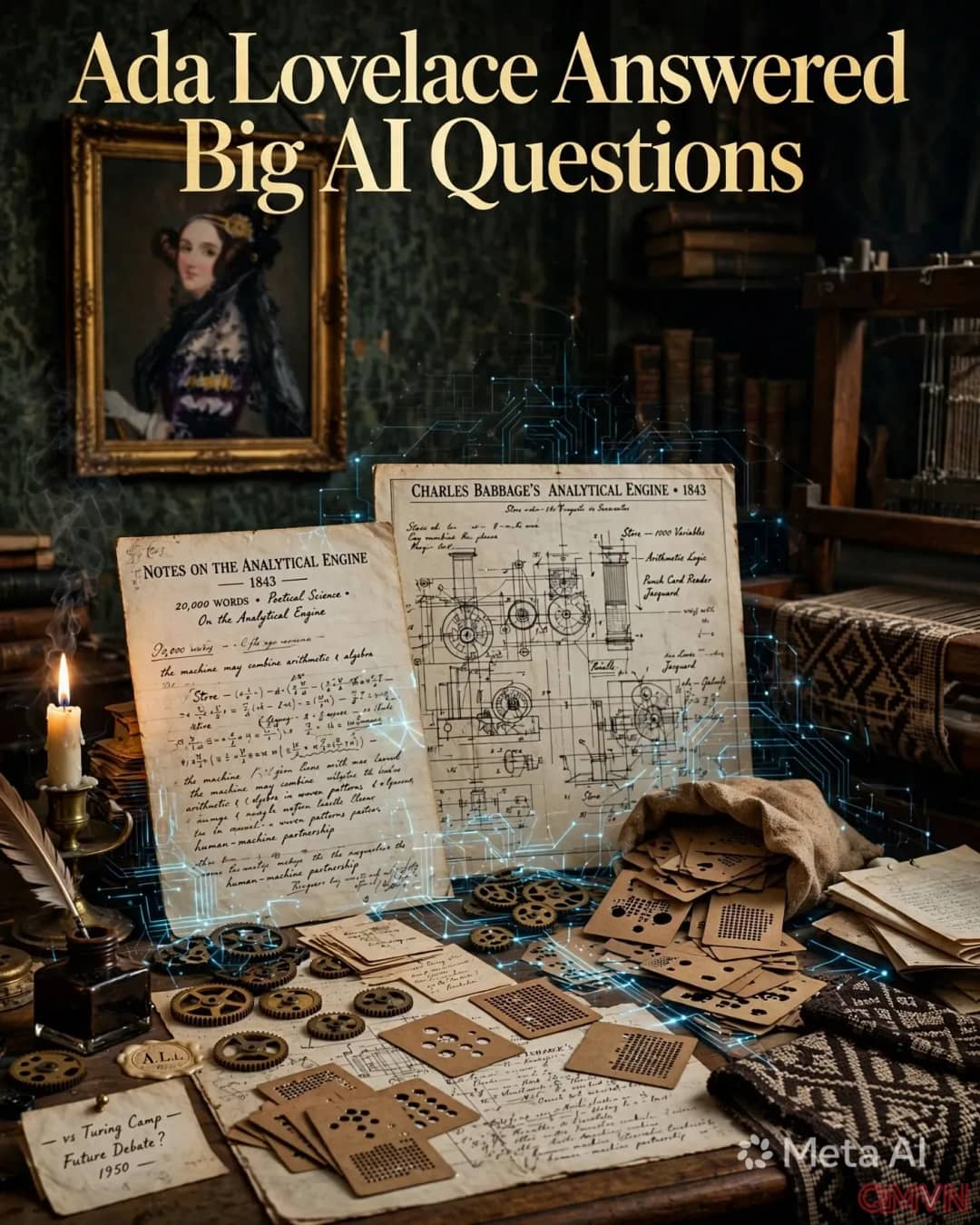
The only legitimate child of the romantic poet Lord Byron, Ada Lovelace inherited her father’s artistic spirit, but her mother had her tutored in mathematics to temper that rebelliousness. From this blend she developed what she called “poetical science,” seeing math as a lovely language describing the harmonies of the universe. Unlike her father, who had defended the Luddites smashing mechanical looms, she was fascinated by Jacquard looms that used punch cards to create patterns.
“The Analytical Engine weaves algebraical patterns just as the Jacquard loom weaves flowers and leaves.” — Ada Lovelace
She realized that punch cards could store and process anything that could be expressed in symbols: words, logic, music and pictures. According to Isaacson, that became the core concept of the digital age. She also wrote step-by-step procedures for the machine to execute, which are regarded as the first published computer programs.
The question “Can machines think?”
In her notes, Lovelace also introduced another important concept: artificial intelligence. She believed that a machine like Babbage’s could perform operations as instructed but could not come up with ideas or intentions of its own.