MAIN STORY
A national prize changes the conversation
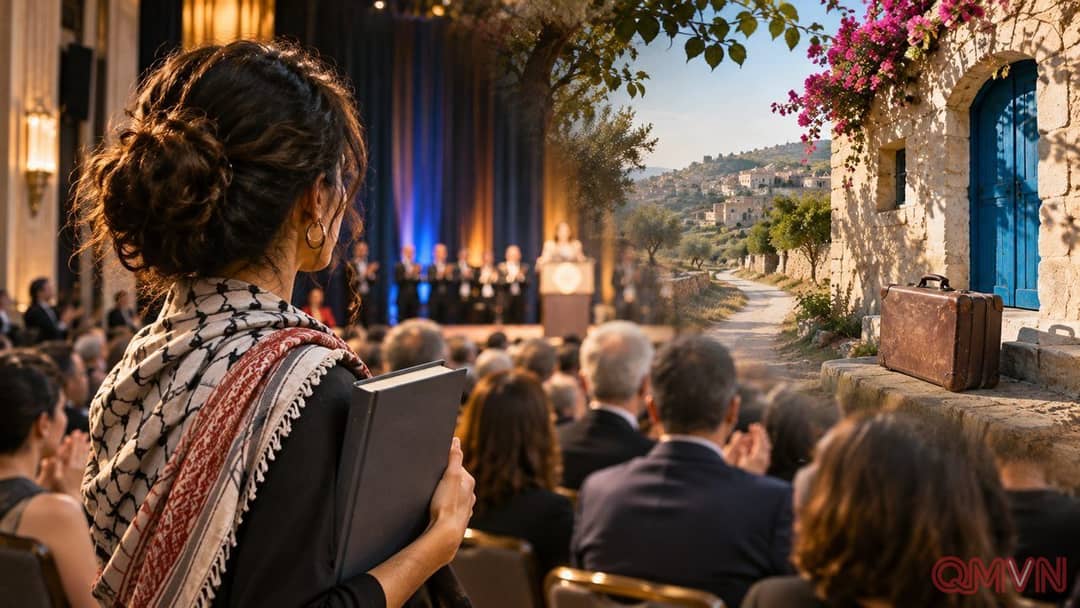
On November 18, 2026, the National Book Foundation named Hannah Lillith Assadi the fiction winner at its 77th National Book Awards ceremony in New York. The award places Paradiso 17 among the most closely watched works of American fiction this year. It is Assadi’s third novel, and the author had previously been recognized by the foundation’s 5 Under 35 program. For her career, the honor is substantial; culturally, it places a Palestinian experience of displacement at the center of a major literary institution.
The importance of the moment extends beyond the writer’s biography. Rather than treating a dispute over territory as an abstract argument, the novel asks readers to inhabit the emotional world of a character. An award cannot resolve competing historical or legal claims, yet it can offer a place where family affection, loss and unfinished memories are recognized as part of the human record. That shift in perspective may be its most lasting contribution.
Sufien’s long search for a home
According to the National Book Foundation’s account, Sufien was born in Palestine before the Nakba and fled as a child. His later journeys take him through Kuwait, Italy and the United States, among other settings, where friendships, work, romance and parenthood shape his life.
Recounting that life from his deathbed, he revisits more than a sequence of countries. He is trying to answer a question that movement never settles: what does home mean once the place that formed you is no longer accessible?
A house with a blue door, ordinary family recollections and the pride of fatherhood carry as much emotional force as large political events. These details resist the temptation to define refugees only through the crisis that displaced them. A person in exile also loves, works, makes mistakes and searches for delight. Displacement therefore becomes more than a physical journey: it survives in language, in relationships between generations, and in the changing story people tell about themselves.
A father’s memory becomes a daughter’s fiction
Assadi comes from Palestinian and Jewish family backgrounds. Reporting by major news outlets identifies her late father, Sami Abdul-Fattah Al-Assadi, as an inspiration: he fled Palestine with his family during the Nakba, studied in Italy and later made his way to New York. Paradiso 17 is fiction, not a documentary biography. That distinction matters because imaginative writing can approach silences left by family testimony and incomplete records without pretending to close them definitively.
Associated Press reporting also describes the book as shaped by grief over her father’s death and by the deaths of Palestinians in the Gaza war. Yet the work does not need its protagonist to function as a single political symbol. It makes room for affection, imperfection, beauty and contradiction. Families preserve the past not only in archives but in stories shared at home; the next generation inherits those stories while retaining the freedom to question, transform and retell them.
American literature and the practice of listening
Questions of belonging have long animated American literature, especially writing about migration and exile. Paradiso 17 adds a Palestinian voice to that conversation. It does not demand that every reader adopt an identical political interpretation. Instead, it asks readers to tolerate complexity: people can cherish a lost birthplace, build meaningful new lives elsewhere, and still remain haunted by what was taken away or left behind.
Recognition from the National Book Award can help overlooked histories reach a much larger readership. It cannot, by itself, restore houses, reunite families or end armed conflict. The real measure of its influence will be whether readers continue exploring narratives unlike their own, and whether that curiosity survives the awards season. At its best, literature offers neither a substitute for justice nor an escape from history, but a deeper capacity to recognize the human beings living within it.